
A rent roll is a dated schedule of units or tenants and their lease terms. It can show contractual occupancy and scheduled rent, but it does not prove that tenants are paying, that concessions have expired or that every listed unit is legally rentable. Treat it as the index for a reconciliation among leases, collections, physical occupancy and the operating statement—not as a complete income statement.
The six-unit example below is hypothetical and contains no tenant information. It demonstrates the method; it does not represent a Faundare Capital underwriting rule or a specific lender’s income calculation.

First, understand where a rent roll fits
A rent roll describes the occupancy and lease terms a property owner reports as of a particular date. It sits between the legal record and the financial record: executed leases establish contractual obligations, while ledgers and bank deposits show what was billed and collected. An operating statement then combines rental income with other revenue and property expenses.
Those records answer different questions and should not be expected to match automatically. A signed lease can be valid while the tenant is delinquent; a unit can be occupied under a concession; and a deposit can include money unrelated to rent. Verification means explaining the differences rather than choosing the most favorable document.
The practical goal is to convert a schedule of tenants into supportable occupancy, income and near-term lease-expiration assumptions for property analysis and financing.
Read every entry as of the report date
A useful residential rent roll normally identifies the unit, unit type, occupancy, lease dates, contractual rent, deposits, concessions and delinquent balances. A commercial version may also need leased area, rent steps, renewal or termination rights and expense recoveries.
The “as of” date controls the meaning of every row. A lease beginning next month is not current occupancy. A lease that expired yesterday may have continued month to month, ended or been replaced. Do not silently choose among those possibilities.
Assume the following rent roll is dated September 30, 2026:
| Unit | Status | Lease end | Contract rent | Current concession | Delinquent balance |
|---|---|---|---|---|---|
| A1 | Occupied | Mar. 31, 2027 | $1,500 | — | — |
| A2 | Occupied | Jan. 31, 2027 | $1,500 | $125 monthly equivalent | — |
| A3 | Occupied | Dec. 31, 2026 | $1,450 | — | $1,450 |
| B1 | Vacant | — | — | — | — |
| B2 | Occupied | May 31, 2027 | $1,550 | — | — |
| B3 | Occupied | Nov. 30, 2026 | $1,500 | — | — |
If B1 is comparable to units renting around $1,525, monthly gross potential rent is $9,025: $7,500 of occupied contractual rent plus $1,525 of vacant-unit market rent. The rent roll does not establish that B1 can achieve $1,525; current comparable leases or other relevant rental evidence must support that assumption.
Reconcile the rent roll to executed leases
For each occupied unit, compare the rent roll with the executed lease and amendments. Verify the premises, start and end dates, base rent, concessions, deposits and recurring charges. Flag differences instead of overwriting one source with another.
For commercial property, a lease abstract can make a long document easier to compare, but the signed lease and amendments control. Confirm escalation schedules, free-rent periods, recovery structure, options and rights that could alter occupancy or income. The OCC’s commercial-real-estate lending handbook describes rent-roll and lease analysis as part of evaluating an income-producing property.2
The example produces two immediate exceptions:
- A2’s $1,500 face rent is reduced by a current concession. Its present economic rent is $1,375 until the concession ends.
- B3 expires within two months. Extending its current rent beyond the lease term requires a supported renewal or re-leasing assumption, including downtime and turnover costs.
A lease audit should preserve the document date and reviewer. If an amendment changes a lease, retain the superseded figure in the audit trail so another reviewer can reproduce the conclusion.
Compare contractual rent with actual collections
Scheduled rent, billed rent and collected rent answer different questions. A property can be physically occupied while producing materially less cash than the rent roll suggests.
Assume the collection record for September shows:
| Unit | Scheduled or adjusted amount | Cash collected | Exception |
|---|---|---|---|
| A1 | $1,500 | $1,500 | None |
| A2 | $1,375 | $1,375 | Concession confirmed |
| A3 | $1,450 | $0 | Full month unpaid |
| B1 | $0 | $0 | Vacant |
| B2 | $1,550 | $1,550 | None |
| B3 | $1,500 | $1,500 | Lease expiration approaching |
| Total | $7,375 | $5,925 |
Physical occupancy is five of six units, or 83.3%. Economic occupancy based on this month’s collections is 65.7%:
$5,925 collected rent ÷ $9,025 gross potential rent = 65.7%
The $3,100 difference between potential and collected rent can be traced rather than assigned to a generic vacancy factor:
| Income bridge | Monthly amount |
|---|---|
| Gross potential rent | $9,025 |
| Less physical vacancy: B1 | −$1,525 |
| Less current concession: A2 | −$125 |
| Less unpaid scheduled rent: A3 | −$1,450 |
| Cash collected | $5,925 |
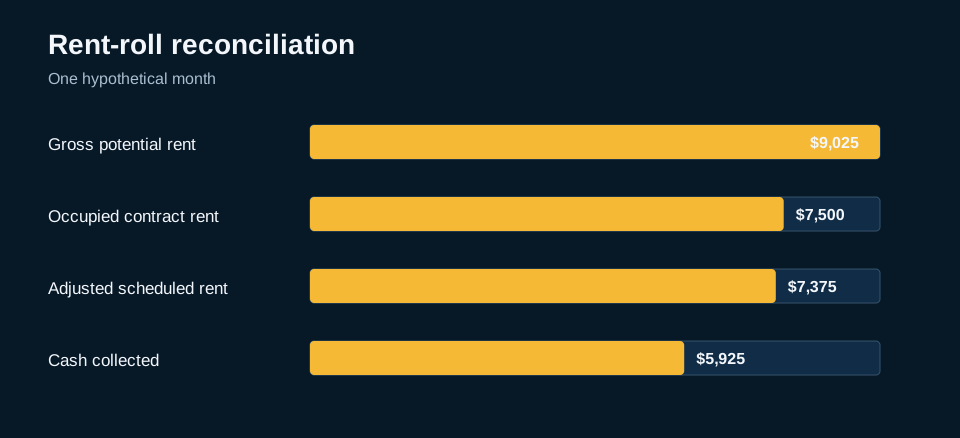
One month does not establish stabilized performance. Annualizing September collections would imply $71,100, but that calculation assumes the vacancy, concession and delinquency persist unchanged for twelve months. Review a relevant trailing period and explain late payments, refunds, security deposits, owner contributions and non-rent deposits rather than matching totals mechanically.
Fannie Mae’s current multifamily guide illustrates a formal validation approach: it calls for reviewing a cash ledger, receipts journal, at least three months of deposit-confirming bank statements or similar records; discussing receivables with site management; and documenting a lease audit against the rent roll.3 Those requirements apply to that program, not every rental-property loan, but the evidence relationships are broadly useful.
Measure lease-expiration and renewal exposure
Current occupancy can conceal near-term rollover. A lease-expiration schedule makes that exposure visible. In the example, B3’s $1,500 lease expires within 60 days and A3’s $1,450 lease expires within approximately 90 days. Together, $2,950 of monthly contractual rent, or 39.3% of occupied contractual rent, faces a renewal or re-leasing decision within the next quarter:
$2,950 expiring rent ÷ $7,500 occupied contractual rent = 39.3%
That does not mean both tenants will leave. It identifies where the forecast depends on renewal probability, market rent, notice, downtime, concessions and turnover work. A credible forward schedule shows each expiration rather than applying one portfolio-wide renewal assumption to every lease.
For commercial property, the same analysis should also consider tenant concentration, contractual options, expense-recovery changes and tenant-improvement or leasing-commission obligations. A large tenant’s lease event can affect income, costs and collateral value at the same time.
Test the unit inventory and occupancy claims
Walk the unit list against the property itself, assessor or permit information where appropriate, and other operating records. Investigate:
- units missing from either the rent roll or physical property;
- occupied units shown as vacant, or vacant units shown as occupied;
- model, employee or uninhabitable units counted as rentable;
- units advertised as available while shown as occupied;
- unusual clusters of identical lease dates or recent move-ins;
- deposits inconsistent with leases or applicable handling requirements;
- recurring parking, pet, storage or utility charges omitted from the report; and
- commercial space measurements that do not reconcile with lease descriptions.
Fannie Mae identifies discrepancies between rent-roll occupancy and inspections, units simultaneously shown as occupied and marketed for lease, and mismatched unit counts among indicators that warrant investigation.4 These are review signals, not proof of misrepresentation.
Physical verification does not determine whether a unit or use is legally permitted. That question requires the relevant public records and qualified local review.
Build an exception log instead of forcing agreement
An exception log preserves the difference between evidence and assumption.
| Exception | Financial effect | Evidence needed | Current treatment |
|---|---|---|---|
| A2 concession ends after two months | Near-term revenue below face rent | Lease concession addendum | Use $1,375 for two months |
| A3 delinquent one month | Collections below scheduled rent | Ledger, deposits and collection status | Exclude unpaid amount from current collections |
| B1 vacant | No current contractual income | Market-rent support and leasing status | Use zero current rent; show market rent separately |
| B3 lease expires soon | Renewal and downtime uncertainty | Renewal notice or leasing scenario | Do not extend current rent without a scenario |
The log should name the responsible reviewer, required document, target resolution date and treatment if the answer remains unfavorable. That last column prevents missing evidence from becoming an optimistic assumption by default.
Translate verified evidence into underwriting inputs
Keep five layers separate:
- Potential schedule: occupied contract rent plus supportable market rent for vacant units.
- Contractual schedule: rent legally stated in current leases.
- Current collections: cash received for the measured period.
- Known adjustments: concessions, delinquency, vacancy and documented lease changes.
- Forward assumptions: renewal, market rent, downtime, turnover cost and collection expectations.
The income selected for a DSCR or commercial-loan analysis depends on the property, documentation, loan structure and lender requirements. A rent roll supports that analysis; it does not by itself establish effective gross income, net operating income or qualifying rent.
Before relying on the result, the analysis should answer:
| Decision question | Evidence needed |
|---|---|
| What is collectible today? | Current rent roll, leases, receivables and recent deposits |
| What changes before the expected closing? | Lease expirations, notices, concessions and pending move-ins |
| What income is supportable after closing? | Market evidence, renewal assumptions and documented operating history |
| Which revenue is non-rent or reimbursable? | Lease provisions, ledgers and third-party market support where applicable |
| What downside should be modeled? | Vacancy, collection loss, turnover timing and tenant concentration |
References
1. Luke van Zyl. Low-angle exterior view of a modern multifamily apartment building. https://unsplash.com/photos/koH7IVuwRLw. Unsplash. Used under the Unsplash License. Accessed October 3, 2026.
References are numbered in order of first citation. Program-specific guidance is identified in the text and should not be treated as a universal lending standard.
2. Office of the Comptroller of the Currency. Comptroller’s Handbook: Commercial Real Estate Lending, Version 2.0. March 2022; reputation-risk references revised March 20, 2025. https://www.occ.treas.gov/publications-and-resources/publications/comptrollers-handbook/files/commercial-real-estate-lending/pub-ch-commercial-real-estate.pdf. Accessed October 1, 2026.
3. Fannie Mae. Multifamily Selling and Servicing Guide: 401.03 Validating Rent Collections, Bad Debt, and Secondary Income. https://mfguide.fanniemae.com/node/22181. Accessed October 1, 2026.
4. Fannie Mae. Multifamily Mortgage Fraud Prevention. https://multifamily.fanniemae.com/multifamily-mortgage-fraud-prevention. Accessed October 1, 2026.
Figure and table provenance. The property records, calculations and analytical graphic in this guide were created by Faundare Capital for a hypothetical teaching example. The opening photograph is cited in the references. External references support the verification methods and program examples; they do not supply the fictional observations.