
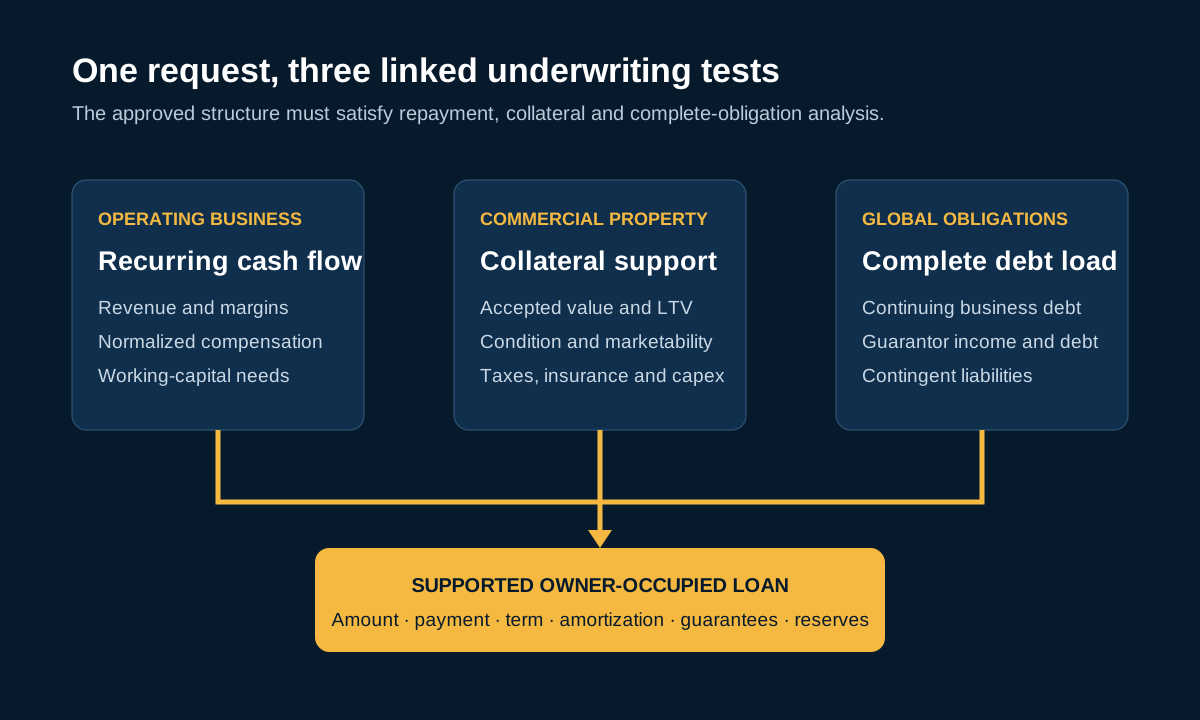
An owner-occupied commercial real estate loan finances property used principally by the borrower's operating business. A manufacturer may buy its plant, a medical practice its clinic, or a contractor its office and yard. The real estate secures the loan, but the occupying business usually supplies the cash flow that makes the payments. Underwriting therefore connects a property decision with a business-credit decision.
This structure differs from an investment-property commercial mortgage. A landlord expects tenant rent and property net operating income to repay investment debt. An owner-user expects revenue from selling goods or services to cover payroll, inventory, taxes, occupancy costs and debt. The property still needs acceptable value, condition and marketability, but collateral cannot repair a business cash-flow deficit.
The worked example follows a hypothetical wholesale distributor buying a $1.6 million office-and-warehouse property. It assumes a $1.2 million loan, a 7.25% illustrative rate, 20-year amortization and 10-year maturity solely to show how the tests interact. These inputs are not current offered terms.
Begin with the property-business relationship
“Owner-occupied” describes use, not necessarily the name printed on the deed. A real estate holding company may own the building and lease it to a related operating company. The lender then reviews the property owner, operating company, lease or occupancy agreement, and guarantors as one connected credit.
The business should define five facts before comparing loans:
- which entity will own the property;
- which entity will occupy it and what percentage of the space it will use;
- how related-entity rent, distributions and guarantees connect the entities;
- which existing obligations continue after closing; and
- which business cash flow will repay the proposed property debt.
Occupancy rules depend on the program. A conventional commercial lender may apply its own owner-user definition. SBA rules are more prescriptive and distinguish existing buildings from new construction. For the acquisition, renovation or reconstruction of an existing building, current SBA Form 1920 asks whether the applicant or operating company will occupy at least 51% of the rentable property. For construction of a new building, or refinancing a short-term construction loan, it asks whether the applicant or operating company will permanently occupy at least 60%, lease no more than 20% long term, plan to occupy the remaining space within three years and occupy all of it within ten years.2 These are SBA eligibility conditions, not universal definitions of owner occupancy; the current form, regulation and SOP control the actual transaction.
Partially rented space also needs careful treatment. Third-party rent can support the property, but a lender may still underwrite the operating company as the primary payer. Lease income should be supported by executed documents, while the business plan should explain whether excess space is permanent, temporary or reserved for expansion.
Identify the primary and secondary repayment sources
The Office of the Comptroller of the Currency states that cash flow from the occupying business is usually the primary repayment source for owner-occupied property. It also directs banks to consider the occupying business, borrower and guarantors while retaining collateral analysis such as valuation and supervisory LTV limits.3
That produces a practical order of analysis:
- Primary repayment: recurring cash generated by the operating business after normal expenses and necessary reinvestment.
- Additional support: verified rent from unrelated tenants and recurring guarantor cash flow accepted by the lender.
- Secondary repayment: liquidation or refinance of the property and other pledged collateral.
- Structural protection: borrower equity, guarantees, covenants, reporting, reserves and amortization.
A strong appraisal supports recovery and loan sizing. It does not prove that the monthly payment fits the business. Conversely, strong business earnings do not make an overvalued or functionally obsolete building acceptable collateral.
Reconcile cash flow before calculating coverage
Taxable income, EBITDA, bank deposits and free cash flow are not interchangeable. The starting record depends on the program, but every method should reach a recurring cash amount without counting the same item twice.
Assume the company reports the following normalized annual amounts before the property purchase:
| Cash-flow item | Annual amount |
|---|---|
| Revenue | $2,400,000 |
| Cash operating expenses other than current rent | −$1,940,000 |
| Normalized owner compensation | −$120,000 |
| Cash available before occupancy costs and debt service | $340,000 |
The normalization excludes depreciation because it is noncash, removes a one-time legal settlement, and uses recurring owner compensation rather than discretionary distributions. It also removes the current $120,000 annual rent, because the business will leave that leased location after the purchase. The replacement costs of ownership must then be introduced explicitly rather than subtracting both old rent and new occupancy costs.
The proposed property is expected to require $60,000 per year for real estate taxes, insurance, routine maintenance and association or common-area obligations. The company also has $40,000 of continuing annual equipment-loan payments. Cash available for the proposed mortgage is therefore:
$340,000 − $60,000 − $40,000 = $240,000
This bridge is more useful than applying a ratio to an unadjusted tax-return figure. It shows which expenses disappear, which continue and which begin after closing.
Size the loan under value and repayment constraints
Property leverage is one independent limit. If the lender permits a 75% loan-to-value ratio and accepts the $1.6 million purchase price as value, the collateral ceiling is:
$1,600,000 × 75% = $1,200,000
At the hypothetical 7.25% rate and 20-year amortization, a $1.2 million loan requires approximately $9,485 per month, or $113,814 per year, in principal and interest.
The example measures combined coverage as recurring cash available after post-closing occupancy costs divided by continuing debt service plus the proposed mortgage:
Coverage = ($340,000 − $60,000) ÷ ($40,000 + $113,814) = 1.82×
| Coverage component | Annual amount |
|---|---|
| Adjusted business cash before occupancy and debt | $340,000 |
| Post-closing ownership costs | −$60,000 |
| Cash available for debt service | $280,000 |
| Continuing equipment debt | $40,000 |
| Proposed property principal and interest | $113,814 |
| Total annual debt service | $153,814 |
| Illustrative combined coverage | 1.82× |
The 1.82× result is a teaching measure, not a universal underwriting formula or approval threshold. A lender may begin with tax returns, business financial statements, adjusted EBITDA, debt-service coverage, global cash flow, bank statements or a combination. It may classify taxes, owner compensation, capital expenditures and affiliate payments differently.
A full global cash-flow review can also include the guarantor's personal income, living costs, taxes, contingent liabilities and debt payments. Guarantor support should be added only when the lender accepts both the income and the related obligations. Counting a distribution at the business level and again as personal income would overstate repayment capacity.
Calculate the complete cash requirement
The down payment is only one use of cash. For the $1.6 million purchase and $1.2 million loan, purchase equity is $400,000. Assume the transaction also requires:
| Cash use | Amount |
|---|---|
| Purchase equity | $400,000 |
| Lender and third-party closing costs | $42,000 |
| Immediate building work and move-in costs | $85,000 |
| Working-capital cushion retained after closing | $150,000 |
| Total planned liquidity | $677,000 |
The retained cushion is not automatically a lender-required reserve or closing deduction. It is capital the business keeps available for relocation disruption, inventory timing, payroll and an operating shortfall. A structure that reaches the closing table but consumes the cash needed to run the company can weaken the primary repayment source that justified the loan.
The sources-and-uses schedule should also separate real estate from equipment and working capital. Some structures can finance several uses together; others cannot. Rolling short-lived equipment or working capital into long-lived real estate debt may reduce the payment while extending repayment far beyond the asset's useful life.
Compare financing structures by permitted use and execution
The relevant question is not which program has the lowest advertised rate. It is which structure can legally and practically finance the required uses while preserving repayment capacity.
Conventional commercial mortgage
A bank or credit union may finance an established business with supportable historical earnings, acceptable collateral, borrower equity and guarantor strength. Terms vary by institution and may include a maturity shorter than the amortization schedule. The borrower should compare recourse, covenants, reporting, prepayment provisions, renewal assumptions and the amount due at maturity—not only the note rate.
SBA 7(a)
The SBA describes 7(a) as a lender-made, SBA-guaranteed program that can finance real estate, equipment, working capital, eligible debt refinancing and ownership changes. The maximum 7(a) loan amount is currently $5 million, and current SBA lender guidance allows up to 25 years including extensions for real estate.4 Eligibility, collateral, guarantee percentage, fees and allowed uses remain transaction-specific.
The broader use-of-proceeds authority can make 7(a) relevant when a property purchase is only one part of the capital need. The operating business must still be eligible, creditworthy and reasonably able to repay.
SBA 504
The 504 program finances qualifying fixed assets through a private lender and a Certified Development Company. SBA states that 504 proceeds may fund land, buildings, construction, renovation and qualifying long-lived equipment, but not working capital or inventory.5 Available maturities include 10, 20 and 25 years.
A customary 504 allocation uses at least 50% third-party lender financing, up to 40% through the CDC/SBA-guaranteed debenture and at least 10% borrower contribution.6 Project type, business age or other risk features can require more borrower equity. The familiar “50-40-10” shorthand is a starting pattern, not a guaranteed capitalization.
Private or bridge commercial financing
A private structure may be considered when timing, renovation, property condition, documentation or another execution issue prevents immediate conventional or SBA financing. It usually requires a clearly funded transition and repayment plan. If the expected exit is bank or SBA debt, the borrower should test that takeout under realistic post-closing business results rather than assume approval.
Faundare Capital's commercial program currently addresses owner-occupied and income-producing property through bridge and long-term structures. Published ranges describe program orientation; final leverage, pricing, cash-flow method and documentation depend on the specific property and borrower.7
Examine maturity, amortization and balloon exposure
Amortization sets the payment schedule. Maturity determines when the loan must be repaid. A loan amortized over 20 years but maturing in 10 years leaves a balloon payment.
In the example, the $1.2 million loan amortized over 20 years would still have a balance of approximately $807,873 after 10 years. The business must then refinance, sell the property or pay the balance from another source. The purchase decision should therefore test conditions at maturity:
- whether the business could support a refinance at a higher rate;
- whether the property will remain useful and marketable;
- whether principal reduction will create sufficient refinance equity;
- whether major capital expenditures will be pending; and
- whether a prepayment or exit restriction affects an earlier move.
A low initial payment can conceal refinancing risk when the property has a specialized build-out or the business depends heavily on one owner, customer, license or location.
Stress the business before relying on the property
The base case has 1.82× coverage. That margin should be tested against operating changes because property debt continues when revenue weakens.
| Scenario | Cash after ownership costs | Total debt service | Coverage |
|---|---|---|---|
| Base case | $280,000 | $153,814 | 1.82× |
| Adjusted cash before occupancy falls to $290,000 | $230,000 | $153,814 | 1.50× |
| Adjusted cash falls to $260,000 and ownership costs rise to $70,000 | $190,000 | $153,814 | 1.24× |
The downside does not prove that the purchase is unacceptable. It identifies the operating cushion consumed by lower margins and higher property costs. A lender may also stress the interest rate, discount one-time revenue, require capital-expenditure reserves or exclude uncertain guarantor support.
The property itself needs a separate downside review. Environmental conditions, deferred maintenance, zoning, access, parking, specialized improvements and code compliance can increase cash required or reduce resale options. A business may value a customized facility more highly than the broader market does; the appraisal and acquisition price do not always measure the same strategic value.
Assemble a package that explains the complete credit
A coherent submission connects the entities, cash flow, property and requested structure. Typical materials may include:
- purchase contract or current mortgage and payoff information;
- business and personal tax returns when required by the selected program;
- year-to-date income statement, balance sheet and debt schedule;
- business bank statements and accounts-receivable, accounts-payable or inventory reports when relevant;
- organizational documents and ownership information for the operating and property-holding entities;
- personal financial statements and real estate schedules for guarantors;
- property rent roll and leases for any third-party occupants;
- building plans, improvement budget, equipment list and contractor support when applicable; and
- an explanation of post-closing liquidity, relocation timing and the use of every dollar requested.
The purpose is not to maximize document volume. It is to let the lender reproduce the entity relationships, normalized cash flow, continuing obligations, required equity and sources-and-uses schedule without resolving contradictions among them.
Decide whether ownership strengthens the business
The example supports a $1.2 million collateral ceiling and produces 1.82× illustrative combined coverage, but the conclusion depends on more than those two numbers. The company must supply approximately $527,000 for equity, costs and immediate work while preserving the separate $150,000 working-capital cushion. It also accepts a projected $807,873 balloon balance after ten years.
The purchase is stronger when the facility supports the operating plan, normalized cash flow covers the complete post-closing debt burden, the cash contribution does not impair operations, and the maturity has a credible refinance or payoff path. It should be revised when approval depends on double-counted income, disappearing working capital, unsupported affiliate rent or an assumed takeout that has not been tested.
Use the commercial loan calculator to reproduce the property value, proposed payment and owner-occupied cash-flow case. Its result is a planning model; the selected lender or program determines the accepted adjustments and final structure.
References
1. Alberto Rodríguez. A large warehouse filled with lots of boxes. Unsplash, Unsplash License. Published May 21, 2023. Accessed October 18, 2026. Editorially cropped to 16:9.
2. U.S. Small Business Administration. SBA Form 1920: Lender's Application for Loan Guaranty. Current form accessed October 17, 2026. Cited for the existing-building and new-construction occupancy questions; complete eligibility depends on applicable regulations and the current SOP.
3. Office of the Comptroller of the Currency. Comptroller's Handbook: Commercial Real Estate Lending, Version 2.0, January 2025, pp. 55–60. Accessed October 17, 2026.
4. U.S. Small Business Administration. 7(a) Loans and SBA Lender Resources. Accessed October 17, 2026. Program limits and requirements can change.
5. U.S. Small Business Administration. 504 Loans. Accessed October 17, 2026.
6. U.S. Small Business Administration, Office of Inspector General. Verification Inspection of SBA's 504 Loan Liquidation Process, Report 25-02, November 12, 2024. Accessed October 17, 2026. Cited for the customary third-party lender, CDC and applicant allocation.
7. Faundare Capital. Commercial Real Estate Loans. Accessed October 17, 2026. Current program orientation; final terms depend on underwriting, program availability and approval.