
A commercial property can appear attractive on price per square foot while failing on income quality, tenant concentration, capital needs or financing. Acquisition underwriting connects the leases and operating history to a supportable value, then tests whether the proposed capital structure can survive ordinary setbacks.
This article uses a hypothetical small industrial property. The assumptions demonstrate the method and are not market benchmarks, lending requirements or Faundare Capital program terms.
Understand what is being acquired
Commercial property generally means real estate used to produce rental income or support a business rather than serve as the owner's primary residence. It includes office, retail, industrial, mixed-use, hospitality and special-purpose buildings, as well as apartment properties commonly treated as multifamily commercial real estate once they contain five or more units. A property may be income-producing, with repayment supported mainly by tenant rent and property cash flow, or owner-occupied, with repayment supported mainly by the operating business that uses it. This article focuses on an income-producing acquisition.
Commercial real estate underwriting evaluates several linked systems: the legal property, the building and site, the leases, the operating expenses, the local market and the proposed debt. Unlike a small residential rental analyzed primarily from monthly rent and housing expenses, a commercial property's economics can change materially with one lease expiration, tenant improvement obligation or capital repair. The Office of the Comptroller of the Currency describes income-producing real estate analysis as depending on property cash flow, collateral value, borrower capacity and the structure of repayment.2 None of those dimensions can safely substitute for the others.
Start by defining the transaction. Is the buyer acquiring stabilized income, a lease-up, a renovation, a tenant rollover problem or land with an existing building? The same warehouse can support different prices and loan structures depending on which condition is true.
The example is a 24,000-square-foot multitenant industrial property offered for $2.4 million. It has four suites, three tenants and one vacant 4,000-square-foot suite. One occupied tenant produces 48% of current base rent and its lease expires in fourteen months.
Rebuild income from the leases
The seller reports $240,000 of annual base rent. Reconcile that figure to each executed lease, amendment, commencement date, concession and collection record. A lease audit should also identify reimbursements, renewal options, termination rights and landlord obligations.
| Income bridge | Seller statement | Underwritten base |
|---|---|---|
| Contract base rent | $240,000 | $240,000 |
| Vacant-suite market rent | $48,000 | — |
| Expense reimbursements | $30,000 | $25,000 |
| Less vacancy and collection allowance | −$12,000 | −$18,000 |
| Effective gross income | $306,000 | $247,000 |
The seller's statement includes a full year of rent for the vacant suite even though no lease has been signed. It also assumes every billed reimbursement is collected. The base case excludes vacant-suite rent and reduces reimbursements to the amount supported by current lease language and collections.
Potential rent still belongs in the analysis, but in a separate lease-up case with tenant improvements, leasing commissions, downtime and a probability of execution. Treating the upside as current income recognizes the benefit before paying its cost.
Normalize operating expenses and capital work
The seller reports $76,000 of operating expenses. Current tax information, insurance indications and service contracts support the following adjustment:
| Operating expense | Seller statement | Underwritten base |
|---|---|---|
| Property taxes | $28,000 | $35,000 |
| Insurance | $9,000 | $15,000 |
| Repairs and maintenance | $12,000 | $16,000 |
| Utilities and common area | $10,000 | $10,000 |
| Management and administration | $7,000 | $14,000 |
| Other recurring expense | $10,000 | $8,000 |
| Total operating expenses | $76,000 | $98,000 |
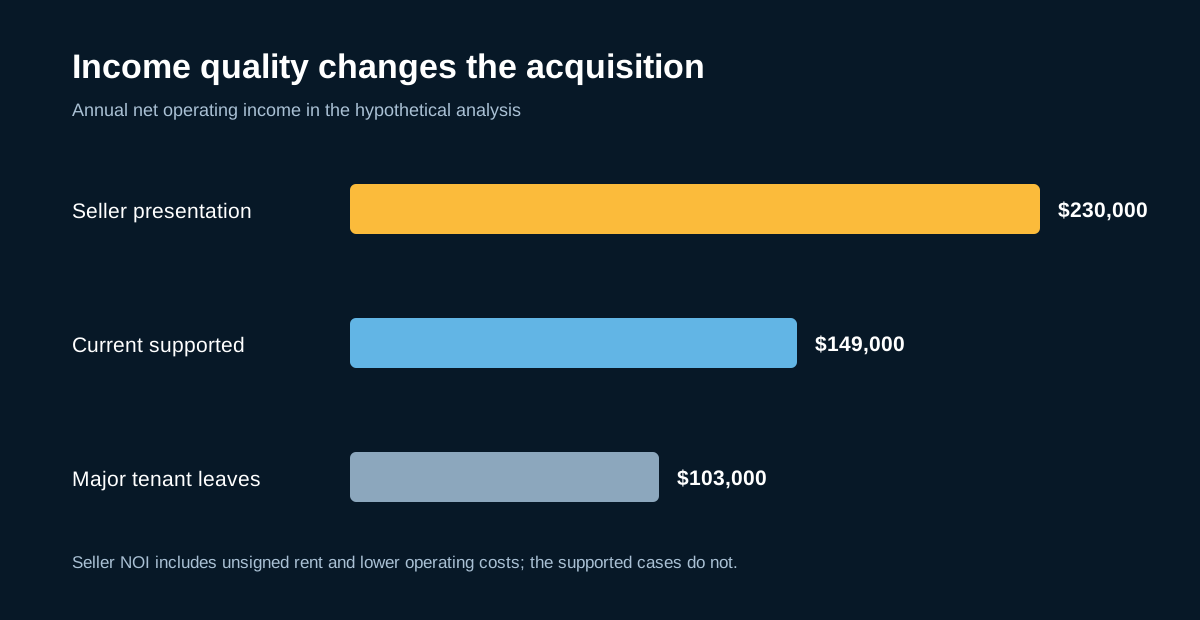
Underwritten net operating income (NOI) is therefore $149,000, compared with the seller's $230,000 presentation. The largest differences are not advanced formulas; they are the removal of unsigned rent and the replacement of costs that are unlikely to continue after the sale.
Now separate operating expenses from capital expenditures. Inspection identifies $65,000 of paving and drainage work, $40,000 of roof repairs and a $35,000 allowance for the vacant suite. Those costs do not belong in recurring NOI merely because they occur after closing. They do belong in total acquisition capital and liquidity planning.
Test value with more than one income case
At the $2.4 million asking price, $149,000 of base NOI implies a 6.21% capitalization rate. The percentage is a relationship, not proof that the price is supported. A capitalization rate must be matched to the property type, location, lease duration, tenant risk, condition and income convention.
Use a range rather than one favorable conclusion:
| Case | NOI | Assumed cap rate | Indicated value |
|---|---|---|---|
| Current supported operations | $149,000 | 7.00% | $2,128,571 |
| Lease-up after stated costs | $183,000 | 6.75% | $2,711,111 |
| Major tenant leaves | $103,000 | 7.75% | $1,329,032 |
The lease-up case is not today's value merely because the arithmetic is possible. It requires a signed tenant, capital, time and successful execution. The downside case shows how tenant concentration can affect both income and market pricing at the same time.
Size the debt from several constraints
Assume a proposed loan of $1.56 million, or 65% of the asking price, with annual debt service of $126,000. The base case produces:
- Loan-to-value (LTV) at asking price: $1,560,000 ÷ $2,400,000 = 65.0%.
- DSCR on base NOI: $149,000 ÷ $126,000 = 1.18×.
- Debt yield: $149,000 ÷ $1,560,000 = 9.55%.
These measures answer different questions. LTV depends on the supportable value; DSCR depends on debt service and the accepted cash flow; debt yield relates property income to loan principal without using the interest rate or amortization schedule.
The loan looks different against the current-operations value of $2.129 million: LTV rises to 73.3%. If the major tenant leaves and NOI falls to $103,000, DSCR falls to 0.82× and debt yield to 6.60%. A strong result based on the asking price can disappear when the underlying income is corrected.
Build the complete cash requirement
The equity requirement is not only purchase price less loan proceeds. For the example:
| Acquisition cash use | Amount |
|---|---|
| Purchase equity | $840,000 |
| Closing and financing costs | $70,000 |
| Paving, drainage and roof work | $105,000 |
| Vacant-suite improvement allowance | $35,000 |
| Leasing commission and legal allowance | $18,000 |
| Six months of debt-service and operating liquidity | $125,000 |
| Modeled initial and near-term cash | $1,193,000 |
This schedule does not assume the reserves will all be spent. It shows the capital that may be unavailable for distribution while the plan is executed. If loan proceeds reimburse some work later, model the timing and eligibility rather than reducing the day-one requirement without evidence.
Decide whether the acquisition works
A defensible commercial acquisition memo should state:
- Which income is contractual, collected, market-supported or speculative?
- Which expenses were normalized, and what evidence supports the adjustment?
- What capital work is required before stabilization, and who funds it?
- How do value, DSCR, debt yield and borrower cash change when a major assumption weakens?
- Which lease, title, survey, zoning, environmental or physical issue can still change the plan?
The FDIC's commercial real-estate loan-review procedures identify incomplete credit and collateral documentation, minimal borrower liquidity, unsupported value growth and refinancings without credible repayment support as warning signs.3 An investor's diligence should recognize the same mechanisms even though the investor and lender make different decisions.
For this example, the asking price depends heavily on lease-up and expense assumptions that are not yet supported. The property may still be investable at a different price or after stronger evidence, but the current lease-up case should not be mistaken for present performance.
Turn the underwriting into a decision
Underwriting is complete when the buyer can identify which price, financing structure and cash commitment remain acceptable under the supported base case and a plausible downside. The result does not have to be a purchase. It may support a lower offer, additional diligence, a financing contingency or a decision to walk away. Here, the unsupported vacant-suite income, near-term tenant rollover and identified capital work make the $2.4 million asking price difficult to defend from current operations alone.
If the revised economics remain workable, model the proposed debt and coverage before comparing financing structures. Buyers with a defined property, financing purpose and requested amount can then review commercial real estate financing or discuss the transaction. Those steps should use the reconciled underwriting case rather than the seller's presentation.
References
1. Craftsman Concrete Floors. Workers applying a resinous floor finish inside an industrial facility. Dallas, Texas. https://unsplash.com/photos/workers-inspect-a-large-empty-industrial-warehouse-space-68E-dFpOF0g. Unsplash. Used under the Unsplash License. Published February 28, 2026; accessed October 3, 2026.
2. Office of the Comptroller of the Currency. Comptroller's Handbook: Commercial Real Estate Lending, Version 2.0. March 2022; reputation-risk references revised March 20, 2025. https://www.occ.treas.gov/publications-and-resources/publications/comptrollers-handbook/files/commercial-real-estate-lending/pub-ch-commercial-real-estate.pdf. Accessed October 3, 2026.
3. Federal Deposit Insurance Corporation. Risk Management Manual of Examination Policies: Commercial Real Estate Lending—Commercial Real Estate Loan Review. May 2024. https://www.fdic.gov/risk-management-manual-examination-policies/commercial-real-estate-lending. Accessed October 3, 2026.
Figure and table provenance. The property, leases, costs, loan assumptions, calculations, tables and analytical graphic are hypothetical and were created by Faundare Capital for instruction. The opening photograph is cited in the references.