
A renovation budget should connect each property condition to a defined remedy, quantity, responsible trade and evidence source. Keep base scope, contingency, optional upgrades and nonconstruction project costs separate. That structure makes bids comparable, changes visible and cash needs easier to forecast.
The example below is hypothetical. It teaches budgeting mechanics and does not represent local construction pricing or Faundare Capital loan terms.
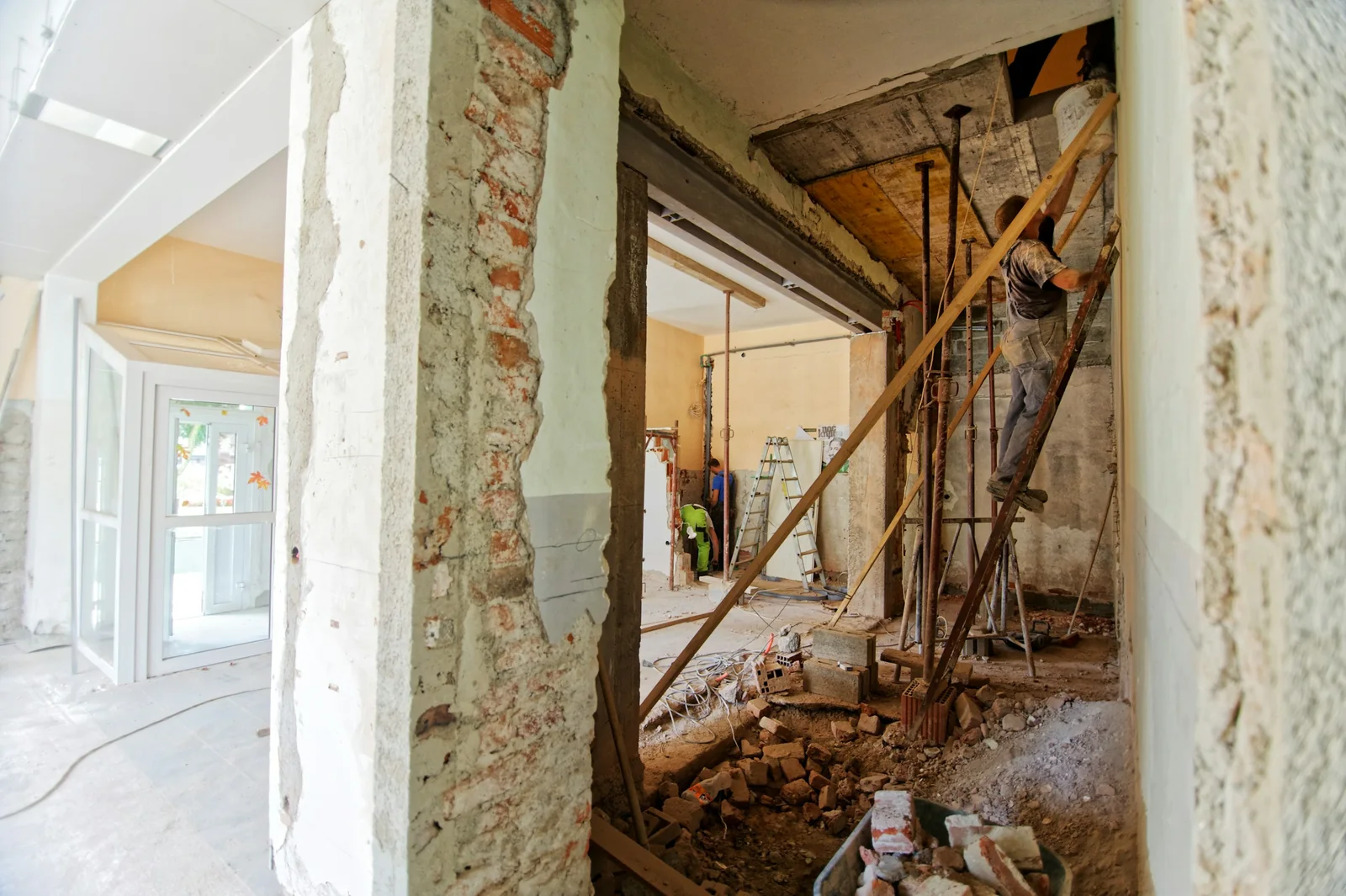
First, understand what a renovation budget controls
A renovation budget is the financial version of the work plan. It translates observed property conditions into defined tasks, prices and timing so an investor can decide what the project will cost, when cash will be needed and whether the finished property can support the investment. A list of round-number allowances cannot perform that job because it does not identify what is being purchased or what remains unknown.
The budget also connects four decisions that are often analyzed separately: the purchase price, contractor agreement, financing request and project schedule. A scope change can alter all four. The useful document therefore preserves the original plan, records approved changes and forecasts the remaining cost instead of showing only invoices already paid.
The sections below build that control system from scope through completion.
Freeze the scope before comparing prices
Begin with a room-by-room and system-by-system scope. “Renovate kitchen” is not a budget line. Record demolition, cabinet quantity and grade, countertops, sink, fixtures, appliances, electrical work, plumbing work, finishes, installation and exclusions.
Each line should carry an evidence status:
- Bid: a contractor or supplier has priced a defined scope.
- Quantity estimate: the amount derives from measured units and an identified unit cost.
- Allowance: the work is known but selection or condition is unresolved.
- Placeholder: access or investigation is insufficient; the figure is provisional.
Allowances and placeholders are not equivalent to committed costs. A budget with many of them needs more investigation or more capacity for uncertainty.
Before pricing, assign each line four identifiers: location, quantity, specification and responsible trade. “Replace 900 square feet of first-floor flooring with a named material or approved equivalent, including removal, subfloor preparation, transitions and disposal” can be measured and bid. “New flooring” cannot.
Photographs help document condition, but they do not establish concealed quantities or code requirements. Record the inspection method and the areas that could not be accessed. The budget should show which assumptions would change if later investigation is unfavorable.
Build the base construction estimate
For the same hypothetical property used in the pre-offer analysis, the defined scope is:
| Scope group | Base estimate | Evidence status |
|---|---|---|
| Demolition and site protection | $3,000 | Contractor bid |
| Roofing | $8,500 | Specialist bid |
| HVAC | $6,500 | Allowance pending final equipment selection |
| Electrical corrections | $4,500 | Allowance pending panel inspection |
| Plumbing corrections | $4,000 | Quantity estimate |
| Kitchen | $10,000 | Mixed bid and material allowance |
| Bathrooms | $8,000 | Quantity estimate |
| Flooring | $6,000 | Measured quantity and supplier quote |
| Interior paint | $4,500 | Contractor bid |
| Exterior and landscaping | $3,500 | Allowance |
| Permits, waste and final cleaning | $3,500 | Mixed documented fees and estimate |
| Base construction estimate | $62,000 |
The total is meaningful only because the scope and uncertainty behind each line remain visible. A $62,000 lump-sum quote with no inclusions, quantities or responsibility matrix cannot be compared reliably with this estimate.
Normalize contractor bids before choosing one
Suppose Bid A is $59,000 and Bid B is $64,500. The lower total is not necessarily less expensive. Create a common scope and add every exclusion back to the bidder’s price.
| Adjustment | Bid A | Bid B |
|---|---|---|
| Submitted price | $59,000 | $64,500 |
| Permit fees excluded | +$1,500 | Included |
| Waste containers excluded | +$1,200 | Included |
| Appliances excluded | +$3,500 | +$2,500 allowance |
| Painting includes closets | No: +$900 | Yes |
| Normalized comparison | $66,100 | $67,000 |
The normalized totals are close. Selection should also consider schedule, supervision, references, licensing where applicable, insurance, payment terms, change-order procedure and the contractor’s ability to explain the scope. These checks do not guarantee performance; they clarify what is actually being purchased.
Price the payment schedule as carefully as the work. A bid that requires a large mobilization deposit can create more borrower cash exposure than a slightly higher bid paid against verified progress. Tie each payment to an observable milestone, identify stored-material treatment and avoid counting the same deposit again when later invoices arrive.
Give contingency one job
Construction contingency covers uncertainty within the intended project. It should not quietly fund design upgrades or scope added after the budget is approved.
This example carries $7,500 separately from the $62,000 base estimate. The amount is a project-specific teaching assumption, not a recommended percentage. Its adequacy depends on access, building age, scope maturity, system condition and the amount already held as allowances.
Maintain three buckets:
- Base scope: work currently intended and priced.
- Contingency: unresolved conditions or quantity uncertainty within that scope.
- Optional upgrades: desirable work that can be removed without preventing the intended outcome.
When an unknown condition becomes known, transfer the approved amount from contingency into the affected scope line. Preserve the original budget so the variance remains visible.
The $7,500 teaching contingency equals approximately 12.1% of the $62,000 base estimate. That ratio describes this example; it is not a universal target. Test what the reserve actually covers:
| Unresolved condition | Illustrative cost if unfavorable | Evidence still needed | Contingency remaining |
|---|---|---|---|
| Starting reserve | — | — | $7,500 |
| Electrical panel requires replacement | $3,200 | Electrician inspection | $4,300 |
| Subfloor damage in kitchen | $2,400 | Access after cabinet removal | $1,900 |
| Sewer repair also required | $6,000 | Sewer scope | $4,100 shortfall |
The combined case exceeds the reserve. That does not prove the project is unacceptable; it shows that the sewer question must be investigated, separately funded or reflected in the purchase decision before commitment.
Separate construction cost from the full project budget
The construction estimate does not include every dollar required to complete the investment. The project model also needs acquisition costs, financing fees, interest, taxes, insurance, utilities, maintenance, marketing and sale costs. Combining them into “rehab” makes it difficult to see whether construction or time caused a variance.
Use connected schedules:
- Construction budget: scope, commitments, payments and forecast to complete.
- Project budget: acquisition, construction, financing, carrying and disposition costs.
- Cash schedule: when each amount must be paid and when eligible reimbursements or proceeds are expected.
The fix-and-flip pre-offer model uses the same $62,000 base scope and $7,500 contingency. Keeping those figures synchronized prevents an updated construction estimate from leaving the acquisition ceiling unchanged by mistake.
Model draw timing and peak cash exposure
Assume the renovation is completed over five months and eligible work is reimbursed only after verification. The following simplified schedule excludes purchase equity and other closing funds.
| Month | Work paid | Cumulative work paid | Draw reimbursement received | Unreimbursed construction cash at month end |
|---|---|---|---|---|
| 1 | $18,000 | $18,000 | $0 | $18,000 |
| 2 | $16,000 | $34,000 | $15,000 | $19,000 |
| 3 | $14,000 | $48,000 | $16,000 | $17,000 |
| 4 | $9,000 | $57,000 | $14,000 | $12,000 |
| 5 | $5,000 | $62,000 | $14,000 | $3,000 |
| Final verification | $0 | $62,000 | $3,000 | $0 |
The example’s peak unreimbursed construction cash is $19,000, even though all $62,000 is assumed eligible eventually. Contractor deposits, ineligible work, retainage, inspection timing and documentation can change the result. Use the actual approved loan and construction draw process rather than this illustration.
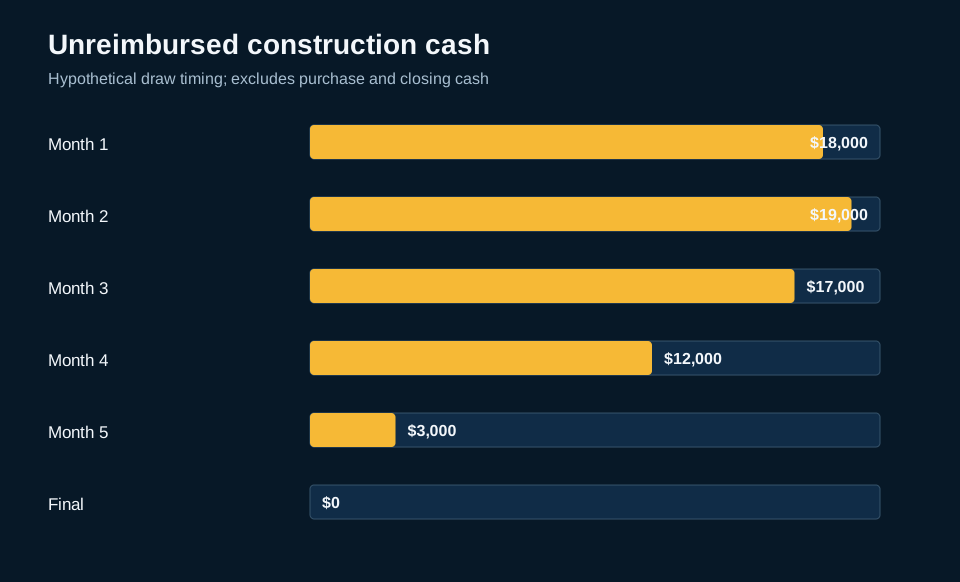
The peak is a timing requirement, not an additional construction expense. The $19,000 is reimbursed later in the example; it still has to be available when contractors are paid. Conversely, an ineligible line or an over-budget amount may remain a permanent borrower contribution. Keep temporary draw float and permanent unfunded cost in separate cash accounts.
Control changes through cost to complete
For each line, track original budget, approved changes, committed cost, paid to date and forecast cost to complete:
Forecast final cost = paid to date + remaining commitments + estimate for uncommitted work
Compare that forecast with the current approved budget. A project can appear “under budget” merely because invoices have not arrived. Cost-to-complete analysis identifies the expected final position before the cash is spent.
A change order record should state the discovered condition, proposed response, alternatives considered, cost, schedule effect, contingency source and approver. Small changes accumulate; record them even when no single item appears material.
Assume that after month two the project has paid $34,000, has $18,000 of signed remaining commitments and needs an estimated $15,000 for uncommitted work:
Forecast final cost = $34,000 paid + $18,000 committed + $15,000 uncommitted = $67,000
Against the $62,000 base budget, the scope is forecasting a $5,000 overrun before contingency. “Only $34,000 spent” would conceal that result. The decision is whether the approved contingency absorbs the variance, the scope changes or more capital is required—not whether unpaid invoices can be ignored.
Separate lender eligibility from project necessity
A necessary project cost is not automatically eligible for reimbursement. The approved loan budget may exclude work completed before closing, unsupported deposits, owner labor, unapproved changes, luxury upgrades or items outside the lender’s collateral scope. Eligibility also does not determine payment timing.
Maintain a funding column for every line:
| Funding classification | Meaning |
|---|---|
| Eligible commitment | Included in the approved renovation facility, subject to draw conditions |
| Borrower-funded base scope | Necessary work outside the approved commitment |
| Cash-funded contingency | Reserve for approved project uncertainty |
| Optional scope | Work that can be removed without defeating the intended result |
The sum of those categories should reconcile to the construction plan and the project cash schedule. Model the combined acquisition, financing and draw assumptions before relying on a headline financing percentage.
Account for regulated and local work
EPA states that the federal Renovation, Repair and Painting rule can apply to paid work disturbing painted surfaces in pre-1978 housing, including houses renovated for resale.2 The rule includes firm certification, training and lead-safe work-practice requirements, while certain states and Tribes administer authorized programs.3 Permits, contractor credentials, inspections and codes are also jurisdiction-specific. Verify them with the responsible authorities rather than using a nationwide checklist as legal guidance.
References
1. Milivoj Kuhar. Workers renovating a residential interior. https://unsplash.com/photos/Te48TPzdcU8. Unsplash. Used under the Unsplash License. Accessed October 3, 2026.
2. U.S. Environmental Protection Agency. Lead Renovation, Repair and Painting Program. Updated 2026. https://www.epa.gov/lead/lead-renovation-repair-and-painting-program. Accessed September 29, 2026.
3. U.S. Environmental Protection Agency. Renovation, Repair and Painting Program: Contractors. https://www.epa.gov/lead/renovation-repair-and-painting-program-contractors. Accessed October 1, 2026.
Figure and table provenance. The budgets, bids, schedules, calculations and analytical graphic in this guide were created by Faundare Capital for a hypothetical teaching example. The opening photograph is cited in the references. The EPA references support the regulatory discussion; they do not supply the fictional costs.