
An investment lot is not simply a smaller piece of land. It should be a legally identifiable parcel with a credible path to its intended residential, commercial or mixed-use improvement, along with usable access, utilities and a repayment exit. A lot loan can finance the acquisition or refinance of that parcel, but it does not resolve uncertain zoning, make utilities available or guarantee later construction financing.
This article concerns select buildable investment lots. It does not address farms, recreational acreage, large raw tracts or subdivision-development financing. Because the same diligence framework applies across intended uses, the worked example uses a residential infill lot while identifying where a commercial or mixed-use proposal requires use-specific review. The example is hypothetical and illustrates a screening method rather than a valuation, engineering conclusion or Faundare Capital loan approval.
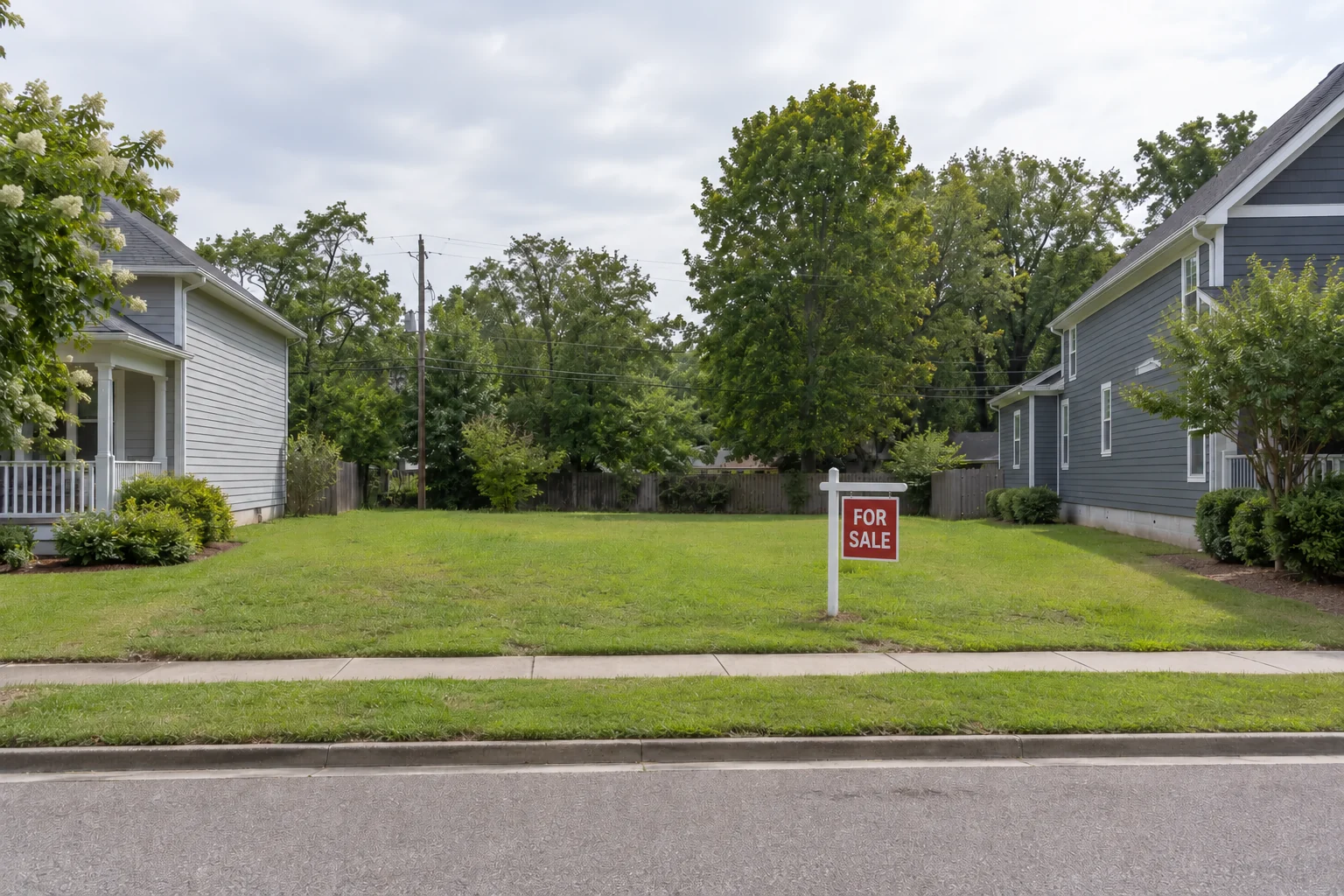
First confirm that the property is a lot, not a land-development project
The word “lot” is often used loosely. For this analysis, the property should be one legal parcel intended for a defined investment improvement, with boundaries and a proposed use that can be investigated without underwriting an entire subdivision.
A platted lot can still be unbuildable. A parcel number does not establish legal access, utility capacity, compliant dimensions or permit eligibility. Conversely, a vacant urban parcel may be a viable building lot even when it needs ordinary site work. The distinction comes from the approvals and physical work required, not from the listing label.
Treat the request as a different financing problem when repayment depends on creating multiple lots, extending public roads or utilities, obtaining a major rezoning, or completing horizontal development. Those activities introduce development risk beyond an individual lot acquisition.
The hypothetical property in this article is a 9,000-square-foot infill lot offered for $250,000. The investor intends to build a non-owner-occupied single-family home for sale. The lot is separately platted, but the investor has not yet confirmed the building envelope, utility connections or the complete site budget.
Reconcile the legal parcel and the right to reach it
Match the purchase contract, assessor record, legal description, title commitment and survey. Confirm that the seller owns the same parcel being marketed and that no adjoining strip, shared drive or separate tract is required for the intended use.
Review recorded easements, restrictions, liens and rights affecting access or construction. A driveway visible from the street may cross another parcel. A utility easement can reduce the building envelope. Private restrictions may be more limiting than public zoning even when the proposed house is otherwise permitted.
An ALTA survey may be appropriate for some transactions, while a boundary, topographic or construction survey may answer different questions. The scope should match the decision. Obtain professional guidance rather than assuming one survey product establishes every condition.
The purchase contract should preserve enough investigation time to resolve material title, survey and access questions. A report received after the contingency expires may describe the problem without preserving a practical exit from the contract.
Prove the buildable envelope
Zoning compliance addresses the parcel's current legal use. Entitlement concerns approvals still needed for a proposed use or development. Neither should be inferred solely from neighboring properties.
Confirm with the applicable jurisdiction:
- the permitted use and allowed density or development intensity;
- minimum lot width, area, frontage and depth;
- front, side and rear setbacks;
- height, lot coverage, parking and access requirements;
- overlays, historic controls or design review;
- whether the lot is legally created and separately buildable;
- impact fees, tree rules and required off-site work; and
- the permits or discretionary approvals still required.
For the residential example, assume the parcel measures 75 feet by 120 feet. Twenty-five-foot front and rear setbacks and eight-foot side setbacks leave a preliminary envelope of 59 feet by 70 feet, or 4,130 square feet. That arithmetic is only a screen. Drainage, utility, driveway, tree, easement and design requirements can reduce the practical footprint. A commercial or mixed-use plan also requires use-specific review of parking, loading, fire access, landscaping, signage, circulation and any buffer requirements.
Verify utilities, drainage and site conditions
“Utilities available” can mean that a line is somewhere nearby. It does not establish capacity, connection rights, tap fees, meter requirements or the cost of reaching the proposed building.
Request written or dated information for water, sewer, electric and any gas service. Identify whether the street must be opened, a main extended, an easement obtained or a private system designed. For septic or well service, determine the tests, approvals and reserve areas required by the jurisdiction.
FEMA identifies the Flood Map Service Center as the official public source for National Flood Insurance Program flood-hazard information.2 Match the map to the surveyed parcel and current proposal. A mapped flood zone does not replace elevation, drainage or local floodplain analysis.
USDA's Natural Resources Conservation Service explains that soil information can help screen flooding, water table, depth to bedrock, slope, subsidence and other conditions relevant to construction.3 Web Soil Survey is a screening resource rather than a site-specific geotechnical conclusion.
Also investigate fill, retaining needs, demolition, trees, protected habitat, prior structures and neighboring drainage. These conditions may not eliminate the project, but they belong in the cost and schedule before the lot price is accepted.
Build a complete lot basis
The purchase price is only the first use of cash. For the example, preliminary lot-related costs are:
| Lot acquisition and readiness | Amount |
|---|---|
| Purchase price | $250,000 |
| Acquisition, title and recording | $7,000 |
| Survey, soils and preliminary civil review | $8,000 |
| Utility taps and connections | $24,000 |
| Clearing, grading and drainage allowance | $18,000 |
| Permit and impact-fee allowance | $12,000 |
| Site-work contingency | $9,000 |
| Lot basis before financing and carrying | $328,000 |
The $78,000 above the purchase price is not interchangeable. Some costs are due before closing, some during design and some during construction. Some may be ineligible for a lot loan or later construction advance. The investor needs both a total basis and a dated cash schedule.
Environmental review should match the property's history and risk. EPA describes All Appropriate Inquiries as a process for evaluating environmental conditions and potential contamination liability and recognizes ASTM standards for specified federal purposes.4 A routine residential lot does not automatically require the same scope as a former commercial or industrial site, but past use, dumping, tanks or fill may justify professional review.
Test the lot price against the finished project
Comparable lot sales help estimate current land value, but the planned improvement also needs a residual economic test. A buildable lot can still be overpriced for the house the market supports.
Assume the proposed home has a supportable completed value of $1,200,000. The investor's preliminary complete-project model is:
| Complete project use | Amount |
|---|---|
| Lot purchase | $250,000 |
| Acquisition and lot diligence | $15,000 |
| Utility and site work | $54,000 |
| Vertical hard costs | $480,000 |
| Plans, permits and other soft costs | $55,000 |
| Construction and site-work contingency | $57,000 |
| Financing and carrying costs | $65,000 |
| Selling and closing costs | $96,000 |
| Total project cost | $1,072,000 |
| Modeled profit before tax | $128,000 |
The modeled profit equals 10.7% of completed value and 11.9% of total project cost. Those percentages are outputs, not universal recommendations. The investor should set a return requirement that reflects duration, execution uncertainty, concentration, taxes and alternative uses of capital.
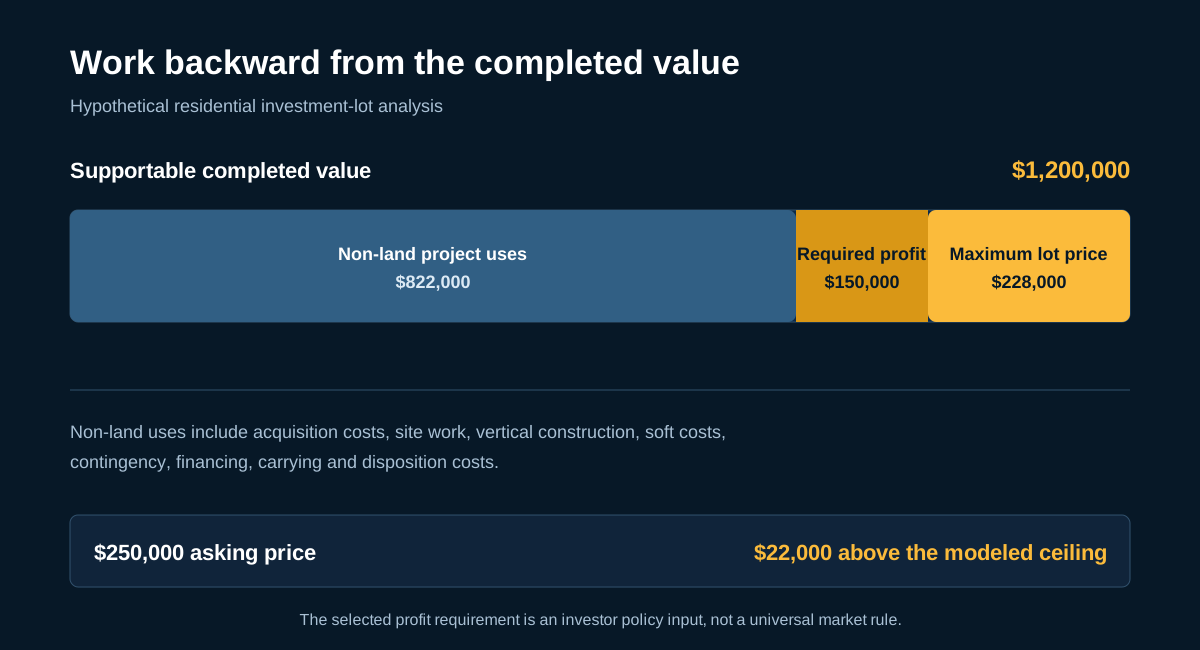
If the investor requires $150,000 of modeled profit, the maximum lot purchase price under the same assumptions is:
Maximum lot price = $1,200,000 completed value − $822,000 non-land project uses − $150,000 required profit = $228,000
At the $250,000 asking price, the project misses that selected hurdle by $22,000. The decision is to support a higher completed value with evidence, reduce another cost without hiding risk, negotiate the lot price or decline the project.
Separate lot-loan proceeds from total project capital
A loan-to-value ratio limits the loan by supported current collateral value. It does not fund every dollar required to buy, hold and prepare the lot.
Assume the current lot value is supported at $220,000 and the illustrative lot loan is limited to 50% LTV:
Illustrative lot-loan limit = $220,000 × 50% = $110,000
At a $250,000 purchase price, the investor supplies at least $140,000 toward the price, plus acquisition costs, diligence, reserves and any excluded site work. Paying above supported value increases the equity requirement because the loan is based on the approved value rather than the contract price alone.
The later construction loan is a separate approval. Its lender may apply different rules to land value, land basis, seasoning, plans, permits, contractor qualifications, budget, contingency, completed value and borrower liquidity. Do not assume that lot equity will be credited at a future appraised amount or that the construction facility will reimburse every pre-closing cost.
Match the holding period to a dated construction path
The lot produces no operating income, so taxes, insurance where applicable, maintenance, loan payments and design costs require another source of liquidity. A six-month delay matters even when the parcel's value has not changed.
Map the transition from lot acquisition to the intended exit:
- close the lot loan and preserve the remaining cash reserve;
- complete survey, design, utility and site investigations;
- obtain the approvals required by the construction lender;
- finalize plans, budget, contractor and contingency;
- apply for and close the construction facility; and
- repay the lot loan from approved construction proceeds, sale proceeds or another documented source.
If repayment depends on a takeout loan, verify that the expected facility can close before maturity and can legally use proceeds to repay the lot debt. Appreciation is not repayment cash. Only a completed sale, approved refinance or other available capital event pays the loan.
Make a lot-loan decision from four reconciled tests
Before closing, the same file should answer four questions:
- Legal: Is the borrower acquiring the correct parcel with insurable title and usable access?
- Buildability: Does the proposed improvement fit the actual zoning, envelope, utility and site conditions for its intended use?
- Economics: Does the supported completed value cover the lot, site work, construction, financing, disposition and required return under a downside case?
- Capital: Can the investor fund the purchase equity, preconstruction work, carrying period and transition into construction financing?
Pause when the parcel cannot be confirmed as a separately buildable lot, access or utilities remain assumptions, the proposed improvement does not fit the practical envelope, site costs are carried as nominal allowances, the deal works only at an unsupported completed value, or construction financing is treated as automatic.
A lot becomes financeable through evidence, not through its size or listing description. The useful analysis connects the legal parcel, buildable envelope, site budget, current value, complete project economics and repayment path before short-term lot debt is added.
References
1. Faundare Capital LLC. Investment lot offered for sale, editorial image. Generated with OpenAI image generation, October 4, 2026. Created for this article; the scene is not a funded property, borrower or site record.
2. Federal Emergency Management Agency. Flood Maps: Products and Tools. https://www.fema.gov/flood-maps/products-tools. Accessed October 4, 2026.
3. U.S. Department of Agriculture, Natural Resources Conservation Service. Soil Surveys Can Help You. https://www.nrcs.usda.gov/conservation-basics/soil/soil-surveys-can-help-you. Accessed October 4, 2026.
4. U.S. Environmental Protection Agency. Brownfields All Appropriate Inquiries. https://www.epa.gov/brownfields/brownfields-all-appropriate-inquiries. Accessed October 4, 2026.
5. Faundare Capital LLC. Hypothetical investment-lot teaching model, Tables 1–2 and Figure 1. October 4, 2026. The parcel, proposed improvement, costs, financing assumptions and calculations were created for instruction and do not describe an actual transaction.