
A construction budget can balance at closing and still become underfunded during the work. The risk appears when the remaining scope costs more than the combination of undisbursed loan proceeds, usable contingency and verified borrower cash. At that point, percentage complete and the original budget no longer answer the central question: can the project pay for every obligation required to reach completion?
Three concepts organize the answer. A cost overrun is the amount by which actual or forecast project cost exceeds the approved baseline. Construction contingency is a controlled budget allowance for defined uncertainty; it is not free proceeds. Construction cost to complete is the current forecast of the remaining physical work and construction closeout obligations. Total capital required through exit adds the remaining interest, carrying costs and sale or refinance expenses. Keeping the two measures separate prevents a construction reserve from appearing to cover a timing or exit deficit.
This article explains how an investor in a business-purpose ground-up construction project can distinguish those amounts, update the forecast after a change and determine whether the remaining capital plan still works. The examples are teaching inputs. The approved budget, eligible costs, reallocations, draw rules and completion obligations come from the executed loan and construction documents.
Start with the approved baseline, not a headline construction number
An overrun can be measured only against a stable baseline. The baseline should connect the plans, specifications, contractor agreement, schedule of values, soft-cost budget, contingency, financing costs and completion schedule that the lender and owner accepted.
Record at least four amounts for every cost line:
| Budget field | What it answers |
|---|---|
| Original approved budget | What the project expected to spend at closing |
| Approved changes | Which later scope, price or schedule changes became binding |
| Actual paid and payable cost | What has been incurred, whether or not a draw has reimbursed it |
| Current forecast at completion | What the line is now expected to cost in total |
The forecast at completion is the useful control. A line can appear under budget because an invoice has not arrived, a contract has not been signed or retained amounts have not been released. None of those timing differences creates savings.
Separate hard construction, soft costs, contingency, interest, taxes, insurance, financing costs and the sale or refinance period. A delayed project may remain within the building contract while exceeding the total capital plan through added interest, professional fees and carrying costs.
Classify the cause before deciding how to fund it
Not every increase should consume the same reserve. Classify a potential overrun by cause and status:
- Scope omission: required work was absent from the plans, specifications or bid.
- Concealed or differing condition: field conditions reveal work that could not be confirmed earlier.
- Allowance variance: an allowance was lower than the actual selected or required item.
- Price or quantity variance: labor, material, subcontractor or measured quantities exceed the estimate.
- Owner change: the investor elects to change quality, layout or function.
- Code, utility or approval requirement: an authority or service provider imposes additional work.
- Delay cost: the schedule adds supervision, rental equipment, insurance, interest, taxes or other time-dependent cost.
- Correction or rework: defective or nonconforming work must be repaired.
The classification affects responsibility, insurance, contractor claims, lender eligibility and the decision to proceed. An owner upgrade should not be presented as an unforeseen condition. A disputed contractor charge should not become an approved budget increase merely because it appears on an invoice.
Maintain a change log that states the issue, affected contract, estimated cost, schedule effect, decision deadline, approval status and proposed funding source. This prevents pending items from disappearing between meeting notes, emails and draw packages.
Treat contingency as governed capital
Contingency protects a project only when the amount, eligible uses and approval authority are clear. A percentage selected without reference to design completeness, site investigation, contract coverage and schedule risk can be either inadequate or unnecessarily expensive.
The U.S. Government Accountability Office describes contingency as part of a risk-adjusted estimate and recommends connecting it to identified uncertainty rather than allocating it mechanically across cost lines.2 That guidance concerns public programs, not private loan terms, but the budgeting principle is useful: reserve should correspond to risk.
Before closing, evaluate the principal uncertainty in:
- site, soil, drainage and utility conditions;
- completeness and coordination of plans;
- fixed-price contracts, allowances, exclusions and unsold trade packages;
- material availability and price exposure;
- permit, inspection and utility dependencies;
- contractor and subcontractor performance;
- weather and schedule float; and
- the carrying period through sale or permanent financing.
There is no universally ideal contingency percentage. A project with complete plans, verified site conditions and executed trade coverage may justify a different reserve from one with unresolved civil work, broad allowances and volatile procurement. GSA's published estimating framework likewise shows that estimate uncertainty narrows as project information becomes more complete.3 Its percentages are federal estimating ranges, not recommended private-loan contingency levels.
A lender-controlled contingency also differs from unrestricted borrower liquidity. The lender may permit a transfer only after reviewing the change, confirming eligibility and determining that sufficient funds remain. The borrower should preserve separate cash for ineligible work, timing gaps and changes that are not approved for loan funding.
Control every change before work proceeds
A change order should identify the revised scope, price, time effect and related work. It should also show whether the amount includes contractor markup, design revisions, permits, testing, tax and changes to other trades.
Before approving a change:
- Confirm why the work is required and which contract provision applies.
- Obtain enough pricing detail to test labor, material, quantity, markup and schedule assumptions.
- Identify every related cost rather than approving the contractor's quote in isolation.
- Determine whether the lender must consent before the work becomes eligible.
- Update the total forecast, construction schedule, interest plan and exit date.
- Assign one documented funding source.
Urgent field direction may precede final pricing, but it should enter the log immediately as a pending exposure. Treating unsigned work as zero until the formal change arrives understates cost to complete at the moment the decision is being made.
Recalculate cost to complete from remaining obligations
Construction cost to complete is not the original budget minus draws. It is the present estimate of the construction work and closeout obligations that remain to be paid and performed:
Construction cost to complete = unpaid base scope + approved changes + probable pending changes + remaining construction-related owner and soft costs + retainage + closeout work
Then complete a second calculation:
Total capital required through exit = construction cost to complete + remaining nonconstruction soft costs + remaining interest and carrying costs + sale or refinance expenses
Assign each obligation to one layer. For example, an architect's fee required to finish construction belongs in construction cost to complete; brokerage and sale-closing costs belong in the exit layer. The categories may differ under the approved budget, but the same cost should never appear in both.
Retainage remains an obligation even when its release is deferred. Stored materials count according to their payment, ownership, location, insurance and installation status. A deposit may reduce the amount due later without proving that the corresponding work is complete.
Update the calculation after each draw and whenever a material change occurs. The FDIC's current construction-lending examination module directs reviewers to compare draws with actual completion and determine whether the undisbursed balance remains sufficient to finish the project.4 That module governs insured institutions rather than every private lender, but it states the same completion test an investor should perform.
Use current evidence:
- executed contracts and subcontracts;
- invoices, commitments and payment records;
- approved and pending change orders;
- inspection or progress reports;
- updated trade bids for unfinished work;
- contractor schedules and procurement logs;
- permit and utility conditions;
- remaining retainage and closeout requirements; and
- the revised monthly interest and carrying-cost forecast.
Do not net an anticipated saving against an overrun until the saving is supported and the affected scope remains complete. An unused allowance is not savings if another required line was omitted.
Compare cost to complete with usable completion funds
After forecasting the obligation, calculate resources that can actually fund it:
Usable completion funds = undisbursed eligible loan proceeds + approved usable contingency + verified uncommitted borrower funds + other committed sources
Keep restricted reserves separate. An interest reserve cannot fund construction unless the lender approves a reallocation and the remaining interest plan still reaches the exit. Undisbursed proceeds for an ineligible or exhausted budget line may not be transferable.
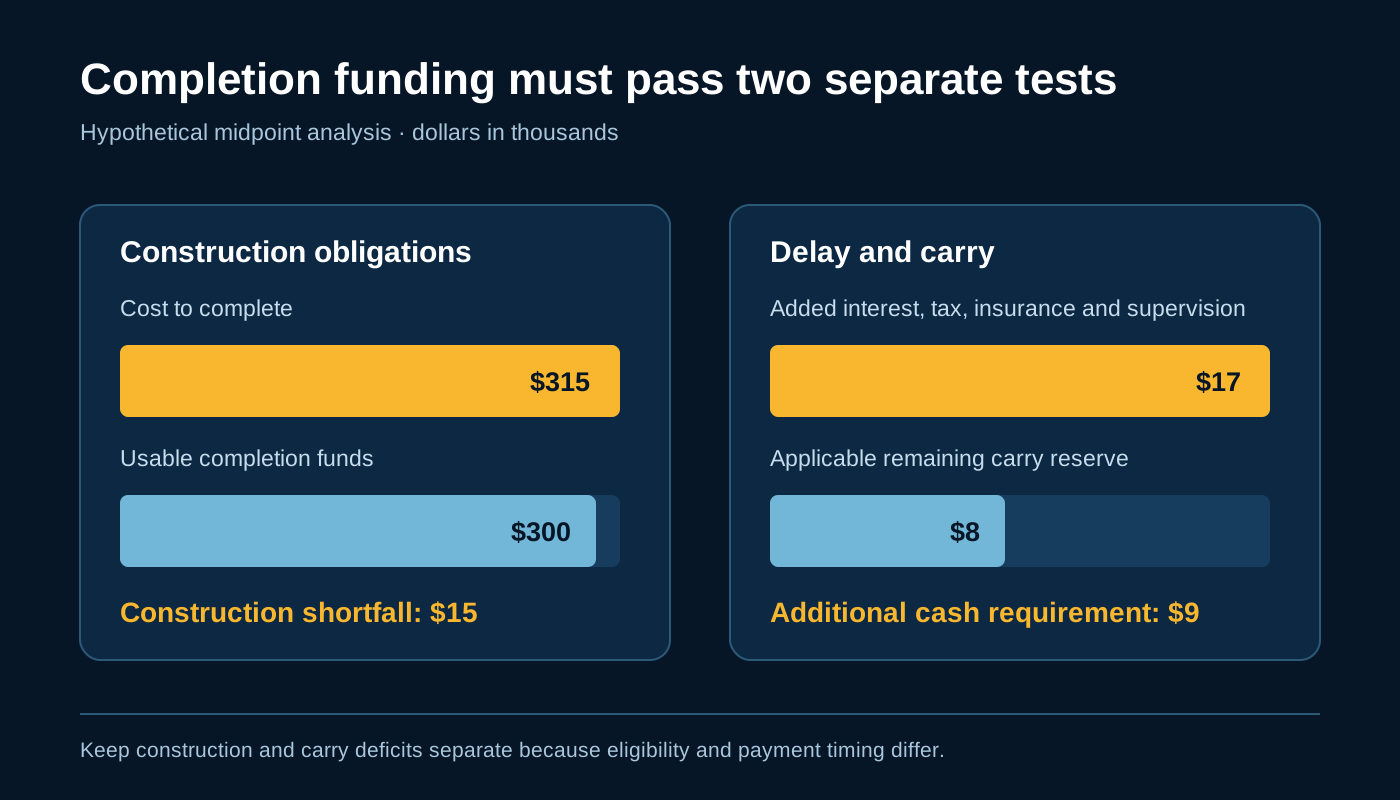
Assume a residential construction project reaches its midpoint with the following remaining obligations:
| Remaining obligation | Amount |
|---|---|
| Unpaid base contracts | $245,000 |
| Approved changes | $32,000 |
| Probable pending site and utility work | $18,000 |
| Retainage and closeout | $20,000 |
| Current construction cost to complete | $315,000 |
The capital available for those construction obligations is:
| Usable source | Amount |
|---|---|
| Undisbursed hard-cost holdback | $255,000 |
| Approved remaining construction contingency | $20,000 |
| Verified uncommitted borrower construction cash | $25,000 |
| Usable completion funds | $300,000 |
The project has a $15,000 construction funding shortfall. It is underfunded even though $275,000 remains in controlled loan proceeds and the physical work may appear more than halfway complete.
Now test time separately. If a two-month delay adds $13,000 of interest and $4,000 of taxes, insurance and supervision while only $8,000 remains in the applicable carry reserve, the delay creates another $9,000 cash requirement. The total identified gap is therefore $24,000, but the construction and carry deficits should remain separate because their eligibility and timing differ.
Resolve a shortfall without hiding it
Once usable completion funds fall below cost to complete, stop treating the issue as an ordinary variance. Prepare a revised sources-and-uses statement and decide which response is contractually and economically supportable.
Potential responses include:
- borrower or guarantor funds deposited under an approved plan;
- documented project savings that preserve the required scope and quality;
- lender-approved reallocation from a genuinely excess eligible line;
- an approved scope revision that does not impair permits, value, marketability or exit;
- contractor or insurance recovery when responsibility and collectability are supportable; or
- additional financing formally approved with its own cost, priority and closing conditions.
Future savings, disputed claims and hoped-for lender increases are not committed sources. Work should not continue merely because stopping is uncomfortable. Continuing through an unresolved deficit can consume the remaining good funds and leave the project incomplete at a more expensive stage.
The loan documents may require the borrower or guarantor to fund overruns, replenish reserves or complete the project regardless of whether the original commitment remains sufficient. Counsel should review those obligations before closing and when a material deficit develops.
Protect the draw and payment sequence
A revised budget must also work in time. Contractors and suppliers may require payment before a construction draw is inspected and released. A project with enough total sources can still stop if those sources arrive after the obligations are due.
Maintain a rolling cash forecast that shows:
- invoice and deposit due dates;
- expected inspection and draw-submission dates;
- lender processing and funding assumptions;
- ineligible costs paid from equity;
- minimum unrestricted liquidity after each payment; and
- the effect of a delayed draw or rejected item.
Do not pay later-phase work from money needed to cure an earlier shortfall unless the revised completion plan demonstrates that every remaining obligation can still be funded. A draw approval reimburses eligible progress; it does not prove that the entire project remains capitalized.
Monitor leading indicators before the deficit appears
The most useful controls identify pressure before contingency is exhausted. Review these indicators at least with each draw:
- committed cost compared with the approved budget;
- pending changes as well as approved changes;
- contingency remaining as dollars and in relation to unresolved risk;
- schedule variance and monthly carrying-cost run rate;
- procurement items without final price or delivery dates;
- unpaid invoices, retainage and potential lien exposure;
- undisbursed funds by eligible budget line;
- borrower cash reserved for the project; and
- current cost to complete compared with usable completion funds.
Escalate when a line is forecast to exceed budget, not after payment proves the overrun. The earlier review preserves more choices: redesign, rebid, sequencing changes, owner funding or a disciplined decision not to add optional scope.
Decide whether the project remains fully funded
A current construction plan should answer four questions at the same date:
- Scope: What work and closeout conditions remain?
- Cost: What will those obligations cost, including probable changes and delay?
- Capital: Which loan proceeds, approved contingency and verified equity can actually pay them?
- Timing: Will each source arrive before the corresponding payment and before maturity?
If usable funds exceed cost to complete only because the model assumes an unapproved transfer, an uncollected claim or an unsupported saving, the project is not fully funded. Resolve the source, revise the scope or add capital before authorizing work that depends on it.
Review Faundare Capital's current Ground-Up Construction program after the project budget, schedule and completion resources are reconciled.5 The relevant commitment is not merely the original loan amount; it is the combination of eligible undisbursed proceeds and reliable equity that can still deliver a completed, financeable property.
References
1. Phil Hearing. *House under construction with scaffolding and bricks*. Unsplash, under the Unsplash License. Published May 10, 2026; accessed October 12, 2026. Cropped by Faundare Capital for editorial presentation.
2. U.S. Government Accountability Office. *Cost Estimating and Assessment Guide: Best Practices for Developing and Managing Program Costs*. GAO-20-195G, March 2020, pp. 145–160. Risk and uncertainty analysis, risk-adjusted estimates and contingency allocation.
3. U.S. General Services Administration. Develop and Manage Costs for RWA Projects. Updated February 3, 2026; accessed October 12, 2026. Describes how estimate ranges narrow as scope and design information become more complete.
4. Federal Deposit Insurance Corporation. *Construction and Land Development Lending*, Risk Management Manual of Examination Policies. October 2025 examination module, pp. 6–7. Construction-progress monitoring, draw comparisons and sufficiency of remaining funds.
5. Faundare Capital. Ground-Up Construction Loans. Accessed October 12, 2026. Current program orientation; eligibility, cost treatment, leverage, draws, proceeds and terms remain subject to underwriting and approval.