
A construction budget is not only a list of costs. It is a funding plan that connects the scope, contracts, contingency, schedule, borrower equity and lender draws. A project can remain within its final budget and still fail if cash is required before a draw becomes available.
The example is a hypothetical ground-up residential investment property. Its costs, timing and financing assumptions explain the method; they are not bids, market benchmarks or Faundare Capital program terms.
Understand the three documents that must agree
The scope states what will be built. The budget assigns cost to that scope. The schedule shows when the work and cash uses occur. If the documents use different assumptions, a detailed spreadsheet can still be wrong.
The Office of the Comptroller of the Currency describes acquisition, development and construction lending as dependent on project feasibility, cost estimates, repayment sources, borrower equity, inspections and controlled disbursements.2 That framework is useful to an investor because the same items determine whether a project can reach completion without an unplanned capital call.
Begin with an identified site, plan set and delivery method. A fixed-price contract can still contain allowances, exclusions and change provisions. A cost-plus arrangement shifts more cost risk to the owner. The budget should identify those differences rather than placing every line under one contractor total.
Build the uses from the project, not the loan amount
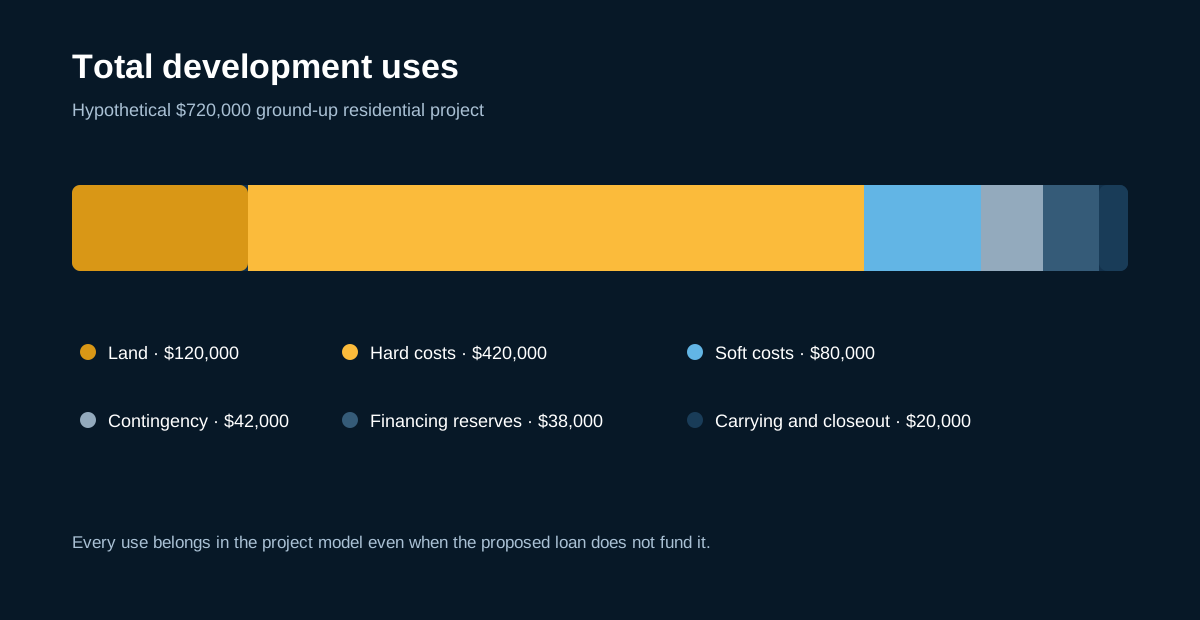
Consider a single-family investment property intended for sale after completion. The site is under contract for $120,000. The initial development budget is:
| Project use | Amount | Basis |
|---|---|---|
| Land acquisition | $120,000 | Purchase contract |
| Site work and foundation | $82,000 | Contractor schedule |
| Framing and exterior enclosure | $128,000 | Contractor schedule |
| Mechanical, electrical and plumbing | $78,000 | Trade allowances |
| Interior finishes | $92,000 | Scope and allowances |
| Landscaping and final site work | $40,000 | Contractor schedule |
| Hard costs | $420,000 | Before contingency |
| Architecture, engineering and permits | $34,000 | Proposals and fee schedule |
| Builder overhead and supervision | $24,000 | Contract |
| Legal, insurance, taxes and utilities | $22,000 | Estimates |
| Soft costs | $80,000 | Before financing |
| Construction contingency | $42,000 | 10% of hard costs |
| Interest and lender-controlled reserves | $38,000 | Financing model |
| Sales, carrying and closeout allowance | $20,000 | Project model |
| Total development cost | $720,000 | All modeled uses |
Hard costs purchase physical construction. Soft costs include professional, approval and administrative uses. The categories matter because a loan may treat them differently, but eligibility does not change the project's total economic cost.
Translate total cost into loan proceeds and borrower cash
The project budget and the lender's eligible-cost schedule answer different questions. The project budget captures every modeled use. The eligible-cost schedule determines which uses may support advances under the approved loan. Costs that are excluded from advances still require capital and remain part of the project's economics.
Assume solely for this example that the approved commitment is $500,000 and advances reimburse the $420,000 hard-cost budget and $80,000 soft-cost budget. The resulting capital structure is:
| Capital source or use | Amount | Interpretation |
|---|---|---|
| Total development cost | $720,000 | All modeled project uses |
| Illustrative loan commitment | $500,000 | Maximum advances for eligible hard and soft costs |
| Borrower capital assigned to the project | $220,000 | Land, contingency, financing reserve and sale or closeout allowance |
| Loan-to-cost | 69.4% | $500,000 ÷ $720,000 |
The $220,000 is the permanent difference between modeled cost and loan proceeds; it is not the complete liquidity requirement. The borrower may also need temporary cash to pay eligible invoices before inspection and reimbursement. The loan agreement determines whether equity must be invested first, proportionately with advances or according to another sequence. It also determines eligible costs, retainage, inspection conditions and the timing of releases. None of those mechanics should be inferred from the commitment amount alone.
Make allowances visible
The mechanical and finish budgets contain selections that are not final. An allowance is not a guaranteed price. Record the quantity, quality level, tax, delivery, installation and escalation assumption behind each one.
Suppose the $92,000 finish budget includes a $14,000 cabinet allowance. The final cabinet proposal is $20,500, including delivery and installation. That $6,500 difference either consumes contingency, requires a scope change or increases total cost. Leaving the original allowance in the forecast after selection would hide the variance.
Use a commitments log beside the budget:
| Cost status | Amount | Interpretation |
|---|---|---|
| Executed contracts and purchase orders | $265,000 | Price committed, subject to changes and exclusions |
| Current proposals | $105,000 | Priced but not committed |
| Owner estimates and allowances | $50,000 | Highest uncertainty |
| Hard-cost subtotal | $420,000 | Reconciles to the approved hard-cost budget |
Builder supervision remains in soft costs under this model. If a contractor schedule includes it inside a trade total, reclassify the cost once rather than adding a second allowance. Reconciliation should resolve classification changes before calculating contingency or loan-to-cost.
Size the contingency from remaining risk
A construction contingency should respond to undefined or changed work, not fund known omissions. The example uses $42,000, equal to 10% of hard costs, only as a starting assumption. Its adequacy depends on design completion, site conditions, contract structure and the amount already committed.
Track each use of contingency with the event, approved amount, responsible party and resulting cost-to-complete. If cabinets use $6,500 and an unplanned drainage connection uses $11,000, remaining contingency is $24,500. Reporting the original $42,000 while moving the changes into separate budget lines overstates protection.
Convert the construction schedule into cash periods
The draw schedule should follow expected work in place, not divide the commitment evenly by the number of months.
| Period | Eligible work paid | Illustrative draw after verification | End-of-period unreimbursed balance |
|---|---|---|---|
| Month 1: site and foundation | $70,000 | $63,000 | $7,000 |
| Month 2: foundation and framing | $100,000 | $90,000 | $17,000 |
| Month 3: framing and enclosure | $120,000 | $108,000 | $29,000 |
| Month 4: rough trades | $100,000 | $90,000 | $39,000 |
| Month 5: finishes | $70,000 | $63,000 | $46,000 |
| Month 6: completion and retained amount | $40,000 | $86,000 | $0 |
| Total or ending balance | $500,000 | $500,000 | $0 |
The illustration retains 10% of verified work through month five. The month-six draw includes $40,000 for final eligible work and releases the accumulated $46,000. This is a teaching convention, not a statement of any lender's construction draw process. Actual advances may fund directly, reimburse the borrower, retain a different percentage, require lien waivers or exclude particular costs. Current OCC guidance emphasizes inspections, budget monitoring, disbursement controls and verification that remaining funds are sufficient to complete the project.2
The end-of-period balance is not the highest cash needed during the month. If the borrower pays contractors before each reimbursement, the largest temporary outlay in this schedule occurs in month three: the prior $17,000 unreimbursed balance plus $120,000 of current work equals $137,000 before the $108,000 draw arrives. Deposits, inspection timing and ineligible invoices can increase that peak. The liquidity schedule should therefore show both the permanent borrower capital and the temporary reimbursement bridge by date.
Reforecast cost to complete every month
Budget variance alone looks backward. Cost to complete asks how much cash is still required to finish the approved scope. Update it from executed commitments, pending changes, remaining allowances and observed production.
After month three, the example has $290,000 of eligible work completed and $261,000 of cumulative loan advances. The $29,000 difference agrees with the end-of-period unreimbursed balance in the draw schedule. Remaining loan availability is therefore $239,000.
Assume the current forecast contains:
- $210,000 of original-scope hard and soft costs still to complete;
- $18,000 of identified probable changes charged against contingency;
- $24,000 of contingency that remains unallocated;
- $38,000 of financing reserve still available; and
- $20,000 of sales, carrying and closeout costs still to be funded.
Remaining cost to complete is $210,000 + $18,000 + $24,000 + $38,000 + $20,000 = $310,000. Adding $290,000 of completed eligible work and the $120,000 land cost already paid reproduces the original $720,000 total development cost. The $239,000 of remaining loan availability covers the $210,000 of original eligible work plus the eventual release of the $29,000 already paid but not yet reimbursed. Borrower capital must cover the remaining contingency, financing and closeout uses as they occur.
This reconciliation also exposes overruns. If the $18,000 of probable changes is added without reducing contingency, the total forecast becomes $738,000. The report should state whether each change is funded from contingency, transferred into a revised budget line or added above the approved total.
Test delay and exit before construction starts
A three-month delay can add interest, taxes, insurance, utilities, supervision and opportunity cost even when direct construction cost is unchanged. It can also move the sale or lease-up into a different market period.
The completed plan should identify the repayment path. A sale exit needs a supportable completed value, selling-cost estimate and absorption period. A rental exit needs achievable rent, stabilized expenses, a certificate of occupancy and financing that can replace the construction debt. The OCC notes that construction underwriting should consider the source and timing of repayment and whether completed-project income supports the expected value.2
Pause the project when the plans and contractor price cover different scopes, uncommitted allowances are treated as fixed, contingency has already been consumed without a revised forecast, the borrower cannot fund work before reimbursement, or the exit only works at the highest value and shortest schedule.
Make the construction decision from the reconciled plan
The example now ties to one capital structure: $720,000 of total development cost, a $500,000 illustrative commitment, $220,000 of permanent borrower capital and as much as $137,000 of temporary pre-reimbursement cash under the assumed payment sequence. At the end of month three, the model shows $310,000 remaining to complete against $239,000 of loan availability, with borrower capital assigned to the balance.
Proceed only when the scope, contracts, budget, draw rules and remaining liquidity support the same completion plan, and when a plausible delay still leaves a supportable sale or rental exit. If an eligible cost is removed, a draw is delayed or a probable change exceeds available contingency, revise the sources-and-uses schedule before relying on the original completion date or profit estimate. Investors with a defined site, plans, budget and exit can then review ground-up construction financing or discuss the project using the reconciled case.
References
1. Troy Mortier. A house under construction. https://unsplash.com/photos/a-house-is-under-construction-ZJ7XIWR01gU. Unsplash. Used under the Unsplash License. Accessed October 3, 2026.
2. Office of the Comptroller of the Currency. Comptroller's Handbook: Commercial Real Estate Lending, Version 2.0. March 2022; reputation-risk references revised March 20, 2025. https://www.occ.treas.gov/publications-and-resources/publications/comptrollers-handbook/files/commercial-real-estate-lending/pub-ch-commercial-real-estate.pdf. Accessed October 3, 2026.
Figure and table provenance. The project, costs, contracts, draw mechanics, calculations, tables and analytical graphic are hypothetical and were created by Faundare Capital for instruction. The opening photograph is cited in the references.