
A DSCR cash-out refinance replaces or adds debt against a rental property and returns part of the owner's equity as cash. The transaction may fund another acquisition, return renovation capital, consolidate property debt or create business liquidity. The amount deposited at closing is rarely the advertised loan amount. Value, leverage, qualifying rent, the proposed payment, existing liens and closing costs determine the deposit; any post-closing liquidity requirement can further reduce the amount freely available for a new use.
This article addresses a business-purpose refinance of a non-owner-occupied property with one to four units. In this setting, a DSCR loan commonly qualifies the property by comparing supported monthly rent with monthly principal, interest, taxes, insurance and applicable association dues. A five-plus-unit apartment refinance generally starts with net operating income and annual debt service instead. The two calculations share a name but do not use the same income measure.
The worked example uses a hypothetical rental property worth $350,000, a $150,000 existing payoff and $2,800 of qualifying monthly rent. It assumes a 30-year amortizing loan at 8.25% solely to demonstrate the mechanics. The rate, leverage and costs are teaching inputs rather than a current quote.

Understand what the refinance changes
A first-lien cash-out refinance pays off the existing mortgage and records a new first mortgage for a larger amount. The difference does not all become borrower cash. The new loan must first satisfy the old payoff, lender charges, third-party costs, prepaid items and any amounts held in escrow or reserve.
The transaction changes four parts of the property capital structure at once:
- the principal balance secured by the property;
- the interest rate, amortization, term and prepayment provisions;
- the monthly property obligation used in the lender's DSCR test; and
- the owner's remaining equity and liquidity after closing.
That is why “How much equity do I have?” and “How much cash can I receive?” are different questions. Market equity is the supported property value minus all liens. Accessible cash is the permitted new loan minus the payoff and every closing deduction. A property can have substantial equity and still produce little cash if DSCR, seasoning, costs or reserves constrain the refinance.
Separate program eligibility from conventional mortgage rules
“Seasoning” can refer to several different clocks: time since title transfer, age of the mortgage being paid off, time since a cash purchase, or operating history after renovation and lease-up. A lender may use those periods to decide whether the property is eligible, whether current appraised value may be used and how rent or payment history must be documented.
There is no universal seasoning period for all DSCR loans. Current program rules control. Fannie Mae's conventional cash-out guidance illustrates the distinction: its December 2025 guide generally requires at least one borrower to have held title for six months and an existing first mortgage being paid off to be at least twelve months old, subject to stated exceptions.2 Those are agency conventional rules. They do not establish the requirements of a private business-purpose DSCR program.
Before relying on current value, ask the proposed lender to state in writing:
- the minimum title-holding period;
- any minimum age for the lien being refinanced;
- whether a recent arm's-length purchase price or documented cost basis limits value;
- which renovation costs can be added to that basis; and
- which appraisal, lease and payment-history documents are required.
This distinction is material after a renovation. An appraisal may support a $350,000 current value while a program still sizes proceeds from the $290,000 purchase-and-improvement basis until its seasoning requirement is met.
Size the loan under every applicable limit
The maximum loan is the lowest amount produced by the lender's value, DSCR, credit, property, loan-size and program rules. Start with the value constraint:
LTV-limited loan = accepted value × maximum cash-out LTV
Assume the program accepts the $350,000 appraisal and allows no more than 70% cash-out loan-to-value for this scenario:
$350,000 × 70% = $245,000
The $245,000 result is a ceiling, not a promise. Faundare Capital's current DSCR program orientation states up to 75% LTV for refinances, with rate-and-term and cash-out limits varying by scenario.5 Maximum leverage and the lowest published DSCR threshold should not be assumed to apply together.
The income constraint must then be tested against the proposed payment. For a one-to-four-unit residential investment property:
Residential DSCR = qualifying monthly rent ÷ monthly PITIA
The rent source is program-specific. A lender may consider an executed lease, appraiser-supported market rent or the lower of two documented amounts. Fannie Mae's Form 1007 for a one-unit investment property and Form 1025 for a two-to-four-unit property illustrate appraisal tools used to support market rent in residential mortgage analysis.3 A private DSCR guide determines how that evidence enters its ratio.
Calculate the new payment before the cash-out amount
For the example, assume the property's qualifying rent is $2,800 per month and the applicable DSCR requirement is 1.20. Rearranging the ratio gives the maximum monthly property obligation:
Maximum PITIA = $2,800 ÷ 1.20 = $2,333
The modeled monthly property expenses are:
| PITIA component | Monthly amount |
|---|---|
| Property taxes | $410 |
| Property insurance | $165 |
| Association dues | $0 |
| Maximum principal and interest available | $1,758 |
At the illustrative 8.25% rate and 30-year amortization, approximately $234,000 of principal produces $1,758 of monthly principal and interest. Adding taxes and insurance gives total PITIA of approximately $2,333, and the resulting DSCR is 1.20.
| Constraint | Maximum loan |
|---|---|
| 70% of accepted $350,000 value | $245,000 |
| Loan supported by $2,800 rent at 1.20 DSCR | $234,000 |
| Modeled maximum loan | $234,000 |
The income constraint reduces proceeds by $11,000 below the LTV ceiling. Quoting only “70% cash-out” would overstate the usable loan.
Reconcile gross proceeds to the closing deposit
The refinance produces cash only after the existing debt and transaction costs are paid. Use a sources-and-uses schedule rather than subtracting the mortgage balance from property value.
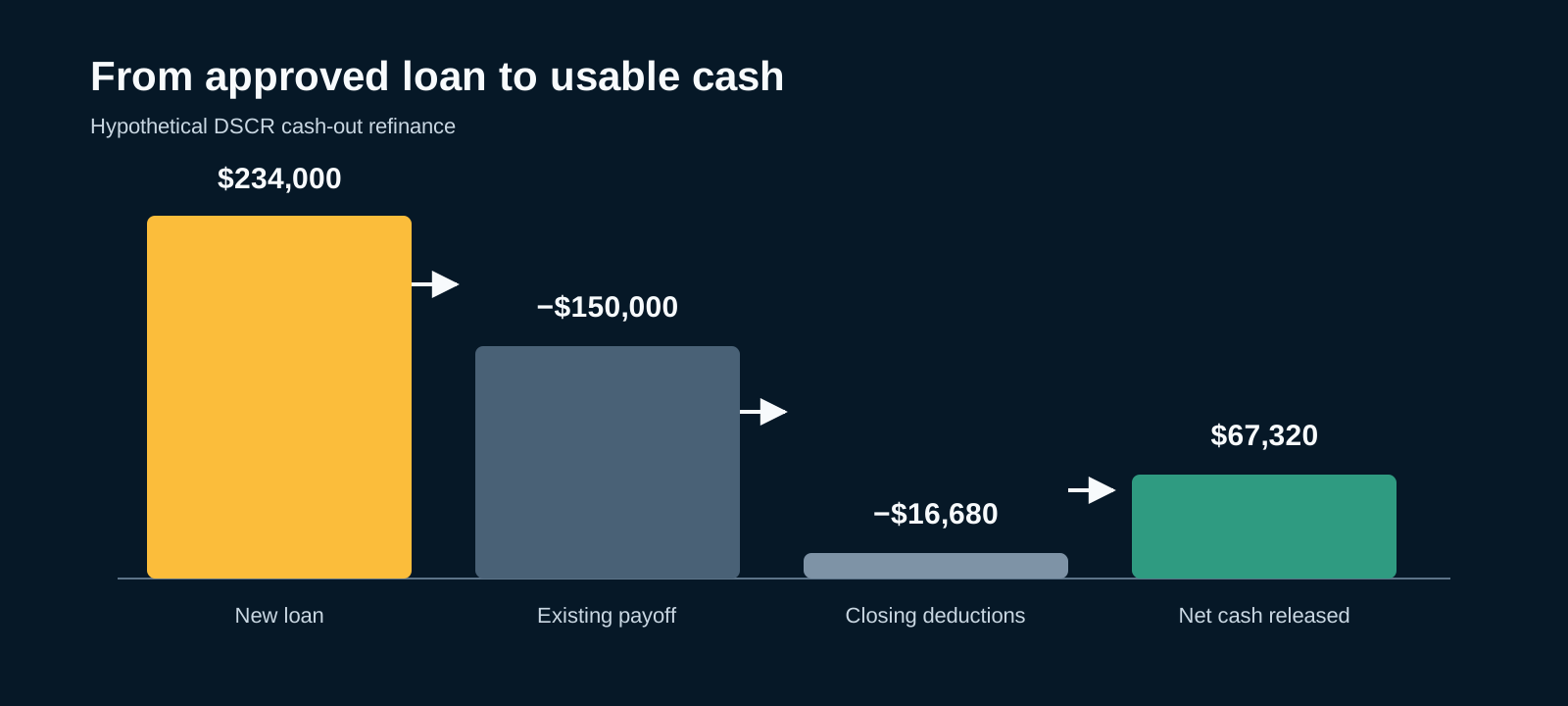
Net cash-out = new loan − existing payoffs − lender charges − third-party closing costs − prepaids and escrows − other closing deductions
The example assumes:
| Refinance source or use | Amount |
|---|---|
| New DSCR loan | $234,000 |
| Existing first-mortgage payoff | −$150,000 |
| Lender fee, assumed at 2% | −$4,680 |
| Appraisal, title, legal, recording and settlement | −$6,500 |
| Prepaid interest and initial tax/insurance escrows | −$3,000 |
| Existing-loan interest and payoff charge | −$2,500 |
| Illustrative net cash to borrower | $67,320 |
The payoff statement should be dated for the expected closing date and include per-diem interest and any release or prepayment charge. Escrow refunds from the old servicer may arrive after closing and should not be counted as settlement proceeds unless the closing documents actually credit them.
The $67,320 is the settlement deposit before any separate post-closing liquidity test. Suppose the approved terms require the borrower to retain six months of the new $2,333 PITIA, and no other verified account satisfies that condition. The borrower would need to earmark approximately $13,998, leaving about $53,322 freely available for the intended use. A liquidity requirement is not automatically a lender fee or closing deduction; it changes deployable cash only when the borrower must preserve part of the proceeds to satisfy it.
Consumer-mortgage guidance provides useful cost vocabulary even though a business-purpose DSCR refinance may not use the same disclosure forms. The Consumer Financial Protection Bureau notes that a “no-closing-cost” refinance still pays for origination through a higher rate, a larger balance or another structure; a higher balance also reduces retained equity.4 The investor should therefore compare economic cost, not the label attached to the fee column.
See how seasoning can change accessible cash
Now assume the property was purchased for $250,000 and the owner can document $40,000 of completed improvements. If the lender uses the $290,000 cost basis rather than the current appraisal, the 70% LTV ceiling becomes:
$290,000 × 70% = $203,000
The DSCR limit remains $234,000, so value basis now controls. Using a 2% lender fee and the same other deductions:
| Value treatment | Appraisal accepted | Cost basis used |
|---|---|---|
| Accepted value | $350,000 | $290,000 |
| LTV-limited loan | $245,000 | $203,000 |
| DSCR-limited loan | $234,000 | $234,000 |
| Modeled loan | $234,000 | $203,000 |
| Estimated net cash after payoff and costs | $67,320 | $36,940 |
The same property and rent produce $30,380 less net cash because the accepted value basis changes. Waiting for a seasoning threshold may increase eligible proceeds, but waiting also has costs: interest on the existing loan, taxes, insurance, maintenance and the risk that value, rent or program terms change. The decision should compare the expected incremental proceeds with the cost and uncertainty of the delay.
Compare the old obligation with the new one
Cash-out is borrowed capital. The property must carry the larger balance after the closing proceeds have been spent.
Assume the current mortgage statement reports principal and interest of $921 per month on the existing $150,000 loan, and the property has the same $575 of taxes and insurance. Existing PITIA is therefore about $1,496. The proposed $234,000 loan raises PITIA to about $2,333, an increase of $837 per month.
| Payment comparison | Existing debt | Proposed refinance |
|---|---|---|
| Principal and interest | $921 | $1,758 |
| Taxes and insurance | $575 | $575 |
| PITIA | $1,496 | $2,333 |
| DSCR at $2,800 qualifying rent | 1.87 | 1.20 |
The lower coverage ratio is not automatically unacceptable; it is the direct consequence of replacing equity with debt. The investor must still test the full owner cash flow after vacancy, repairs, management, capital reserves and other expenses that residential DSCR may not deduct. A lender ratio at its minimum can coexist with thin or negative owner cash flow.
The use of proceeds should also have a defined economic purpose. If the $67,320 funds another investment, compare its expected return and risk with the refinance's interest, fees, prepayment constraints and reduced property cash flow. If the proceeds merely reimburse old equity, decide whether the increased payment and lower retained equity improve the portfolio's resilience or weaken it.
Compare a new first lien with a second-lien cash-out
A first-lien cash-out refinance reprices the entire $150,000 existing balance as part of the new $234,000 loan. That can be inefficient when the current first mortgage has favorable terms. A second-lien DSCR structure, when available, leaves the first mortgage in place and adds a subordinate loan for part of the accessible equity.
The comparison must use the complete capital structure:
- the first-lien payoff, rate, payment and prepayment terms;
- the second-lien principal, payment, fees and maturity;
- combined loan-to-value rather than the second-lien amount alone;
- the program's treatment of both payments in DSCR; and
- net proceeds after the new loan's costs and any required reserves.
Preserving a low-rate first mortgage can reduce the amount of debt being repriced, but a subordinate lien may carry a higher rate, a shorter amortization or stricter combined-leverage limits. Faundare Capital has arranged both first-lien cash-out and second-lien DSCR transactions; those funded examples show that both structures exist, not that either structure or its historical terms are available for a new request.6
Stress the variables that can reduce proceeds
The preliminary result should survive changes that can occur between application and closing. Test at least:
- a lower appraisal or a lender-imposed value adjustment;
- use of cost basis until seasoning is satisfied;
- qualifying rent below the current lease or requested market rent;
- higher property taxes after reassessment;
- a larger insurance premium or deductible requirement;
- a higher interest rate or fewer lender credits;
- a payoff that includes additional interest or a prepayment charge; and
- a reserve requirement that retains cash after closing.
For example, if qualifying rent falls from $2,800 to $2,650 while the required DSCR remains 1.20, maximum PITIA falls to $2,208. With $575 of taxes and insurance, only $1,633 remains for principal and interest. At the same illustrative rate and amortization, the supported loan falls to roughly $217,000. Before recalculating any fee changes, that reduces gross proceeds by about $17,000.
If annual taxes and insurance instead rise by $1,800, the monthly PITIA burden increases by $150. The loan amount must fall or the qualifying rent must rise to preserve the same DSCR. A refinance that works only with the current tax bill and an unverified insurance estimate has not yet passed the payment test.
Decide whether the cash-out improves the capital plan
The refinance is supportable when the accepted value basis is documented, the proposed rent and PITIA produce the required DSCR, the closing statement reconciles to a useful net amount and the property remains adequately capitalized afterward. The decision should be paused when proceeds depend on an unconfirmed seasoning exception, optimistic rent, stale taxes or insurance, or a payoff estimate that excludes material charges.
For the example, $350,000 of value does not create a $245,000 loan or $95,000 of cash. DSCR limits the loan to about $234,000, and the payoff and closing deductions reduce the settlement deposit to about $67,320. A six-month PITIA requirement funded from those proceeds would reduce freely deployable cash to about $53,322. That capital must be judged against the $837 increase in monthly PITIA, the refinance's full cost and the intended use of funds. If that exchange advances a documented investment plan while preserving reserves, the transaction may be productive. If it only converts property equity into cash without a supportable use or payment margin, the apparent liquidity can leave the property less resilient.
References
1. Getty Images. Suburban houses in Virginia. Unsplash, Unsplash+ License. Published March 19, 2025. Accessed October 16, 2026. Editorially cropped to 16:9.
2. Fannie Mae. *Selling Guide B2-1.3-03: Cash-Out Refinance Transactions*, December 10, 2025. Accessed October 14, 2026. Cited as a conventional-agency example; it does not establish private DSCR program rules.
3. Fannie Mae. *Selling & Servicing Guide Forms*, including Form 1007 and Form 1025. Accessed October 14, 2026.
4. Consumer Financial Protection Bureau. *Is there such a thing as a no-cost or no-closing-cost loan or refinancing?*, reviewed April 3, 2024. Accessed October 14, 2026. Consumer-mortgage guidance cited only for cost mechanics.
5. Faundare Capital. *DSCR Rental Property Loans*. Accessed October 14, 2026. Current program orientation; final leverage, DSCR, pricing and documentation depend on the approved transaction.
6. Faundare Capital. *Funded Deals: DSCR Cash-Out Refinance and Second-Lien DSCR Cash-Out*. Accessed October 14, 2026. Historical transaction examples; stated principal amounts are not representations of net borrower proceeds or current terms.