
A one-to-four-unit DSCR loan lets a real estate investor qualify primarily from the subject property's rental income rather than from a conventional analysis of the borrower's employment income. The simplicity is useful, but it can also mislead: the lender's ratio is a defined eligibility test, not a complete profit-and-loss statement for the property.
The method described here applies to non-owner-occupied residential investment properties with one to four units. Properties with five or more units usually enter a multifamily underwriting framework that derives net cash flow from a full operating statement before comparing it with annual debt service. The companion article, How to Analyze a DSCR Rental Property Before You Buy, compares those frameworks and then tests the acquisition economics.
All numbers below are hypothetical. Lenders differ in eligible property types, qualifying rent, minimum ratios, leverage, credit standards, reserves, prepayment terms and treatment of vacant or short-term rentals. The current program guide and final approval control the loan.

Start with the residential underwriting boundary
The federal Regulation C definition treats a dwelling with five or more individual units as multifamily.2 The distinction matters because one-to-four-unit investment loans generally use residential appraisal forms and a rent-to-property-payment calculation, while multifamily loans generally underwrite the property's income and expense statement.
| Feature | 1–4 unit residential DSCR | Multifamily DSCR, generally 5+ units |
|---|---|---|
| Typical numerator | Qualifying gross monthly rent | Underwritten annual net cash flow |
| Typical denominator | Monthly PITIA and other required housing debt | Annualized debt service |
| Operating expenses | Usually not itemized except taxes, insurance and association dues in PITIA | Deducted before calculating net cash flow |
| Appraisal focus | Residential value and market-rent support | Income, expenses, capitalization and commercial value |
| Main analytical risk | Treating gross rent less PITIA as true property profit | Overstating income or understating vacancy, expenses and reserves |
This is an underwriting convention, not a statement that a four-unit building has no operating expenses. The borrower should maintain a separate acquisition and operating model even when the lender's qualifying formula is based on gross rent.
Understand the formula before discussing a threshold
The common residential formula is:
1–4 unit DSCR = qualifying monthly rent ÷ monthly PITIA
For this article, residential DSCR divides qualifying monthly rent by the property's monthly PITIA. PITIA combines principal, interest, property taxes, property insurance and association dues when applicable. Actual programs can define both qualifying rent and the denominator differently, particularly when subordinate financing or temporary interest-only payments exist.
A result of 1.00 means the qualifying rent equals the defined monthly property obligation. A result of 1.20 means the qualifying rent is 120% of that obligation. It does not mean the property earns a 20% return, produces a 20% profit margin or retains 20% of rent after all operating expenses.
Minimum acceptable DSCR is program-specific. Some programs permit ratios below 1.00 at lower leverage or with other restrictions; others require a higher ratio for a particular loan amount, property type or risk profile. A useful quote therefore states the minimum, the rent rule, the PITIA components and the proposed leverage together.
Establish the qualifying rent
The rent in the numerator is not automatically the amount in an offering memorandum, online listing or optimistic pro forma. It may come from a current lease, an appraisal's market-rent conclusion or a program-defined comparison of the two.
For a one-unit property, the appraisal may include the Single-Family Comparable Rent Schedule, Fannie Mae Form 1007. The form asks the appraiser to compare rents and reconcile an indicated monthly market rent.3 For a two-to-four-unit property, the Small Residential Income Property Appraisal Report, Form 1025, provides unit-level actual and market rents and a total estimated monthly income.4 These forms support an opinion; the lender's guide determines how that opinion enters DSCR.
Published rules vary. A program may use in-place rent, appraiser-supported market rent, the lower of the two, or a capped relationship between them. Vacant units and short-term-rental income may receive separate documentation or leverage treatment. These possibilities should not be blended into a new rule. They demonstrate why the investor must ask five questions:
- Is the property occupied, partially occupied or vacant?
- Does the lender use lease rent, market rent, the lower of the two or another program formula?
- Which appraisal rent schedule will support the conclusion?
- Are concessions, utilities, furniture or short-term-rental costs adjusted?
- For two-to-four units, is rent established and documented by unit?
A rent roll and the leases remain useful even when the appraisal supplies market rent. They reveal expiration dates, delinquency, concessions and occupancy conditions that a single total can hide.
Build PITIA from the proposed loan and actual property obligations
The denominator must correspond to the loan being requested. For the illustrative duplex below, assume:
| PITIA component | Monthly amount | Verification source |
|---|---|---|
| Principal and interest | $2,210 | Proposed loan amount, rate, term and amortization |
| Property taxes | $550 | Current bill adjusted for the likely post-sale assessment when applicable |
| Property insurance | $260 | Quote for the investor-owned rental property |
| Association dues | $0 | Association documents or title/property review |
| Monthly PITIA | $3,020 | Sum of the verified components |
Do not substitute the seller's mortgage payment. The new principal-and-interest amount depends on the requested loan, and taxes or insurance can change after a transfer, reassessment, coverage review or loss-history inquiry. If the quote uses an interest-only period, confirm whether qualification uses that payment or an amortizing payment and what happens when the payment resets.
Calculate the ratio and test the rent rule
Assume the duplex has a valid lease of $2,200 for Unit A and supported market rent of $2,150 for vacant Unit B. If the lender's written method accepts both amounts, qualifying monthly rent is $4,350:
Residential DSCR = $4,350 ÷ $3,020 = 1.44
The calculation should be reproducible from the quote and supporting records. Now test two changes before treating 1.44 as settled:
| Scenario | Qualifying rent | PITIA | DSCR |
|---|---|---|---|
| Initial illustration | $4,350 | $3,020 | 1.44× |
| Lender qualifies only $4,100 of rent | $4,100 | $3,020 | 1.36× |
| Rent remains $4,350; taxes and insurance rise $140 | $4,350 | $3,160 | 1.38× |
| Lower rent and higher obligations | $4,100 | $3,160 | 1.30× |
The same property moves from 1.44 to 1.30 without a change in purchase price. Rent selection, tax underwriting and the insurance quote are therefore loan-sizing inputs rather than clerical details.
See how a required ratio can constrain the loan
When a program requires a particular DSCR, the formula can be rearranged:
Maximum PITIA supported by rent = qualifying rent ÷ required DSCR
If qualifying rent is $4,350 and the hypothetical requirement is 1.20, maximum PITIA is $3,625. If monthly taxes, insurance and association dues total $810, the remaining amount available for principal and interest is $2,815. The loan amount supported by that payment then depends on the note rate, amortization, term and any interest-only structure.
This is only one sizing constraint. The final loan may also be limited by loan-to-value ratio, minimum credit standards, maximum loan amount, property eligibility, appraisal value, reserve requirements or another program adjustment. A borrower cannot infer proceeds from DSCR alone.
Build the owner's operating model separately
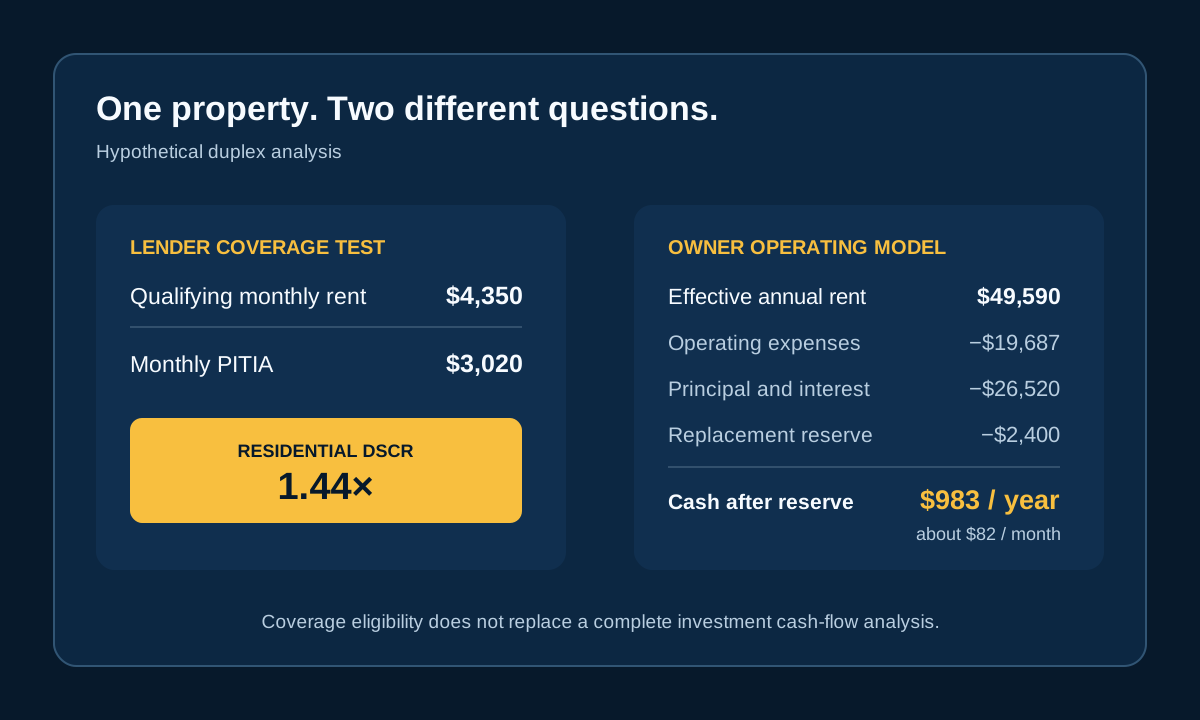
The residential DSCR of 1.44 does not deduct most property expenses. Using the same duplex, the annual owner model might be:
| Annual owner model | Amount |
|---|---|
| Scheduled rent: $4,350 × 12 | $52,200 |
| Vacancy and collection allowance: 5% | −$2,610 |
| Effective rental income | $49,590 |
| Property taxes | −$6,600 |
| Insurance | −$3,120 |
| Owner-paid utilities | −$1,200 |
| Repairs and routine maintenance | −$3,600 |
| Management: 8% of effective income | −$3,967 |
| Administration and leasing | −$1,200 |
| Net operating income before reserves | $29,903 |
| Principal and interest | −$26,520 |
| Replacement reserve | −$2,400 |
| Cash before income taxes and major capital work | $983 |
The loan ratio indicates that qualifying rent covers PITIA by 1.44 times. The owner model indicates only $983 a year, or about $82 a month, after the stated operating costs and reserve. Removing management would improve the spreadsheet but would also assign the work and execution risk to the owner. A complete investment decision needs both views.
Prepare the records that control the calculation
For a purchase, assemble the executed leases, proof of current rent when requested, unit occupancy, appraisal access, tax information, insurance quote and association statement. For a two-to-four-unit property, reconcile every unit rather than relying on one combined rent number. For a refinance, add payment history, current loan information and the operating records required by the program.
Vacancy and short-term rental deserve early discussion. A vacant unit may rely on appraiser-supported market rent under one program and receive different treatment under another. Short-term rental qualification can depend on trailing platform statements, property-management records, appraisal conclusions, seasonal adjustments or leverage limits. Do not assume that gross booking revenue is interchangeable with long-term monthly rent.
Finally, separate qualification from approval. Even when personal employment income is not used to calculate the ratio, the lender may still review credit, liquidity, experience, entity documents, title, insurance, condition, appraisal, sanctions and fraud indicators. “DSCR loan” describes the income-qualification approach; it does not remove the rest of underwriting.
Use three tests before proceeding
A sound 1–4 unit DSCR decision passes three distinct tests:
- Program test: the property, borrower and documentation meet the lender's current eligibility rules.
- Coverage test: qualifying rent supports the proposed PITIA at the required ratio and leverage.
- Investment test: verified rent less vacancy, operating costs, reserves and debt produces an acceptable return with enough liquidity for adverse changes.
Pause when the quote does not identify the rent rule, the tax or insurance figure is provisional, a unit's occupancy cannot be verified, the ratio depends on unsupported future rent, or the owner model works only after removing recurring expenses. The formula is simple; the reliability of its inputs is the real underwriting work.
References
1. Jakub Żerdzicki. House key and calculator for real estate. https://unsplash.com/photos/house-key-and-calculator-for-real-estate-RVk8EwpRwNs. Unsplash. Editorially cropped by Faundare Capital and used under the Unsplash License. Accessed October 3, 2026.
2. Consumer Financial Protection Bureau. 12 CFR § 1003.2(n), Definition of Multifamily Dwelling. Current electronic regulation. https://www.consumerfinance.gov/rules-policy/regulations/1003/2/. Accessed October 3, 2026.
3. Fannie Mae. Single-Family Comparable Rent Schedule, Form 1007. https://singlefamily.fanniemae.com/media/document/pdf/form-1007. Accessed October 3, 2026.
4. Fannie Mae. Small Residential Income Property Appraisal Report, Form 1025. https://singlefamily.fanniemae.com/media/document/pdf/form-1025. Accessed October 3, 2026.
Figure and table provenance. All property facts, loan assumptions, calculations, tables and the analytical graphic are hypothetical and were created by Faundare Capital for instruction. The opening photograph is cited in the references.