
This article concerns a one-to-four-unit residential property purchased and financed as a rental investment, including a detached rental house, duplex, triplex or fourplex. It does not describe an owner-occupied home purchase or a five-plus-unit multifamily or other commercial-property acquisition.
The down payment is only one part of the rental property's cash requirement. An investor may pay an earnest money deposit before closing, wire purchase equity and closing costs at settlement, fund renovation work before a lender reimburses it and still need liquidity after the transaction closes.
Those amounts answer different questions. Cash to close is the final amount due through the settlement agent. Total cash required for the plan includes cash already paid, near-term obligations outside settlement and funds that must remain available after closing. A transaction can close successfully and still be undercapitalized for its first repair, tax bill, vacancy or delayed draw.
The example follows a hypothetical $300,000 one-unit rental acquired for investment. It explains how loan sizing, credits, prepaid items, renovation funding and reserve requirements affect the amount the investor must control. The same framework can be adapted to a duplex, triplex or fourplex, but the actual income analysis, insurance, taxes and reserve requirement will differ. The example is instructional; it is not a Faundare Capital loan quote or a universal underwriting rule.
Start with a sources-and-uses schedule
A sources-and-uses schedule places every dollar of the transaction in one of two columns. Uses show where money goes. Sources show where it comes from. The totals must balance, but a balanced closing statement does not prove the investor has enough liquidity for obligations paid before or after closing.
For the purchase itself, the first calculation is:
Purchase equity = purchase price − loan proceeds applied to the purchase
Assume a $300,000 purchase and a $225,000 acquisition loan. The purchase equity is $75,000. If the investor already placed a $10,000 deposit that will be credited at closing, the remaining purchase equity due through settlement is $65,000.
The deposit did not disappear. It reduced the final wire because the investor funded part of the purchase earlier. Any estimate of “cash needed” that begins only with the closing wire understates the investor's contribution by $10,000.
| Purchase sources and uses | Amount |
|---|---|
| Purchase price | $300,000 |
| Loan proceeds applied to purchase | −$225,000 |
| Total purchase equity | $75,000 |
| Earnest money already paid and credited | −$10,000 |
| Remaining purchase equity due at closing | $65,000 |
The 75% ratio in this example is an input, not a quoted advance rate. A lender may size proceeds using loan-to-value, loan-to-cost, after-repair value, debt-service coverage, debt yield or several constraints at once. The smallest binding limit determines the available proceeds. A higher appraised value does not necessarily increase a loan if cost, cash flow or program limits bind first.
Loan type changes both documentation and cash needs
The same property can produce a different loan amount, closing schedule and reserve requirement under different programs. Identify the intended loan before treating a down-payment percentage as reliable.
| Loan path | What primarily supports repayment | Personal income and tax-return treatment | Effect on the cash plan |
|---|---|---|---|
| Conventional or traditional bank mortgage | Borrower income, debts, credit and assets, with eligible subject-property rent included under the program's rules | Tax returns and Schedule E are commonly used when existing rental income or self-employment income must be analyzed. They are not universal for every salaried borrower or every purchase. | May offer long-term fixed-rate financing, but debt-to-income, reserve and financed-property rules can reduce proceeds or require more liquidity. |
| Bank portfolio loan | The bank's own analysis, which may include global cash flow, property income, guarantor strength and the banking relationship | Banks often request personal and business tax returns, a personal financial statement, rent schedules and account statements. Requirements vary by institution. | Advance rate, amortization, recourse and reserve requirements can differ materially from conventional guidelines. |
| One-to-four-unit DSCR loan | The subject property's qualifying rent relative to principal, interest, taxes, insurance and applicable association dues | Personal income and employment generally are not used to calculate the ratio, and many DSCR programs do not require personal tax returns. The lender still underwrites credit, property, rent, liquidity, title, insurance and other risks.5 | A weak DSCR can reduce maximum proceeds even when the investor has strong personal income. The program may also require post-closing reserves. |
| Bridge, renovation or fix-to-rent loan | Purchase basis, current and after-repair value, scope and budget, borrower execution capacity and a credible exit | Documentation varies. A lender may not use tax returns to qualify income but can require a personal financial statement, bank statements, experience records and evidence supporting the refinance or sale exit. | Renovation proceeds may be held back and disbursed through draws, so the investor must model deposits, unreimbursed work, interest carry and completion liquidity. |
For conventional single-family underwriting, Fannie Mae's current guidance illustrates why the tax-return answer depends on the file. A purchase may use an appraisal rent schedule and an executed lease to document subject-property rent, while certain refinances and existing rental histories use Schedule E; self-employed income may require personal and business returns.4 A DSCR program instead tests the property's rent against its housing expense. “No tax returns” means the lender is not qualifying the loan from the investor's personal taxable income; it does not mean no documentation or no underwriting.
The distinction matters in this example. The assumed $225,000 loan produces $75,000 of purchase equity. If a program's income, DSCR, LTV or other limit reduces proceeds to $210,000, purchase equity rises to $90,000 before any closing cost or reserve changes. Compare programs using the proceeds actually supportable under each method, not a headline maximum leverage ratio.
Build closing costs from line items
Do not estimate closing costs as a percentage and stop. A percentage may help with early screening, but the final cash schedule should identify each cost, who pays it, when it is paid and whether it is financed, credited or paid outside closing.
The hypothetical transaction includes:
| Closing and prepaid item | Amount | Cash effect |
|---|---|---|
| Lender origination charge | $6,750 | Due at closing |
| Appraisal, inspection and property reports | $3,600 | Some may be paid before closing |
| Title, settlement and legal charges | $3,500 | Due at or before closing |
| Recording and transfer charges | $1,200 | Due at closing; allocation varies by location and contract |
| Prepaid interest | $3,200 | Covers the stated period between funding and the first payment cycle |
| Insurance premium and required initial funding | $2,400 | Timing depends on the policy and lender |
| Tax, insurance or other escrow funding | $4,800 | Initial balance, not a fee earned by the lender |
| Closing costs and prepaids | $25,450 |
Adding $25,450 to the $65,000 remaining purchase equity produces a $90,450 illustrative closing wire. The amount should be updated from actual settlement and lender documents as terms become firm.
Consumer mortgage disclosures provide a useful vocabulary: the Consumer Financial Protection Bureau distinguishes total closing costs from cash to close and describes cash to close as down payment plus closing costs, adjusted for deposits, credits and other items.2 A business-purpose DSCR, bridge or renovation loan secured by a one-to-four-unit rental may not use the same consumer forms. Investors should therefore use the settlement statement, lender term sheet and closing instructions actually issued for their transaction rather than assume a Loan Estimate or Closing Disclosure will be provided.
Separate credits from free money
A seller credit can reduce the amount wired at closing, subject to the purchase contract and lender's permitted uses. A lender credit can offset specified charges. Neither necessarily improves the transaction's economics.
The CFPB explains that lender credits commonly involve a higher interest rate, while seller credits may be reflected in the negotiated price.3 The relevant comparison is the full exchange: cash saved now, any change in price or rate, and the cost over the expected hold period.
Credits also may not satisfy every cash requirement. A lender may restrict them from funding the investor's required equity or post-closing reserves. Treat each credit as a designated source and match it to the uses it is actually allowed to pay.
Model renovation cash by timing, not commitment amount
A loan commitment can include renovation funds without making all of those funds available on the closing date. Many construction and renovation loans disburse eligible costs through construction draws after work is completed, documented and inspected. The investor may need to fund deposits, materials and completed work before reimbursement.
Assume the example includes a $60,000 renovation facility, but the first reimbursement occurs only after the investor completes and documents an initial scope. The contractor requires a $12,000 mobilization and material deposit. Another $8,000 of labor and materials will be paid before the first inspection, and the investor keeps $5,000 for noneligible items or timing differences. The near-term project cash need is therefore $25,000, even though the renovation amount is included in the total loan commitment.
| Early project cash | Amount |
|---|---|
| Contractor mobilization and materials deposit | $12,000 |
| Work paid before first verified draw | $8,000 |
| Noneligible costs and timing allowance | $5,000 |
| Near-term cash before first reimbursement | $25,000 |
This is a timing exposure, not necessarily a permanent equity use. Once an eligible draw is reimbursed, the same cash may fund later work. The schedule still needs to test the maximum unreimbursed balance, inspection time, retainage, documentation requirements and costs excluded from the facility.
A financed renovation budget does not eliminate the need for contingency or completion liquidity. Hidden conditions, price changes, material delays, rework and a longer draw cycle can increase the cash the investor must carry even when the approved loan amount remains unchanged.
Keep post-closing reserves outside the closing wire
Reserves are assets available after closing. They should not be counted twice as funds to close and as post-closing liquidity. Fannie Mae's current single-family guidance makes this sequencing explicit for applicable loans: funds to close are subtracted from available assets before reserve sufficiency is measured.6
Reserve methods still differ among one-to-four-unit investment-property programs. A long-term rental loan may express reserves as months of the qualifying property payment. A bridge or renovation loan may also consider completion liquidity, interest carry, construction contingency and the time required to stabilize or refinance the property. The investor's own operating reserve can exceed the lender's minimum.
For the hypothetical purchase, assume the investor decides that $27,000 must remain liquid after closing and after funding the first unreimbursed project work. That figure is a planning assumption based on the expected payment, operating costs, vacancy exposure and renovation timing. It is not presented as an industry-standard percentage.
Calculate total liquidity before calling the deal financeable
The four cash layers are now visible:
| Cash layer | Amount | When it must be available |
|---|---|---|
| Earnest money deposit | $10,000 | Before closing |
| Remaining purchase equity and closing items | $90,450 | At closing |
| Near-term project cash | $25,000 | After closing, before reimbursement |
| Liquidity retained | $27,000 | Remains available after the other uses |
| Total liquidity required for the plan | $152,450 |
The $90,450 settlement wire is accurate but incomplete. The investor must have controlled $10,000 earlier, expects to carry $25,000 before the first reimbursement and intends to retain $27,000. The complete cash plan therefore requires $152,450 of available liquidity across the transaction timeline.
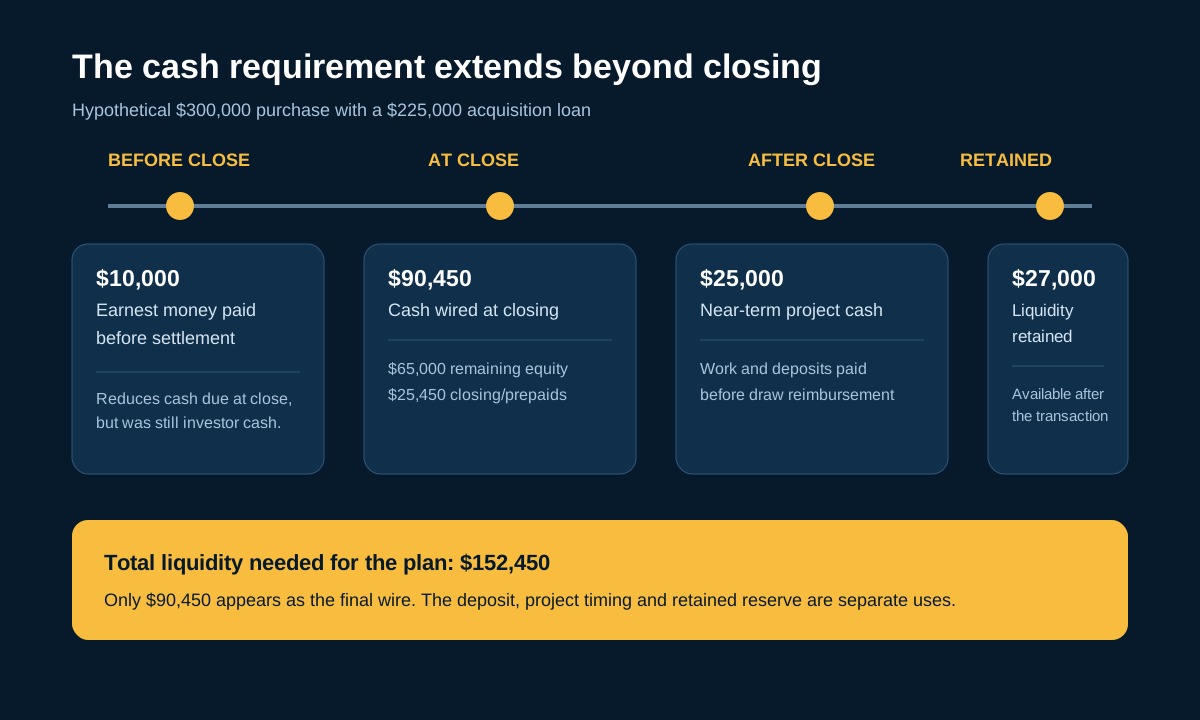
This total is not the same as permanent equity. Some near-term project cash may return through draws, and some retained liquidity may never be spent. The figure measures the capital the investor must be able to control so the plan does not fail between funding events.
Stress the dates that can move
Cash requirements change when the transaction or project changes. Test at least these conditions before removing a financing contingency or making a deposit nonrefundable:
- Loan proceeds fall. If the acquisition loan declines from $225,000 to $215,000, required purchase equity rises by $10,000.
- Closing costs increase. A rate extension, legal issue, new report or revised escrow can raise the final wire.
- A credit becomes ineligible. A negotiated credit may remain in the contract but cannot pay the intended use under the lender's rules.
- The first draw takes longer. One additional pay cycle can increase the maximum unreimbursed construction balance.
- The scope changes. Work discovered after closing can create both a permanent cost increase and a temporary funding need.
- Income starts later. Vacancy, licensing, repairs or tenant turnover can delay operating cash while debt service, taxes, insurance and utilities continue.
| Downside case | Change | Revised total liquidity need |
|---|---|---|
| Base plan | Stated assumptions | $152,450 |
| Lower acquisition proceeds | Loan is $10,000 smaller | $162,450 |
| Slower first draw | Additional $15,000 remains unreimbursed | $167,450 |
| Combined case | Both changes occur | $177,450 |
The combined case requires $25,000 more liquidity without changing the purchase price. An investor who budgeted only the base closing wire would discover the shortage after becoming legally and financially committed.
Reconcile the model to actual documents
Before closing, replace every estimate with the most current source:
- Use the executed purchase agreement for price, deposit, credits and prorations.
- Use the lender's final terms for loan proceeds, fees, reserves and disbursement conditions.
- Use the title or settlement statement for the amount due through closing.
- Use insurance binders, tax information and invoices for prepaid and escrow amounts.
- Use signed scopes, contractor payment schedules and draw rules for the peak unreimbursed project balance.
- Use bank and investment statements to verify the timing and availability of funds.
Preserve the estimate-to-final bridge. If the wire changes, identify the exact line rather than increasing a miscellaneous allowance. If a cost is paid outside closing, remove it from the wire without removing it from total cash required. If a deposit becomes nonrefundable, keep its amount and decision deadline visible.
The purchase is financeable only when the available sources cover every use at the time it comes due and leave the required liquidity intact. That conclusion depends on the complete capital timeline, not the down-payment percentage or the closing wire viewed alone.
References
1. Dillon Kydd. Detached brick house viewed from the street. Unsplash. https://unsplash.com/photos/3Ignkeds3w8. Free to use under the Unsplash License. Accessed October 8, 2026. Editorially cropped.
2. Consumer Financial Protection Bureau. Loan Estimate Explainer, “Calculating Cash to Close.” https://www.consumerfinance.gov/owning-a-home/loan-estimate/. Accessed October 8, 2026.
3. Consumer Financial Protection Bureau. Closing Disclosure Explainer and Is there such a thing as a no-cost or no-closing-cost loan or refinancing? Updated April 3, 2024. https://www.consumerfinance.gov/owning-a-home/closing-disclosure/ and https://www.consumerfinance.gov/ask-cfpb/is-there-such-a-thing-as-a-no-cost-or-no-closing-loan-or-refinancing-en-141/. Accessed October 8, 2026.
4. Fannie Mae. Selling Guide, B3-3.8-02, “Rental Income from the Subject Property,” published September 2, 2026; and B3-3.5-01, “Underwriting Factors and Documentation for a Self-Employed Borrower.” https://selling-guide.fanniemae.com/sel/b3-3.8-02/rental-income-subject-property and https://selling-guide.fanniemae.com/sel/b3-3.5-01/underwriting-factors-and-documentation-self-employed-borrower. Accessed October 8, 2026. These guidelines illustrate income documentation for eligible Fannie Mae loans; individual lender requirements can be more restrictive.
5. Faundare Capital. DSCR Rental Property Loans. Accessed October 11, 2026. Current program orientation describing eligible structures without personal income or tax-return verification; complete underwriting and documentation still apply.
6. Fannie Mae. Selling Guide, B3-4.1-01, “Minimum Reserve Requirements,” version published April 22, 2026. https://singlefamily.fanniemae.com/media/45516/display. Accessed October 8, 2026. This guidance applies to eligible Fannie Mae single-family loans; it is cited to explain the distinction between funds to close and assets remaining for reserves.
Figure and table provenance. The property, purchase, financing, closing, renovation, reserve and downside assumptions are hypothetical. All calculations, tables and the analytical graphic were created by Faundare Capital for instruction.
This article is educational and does not provide legal, tax, accounting, appraisal or lending advice. Actual costs, disclosures, reserve standards and loan requirements vary by lender, property, jurisdiction and transaction.