
A hard-money bridge loan can close a financing gap, but it does not eliminate the investor's cash requirement. The borrower may need acquisition equity, lender and third-party costs, funds for the property plan, monthly interest, operating carry, exit expenses and unrestricted liquidity. Those amounts occur at different times and cannot be replaced by one headline loan-to-value ratio.
This article concerns a business-purpose bridge loan secured by residential or commercial investment property. “Bridge” describes the temporary role of the debt: the loan carries the property through a defined transition before sale, refinance or another repayment event. “Hard money” generally describes a private, collateral-focused lending channel. Neither term establishes one universal fee, rate, leverage ratio or extension right.
The Office of the Comptroller of the Currency describes commercial bridge loans as short-term financing that can allow a newly constructed or acquired property to reach stabilization before sale or permanent financing. It also emphasizes that the income and value assumptions supporting that transition should be analyzed rather than presumed.2 This article applies the same discipline to the investor's cash plan. It does not address a consumer bridge loan secured by an owner-occupied home.
The worked example uses a hypothetical $1,200,000 purchase, a $660,000 bridge loan, a 12-month modeled hold and an 11% annual interest rate. The assumptions teach the method; they are not a Faundare Capital quote or a market benchmark.

Begin with the bridge and the repayment event
The cash model starts with the reason permanent financing is unavailable or unsuitable today. A bridge period may be needed to complete repairs, resolve title or documentation, lease vacant space, improve operating performance, season ownership or close before a longer-term lender can finish underwriting. Each reason produces a different schedule and a different set of cash uses.
State the bridge as one sentence with four facts:
- the property condition or transaction constraint that exists at closing;
- the work or evidence that must change;
- the sale, refinance or other event expected to repay the loan; and
- the date by which that repayment must occur.
For the example, an investor acquires a partially vacant mixed-use property for $1,200,000. The plan is to complete $75,000 of immediate repairs and leasing work, improve documented occupancy and refinance into longer-term debt within twelve months. The bridge loan is interest-only and has no construction holdback in this example, so the property-plan cash remains a borrower use.
The bridge loan amount is $660,000, equal to 55% loan-to-value using the $1,200,000 purchase price and supported current value:
$1,200,000 × 55% = $660,000
Faundare Capital's current bridge-program orientation identifies residential and commercial properties, loan sizes from $500,000 to $5 million, terms of 12 to 24 months and typical leverage of 50% to 60% LTV.4 Those ranges provide context, not approval or final proceeds. The lower of the supported value, cost basis, program limit and transaction-specific underwriting result may control.
Put the example's leverage and rate in market context
For preliminary screening, business-purpose private bridge loans are commonly discussed in a broad range of approximately 50% to 70% of current or as-is value. That is a market-orientation range, not a national average or an available amount. The binding limit may be lower, and a renovation facility may also apply purchase-cost, total-cost or after-repair-value constraints. Faundare Capital's current bridge-program orientation is narrower at 50% to 60% LTV, so the example's 55% LTV sits near the middle of that program range.
Recent transaction data place many private bridge coupons near 10%. The National Private Lenders Association's March 2026 sample market report found that nearly three-quarters of observed bridge loans carried rates from 9% to 12%, including 30% between 10% and 11%; median bridge points were 2.4%.5 The example's 11% annual interest rate is therefore a reasonable teaching input within that observed range. It is not a quote. Interest rate alone does not describe total financing cost: origination points, legal and appraisal charges, minimum-interest provisions, draw fees, extension fees, default interest and the actual payoff date can materially change the result.
Separate gross loan amount from net acquisition proceeds
The commitment is not the amount available to buy the property. The closing statement may deduct lender charges, prepaid interest, taxes, legal costs, title charges, escrows or other items from gross proceeds. A loan-funded reserve can also consume part of the commitment instead of increasing acquisition cash.
Begin with purchase equity:
Purchase equity = purchase price − loan proceeds applied to the purchase
| Purchase source or use | Amount |
|---|---|
| Purchase price | $1,200,000 |
| Bridge proceeds applied to purchase | −$660,000 |
| Total purchase equity | $540,000 |
| Deposit already paid and credited | −$60,000 |
| Remaining purchase equity due at closing | $480,000 |
The investor has not reduced total equity by paying the deposit. The deposit changes timing: $60,000 left the investor's account before closing, and $480,000 remains due at settlement.
The example assumes a lender fee equal to 2% of the $660,000 commitment, or $13,200, plus $18,000 of appraisal, environmental, title, legal, recording and settlement costs. Actual charges and payment timing depend on the property, jurisdiction and documents.
| Closing cash component | Amount |
|---|---|
| Remaining purchase equity | $480,000 |
| Lender fee, assumed at 2% of commitment | $13,200 |
| Other acquisition and closing costs | $18,000 |
| Illustrative closing wire | $511,200 |
The closing wire is accurate only for the stated structure. If the lender nets additional items from proceeds, the investor supplies the same amount through a larger wire unless another permitted source replaces it.
Put property-plan cash outside the acquisition column
The business plan begins after settlement. The investor must identify every required use that the loan does not fund and every financed use that must be advanced before reimbursement.
The example sets aside $75,000 for repairs, tenant-ready work, leasing costs and professional expenses. It is treated as borrower-funded cash because the modeled bridge facility applies entirely to the acquisition. If a real commitment includes future advances, the model must identify eligible costs, draw conditions, inspection timing, retainage and the maximum amount the borrower may have paid before reimbursement.
Do not label the entire $75,000 “contingency.” Known work belongs in the base plan. A contingency is a separate allowance for defined uncertainty, and unrestricted liquidity is different again. Combining all three conceals whether the project is underbudgeted or simply has a timing exposure.
The property plan should also identify income expected during the bridge period. The example assumes current collections offset most operating expenses but leave $3,000 per month of net property carry for taxes, insurance, utilities, security, maintenance and vacancy. Twelve months therefore require $36,000.
Model interest from the balance and the payment structure
At 11% annual interest on a constant $660,000 funded balance, monthly interest is:
$660,000 × 11% ÷ 12 = $6,050
Twelve months of modeled interest equals $72,600. The amount changes if the funded balance, rate, day-count convention or payoff date changes.
The same $72,600 can affect cash at different dates under three structures:
| Interest structure | Closing effect | Ongoing effect | Main modeling risk |
|---|---|---|---|
| Borrower pays monthly | No full-year interest deposit at closing | $6,050 must be available each month | The borrower spends cash faster than planned when the exit is delayed |
| Borrower-funded interest reserve | The required reserve is deposited or controlled at closing | Scheduled interest draws reduce the reserve | Restricted reserve cash may be unavailable for repairs or operations |
| Loan-funded interest reserve | The reserve is part of the facility or added to the debt, as documents permit | Interest advances increase funded principal or consume the reserve | Gross commitment can be mistaken for net purchase proceeds |
The OCC explains that an interest reserve may be funded through the loan budget or by the borrower in a separate account and that its adequacy depends on the period through completion, lease-up, sale or occupancy.2 A reserve does not prove the property can support the debt and should not be counted both as acquisition proceeds and as available interest cash.
This example uses monthly borrower-paid interest. The $72,600 is therefore a planned cash outflow across the hold, not part of the $511,200 closing wire.
Include operating carry and exit costs through payoff
Interest is only one time-dependent cost. The capital schedule must continue through the date loan payoff funds are actually available.
For the twelve-month base case:
| Bridge-period and exit use | Amount |
|---|---|
| Property-plan cash | $75,000 |
| Twelve months of interest | $72,600 |
| Twelve months of net operating carry | $36,000 |
| Refinance appraisal, legal, title and closing costs | $22,000 |
| Planned cash after the acquisition closing | $205,600 |
The $22,000 exit-cost estimate assumes a refinance. A sale model would instead include brokerage, transfer charges, legal costs, buyer credits and other disposition expenses. Only net proceeds after those costs and the complete bridge payoff are available to the investor.
The exit article develops the refinance and sale tests in detail. For this cash model, the central rule is narrower: do not end the forecast when the repair work finishes or the lease is signed. End it when the payoff arrives.
Retain liquidity after known uses
Known equity, costs and carry are expected to be spent. A liquidity reserve remains available for changes that the base schedule does not already include.
The example retains $66,000, equal to 10% of the modeled $660,000 loan. That amount is an investor planning assumption, not a universal lender requirement or a recommended percentage. Its adequacy depends on property condition, current income, repair certainty, insurance exposure, borrower resources and the reliability of the exit.
Do not count the same $66,000 as both a repair contingency and a maturity reserve. If $25,000 is assigned to probable physical work, only $41,000 remains for other uses. Restricted escrows, undrawn loan proceeds and funds committed to another property are not equivalent to unrestricted cash.
The complete base requirement is now visible:
| Cash layer | Amount | Timing |
|---|---|---|
| Deposit | $60,000 | Before closing |
| Remaining equity and closing costs | $511,200 | At closing |
| Property-plan cash | $75,000 | During repairs and leasing |
| Modeled bridge interest | $72,600 | Monthly through month 12 |
| Net operating carry | $36,000 | Monthly through month 12 |
| Refinance costs | $22,000 | At exit |
| Retained liquidity reserve | $66,000 | Remains available after known uses |
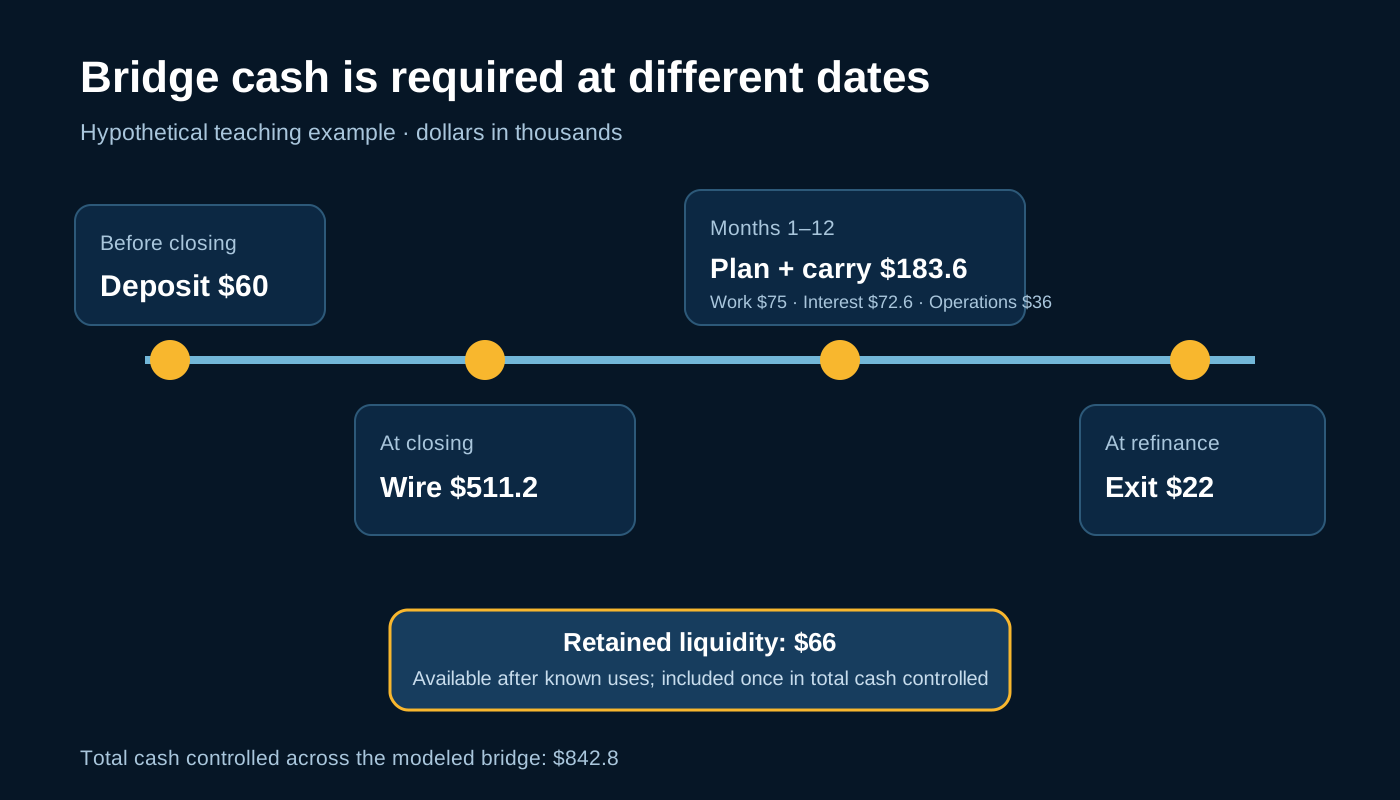
| Total cash controlled for the plan | $842,800 | Across the bridge timeline |
The investor does not wire $842,800 on closing day. The figure measures all borrower cash already paid, scheduled to be spent or intentionally retained through the modeled exit.
Test lower proceeds before relying on the base case
The modeled loan is not final until value, title, property eligibility, borrower capacity and all approval conditions are resolved. A lower loan amount increases equity, although a percentage-based lender fee may decline slightly.
Assume supported value falls to $1,100,000 while the lender retains the 55% LTV constraint. Maximum proceeds become $605,000:
$1,100,000 × 55% = $605,000
Purchase equity rises from $540,000 to $595,000, a $55,000 increase. The modeled 2% fee falls by $1,100 because it is applied to the smaller commitment. Net of that fee change, the plan needs $53,900 more cash, bringing total controlled cash to $896,700 before any other change.
This is why an investor should not use “55% down” as shorthand. The loan is 55% of supported value, while the purchase equity depends on the relationship among value, price and actual proceeds.
Price the extension without assuming it will be granted
An extension test measures whether the property and borrower can carry the loan beyond the original exit date. It does not create a contractual right to more time.
Assume a three-month delay adds:
- $18,150 of interest: $660,000 × 11% × 3 ÷ 12;
- a $6,600 extension fee, assumed at 1% of principal; and
- $9,000 of additional net operating carry.
The delay therefore consumes $33,750 before any new repair, leasing or refinance cost. If the investor uses the $66,000 liquidity reserve, only $32,250 remains. The extension may also require updated value, financial information, insurance, title, taxes, payment history, principal reduction or other conditions.
Federal banking agencies warn that liberal extensions or renewals can mask credit weakness when a borrower cannot meet reasonable repayment terms.3 The investor's model should treat an extension as a conditional downside case and preserve another repayment path. A maturity date is not an automatic option to continue the loan.
Combine the changes that can occur together
Single-variable tests can understate bridge risk because value, work and time often move together. The following cases use the same base model:
| Case | Change from base | Total cash controlled |
|---|---|---|
| Base | Stated assumptions | $842,800 |
| Lower supported value | Net cash increase of $53,900 | $896,700 |
| Additional property work | $25,000 beyond base plan | $867,800 |
| Three-month extension case | $33,750 of interest, fee and carry | $876,550 |
| Combined downside | All three changes | $955,450 |
The combined case requires $112,650 more than the base case. It does not assume the liquidity reserve is available twice. The $66,000 reserve is included once in total controlled cash and becomes the first source for unplanned uses; any downside beyond it requires additional verified capital.
Reconcile the model to the documents
Before the deposit becomes nonrefundable or the bridge closes, replace each teaching input with a current source:
- Use the purchase agreement for price, deposit, credits, deadlines and closing allocations.
- Use the appraisal and lender sizing worksheet for supported value and binding loan constraints.
- Use the term sheet, approval and loan documents for gross commitment, net acquisition proceeds, interest basis, fees, reserves, extension conditions and recourse.
- Use the settlement statement for the final wire and every cost paid outside closing.
- Use signed scopes, leases, operating statements, tax records, insurance binders and vendor schedules for property-plan cash and monthly carry.
- Use a refinance or sale schedule that reaches funded payoff before contractual maturity.
- Verify that unrestricted funds remain after every known use and are available on the date required.
The bridge is financeable only when the investor can fund the entire transition, including a credible delay, without treating conditional proceeds, restricted reserves or an unapproved extension as cash. If the final proceeds, work scope or exit timing changes, revise the capital timeline before relying on the original closing wire.
An investor with a defined property, requested amount, timing and repayment plan can then review Faundare Capital's hard-money bridge program or submit the transaction for review. Program availability and final terms remain subject to complete underwriting and approval.
References
1. Olek Buzunov. View of city buildings through a window frame, showing an unfinished brownstone interior. Unsplash. https://unsplash.com/photos/view-of-city-buildings-through-a-window-frame-c8-JPklbSYs. Free to use under the Unsplash License. Published January 13, 2026; accessed October 13, 2026. Editorially cropped.
2. Office of the Comptroller of the Currency. Comptroller's Handbook: Commercial Real Estate Lending, version 2.0, March 2022, including “Bridge Loans,” “Interest Reserves” and repayment-analysis discussions. https://www.occ.treas.gov/publications-and-resources/publications/comptrollers-handbook/files/commercial-real-estate-lending/pub-ch-commercial-real-estate.pdf. Accessed October 13, 2026. This supervisory guidance applies to national banks and federal savings associations; it is cited here to explain the underlying risk mechanisms, not private-lender program terms.
3. Board of Governors of the Federal Reserve System, Federal Deposit Insurance Corporation, National Credit Union Administration and Office of the Comptroller of the Currency. Policy Statement on Prudent Commercial Real Estate Loan Accommodations and Workouts, June 2023. https://www.federalreserve.gov/frrs/guidance/policy-statement-on-prudent-commercial-real-estate-loan-accommodations-and-workouts.htm. Accessed October 13, 2026.
4. Faundare Capital. Hard-Money Bridge Loan. Accessed October 13, 2026. Current program orientation; property, borrower, leverage, pricing, documentation and approval remain transaction-specific.
5. National Private Lenders Association. *Private Lending Market Report: Bridge & DSCR Loan Trends*, March 2026 sample report. Accessed October 14, 2026. The report describes observed private-lending transactions; it does not establish a rate available to a particular borrower or property.
Figure and table provenance. The property, purchase, financing, cost, interest, operating, reserve and downside assumptions are hypothetical. All calculations, tables and the analytical graphic were created by Faundare Capital for instruction.
This article is educational and does not provide legal, tax, accounting, appraisal or lending advice. Actual proceeds, costs, reserves, extension rights and loan requirements vary by lender, property, jurisdiction and transaction.