
A bridge loan finances a transition. Its repayment plan therefore cannot be a sentence such as “refinance later” or “sell when the work is done.” The exit must identify what will change, how that change will be verified, how much permanent debt or sale proceeds the property can support and how long the process can realistically take.
The example below is a hypothetical neighborhood retail property. Its rents, costs, financing and thresholds explain the analysis; they are not market forecasts or Faundare Capital program terms.
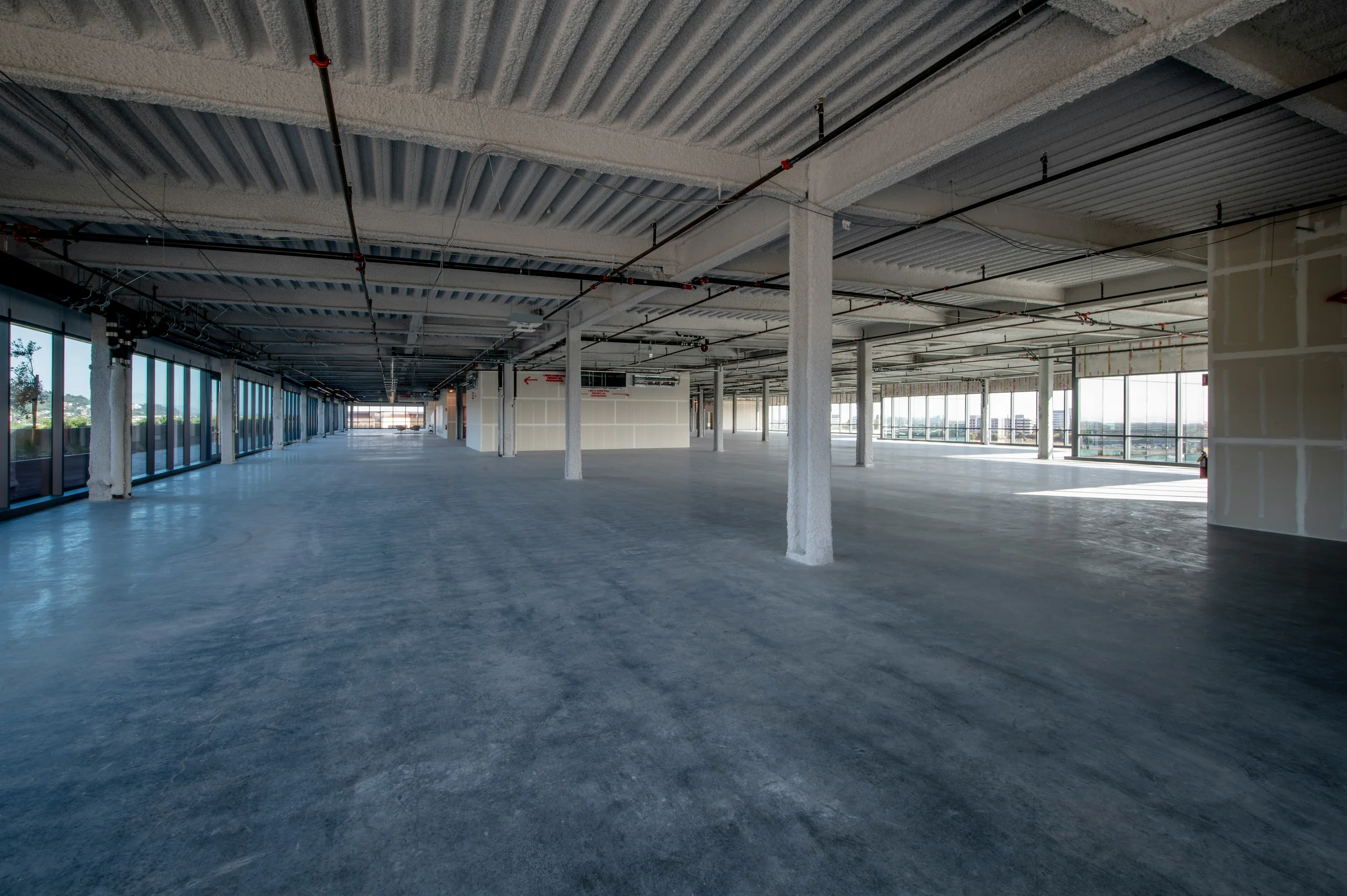
Define which bridge loan you mean
“Bridge loan” describes the temporary role of the debt, not one standardized product. The collateral, borrower, use of proceeds and repayment event determine what the loan actually does. Common real-estate uses include:
| Context | What the financing bridges | Typical repayment event |
|---|---|---|
| Consumer home-sale bridge or swing loan | Purchase of a new primary residence before the current residence is sold | Sale of the current home and permanent financing on the new home |
| Construction bridge | Construction period before long-term financing is available | Separate permanent loan after completion |
| Commercial real-estate transition loan | Acquisition, renovation, lease-up or another path to stabilized operations | Sale or permanent property financing |
| Business-purpose or hard-money bridge | A time-sensitive acquisition, improvement or resolution that conventional financing does not yet fit | Sale, refinance or another documented liquidity event |
These labels overlap, but they are not interchangeable. A home-sale bridge can place an owner-occupied residence at risk. A construction bridge depends on completion and conversion or takeout conditions. A commercial transition loan depends on property performance and permanent-loan proceeds. “Hard money” generally describes a private, collateral-focused lending channel; it does not by itself identify the exit or make every short-term loan a bridge loan.
Regulatory definitions also serve specific rules rather than creating one universal product category. The Consumer Financial Protection Bureau's Regulation C commentary treats a home-sale bridge and construction financing designed to be replaced by separate permanent financing as temporary financing, while explaining that a nine-month investor renovation-and-resale loan is not temporary financing under that rule merely because its term is short.2
Understand what the bridge period is buying
This article uses the commercial transition meaning. The Office of the Comptroller of the Currency describes a bridge loan in this context as short-term financing that can allow a newly constructed or acquired commercial property to reach stabilization before sale or permanent financing.3 The analysis below concerns a business-purpose retail-property loan. It does not describe a consumer loan secured by a primary residence or a construction-to-permanent structure.
The bridge term creates time; it does not itself create occupancy, income, value or a takeout loan.
Name the transition precisely. Examples include completing construction, curing deferred maintenance, leasing vacant space, resolving a title or documentation issue, seasoning operating history or waiting for a scheduled sale. Each transition has different evidence and failure modes.
The example property is purchased for $1.6 million with a $1.1 million interest-only bridge loan. It is 60% occupied and produces $80,000 of current annual NOI. The plan is to complete $180,000 of tenant and building work, lease the vacant space and refinance after NOI reaches $160,000.
Build the exit backward from the takeout
A takeout loan may be constrained by value, cash flow, property condition, borrower qualifications and the permanent lender's program. Model at least the value and coverage constraints.
Assume the stabilized property is evaluated at a 7.50% cap rate:
Stabilized value = $160,000 NOI ÷ 7.50% = $2,133,333
If a permanent lender allowed no more than 70% LTV, the value constraint would be approximately $1,493,000. Now test coverage. Assume a hypothetical permanent-loan annual mortgage constant of 9.26% and a 1.25× DSCR requirement:
Maximum annual debt service = $160,000 ÷ 1.25 = $128,000
Coverage-constrained loan = $128,000 ÷ 9.26% = approximately $1,382,000
Under those assumptions, coverage controls. A $1.382 million takeout could repay the $1.1 million bridge principal and leave $282,000 before refinance costs, unpaid interest, reserves and other closing uses. That cushion is meaningful only if the $160,000 NOI, cap rate and permanent terms are supportable when the refinance occurs.
Show how the property reaches stabilized income
The $80,000 increase in NOI needs an operating bridge:
| Change from current operations | Annual NOI effect | Evidence required |
|---|---|---|
| New lease in vacant storefront | +$105,000 | Executed lease, commencement and collection |
| Additional expense reimbursements | +$18,000 | Lease language and expense basis |
| Vacancy and collection allowance | −$10,000 | Stabilized occupancy assumption |
| Higher taxes and insurance | −$19,000 | Reassessment and current quote |
| Added management and maintenance | −$14,000 | Operating plan and contracts |
| Net improvement | +$80,000 | Reconciles to $160,000 NOI |
A signed lease may still include free rent, tenant-improvement obligations or a future commencement date. Stabilization should be defined by evidence—such as work completion, occupancy, rent commencement and collections—not simply by the month shown in the original business plan.
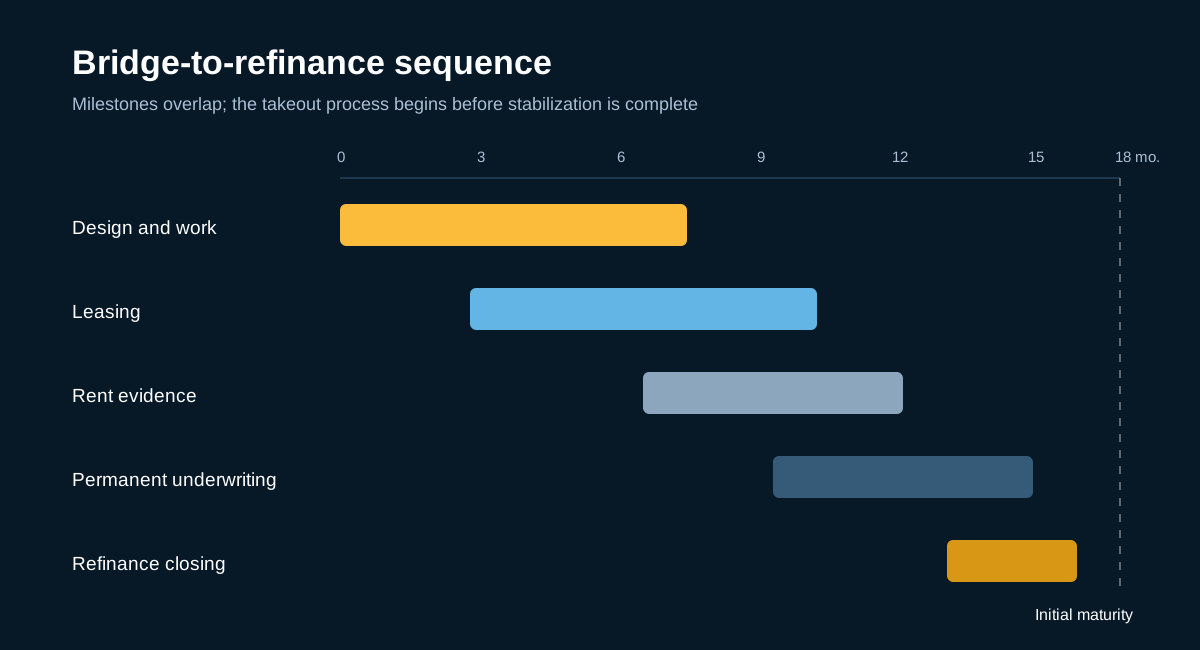
Map the work, leasing and refinance timeline
Assume an 18-month initial bridge term:
| Period | Planned milestone | Decision evidence |
|---|---|---|
| Months 0–2 | Design, permits and contractor mobilization | Approved scope, permits, executed contracts |
| Months 2–6 | Building and tenant improvements | Inspections, draws and updated cost to complete |
| Months 3–8 | Marketing and lease negotiation | Prospect activity, proposals and signed lease |
| Months 7–12 | Tenant opens and pays rent | Commencement certificate and collections |
| Months 10–14 | Permanent-loan underwriting | Trailing operations, appraisal and complete application |
| Months 14–17 | Conditions, documentation and closing | Final approval and scheduled payoff |
The timeline leaves roughly one month before maturity. That is not a comfortable reserve. A refinance can be delayed by appraisal, lease documentation, title, insurance, environmental review, borrower conditions or the permanent lender's closing capacity. If the bridge extension is conditional rather than automatic, it should not be treated as guaranteed time.
Stress the takeout before accepting the bridge
Test income, valuation and permanent financing together:
| Exit case | NOI | Cap rate | Value | 70% LTV limit | Coverage limit | Controlling proceeds |
|---|---|---|---|---|---|---|
| Base stabilization | $160,000 | 7.50% | $2,133,333 | $1,493,333 | $1,382,289 | $1,382,289 |
| Lower NOI | $140,000 | 7.50% | $1,866,667 | $1,306,667 | $1,209,503 | $1,209,503 |
| Lower NOI and higher cap rate | $130,000 | 8.25% | $1,575,758 | $1,103,030 | $1,123,110 | $1,103,030 |
The combined downside produces only about $3,000 above the bridge principal before refinance costs and other payoff items. It is not a viable refinance cushion. The analysis reveals the failure boundary: if NOI reaches only $130,000 while market pricing weakens, the planned takeout may not fully repay the bridge.
Keep sale and refinance exits separate
A sale can be a legitimate secondary exit, but it has different deductions and timing. Gross value is not payoff cash. Deduct brokerage, transfer, legal and closing costs; tenant obligations; unpaid project costs; debt payoff; accrued interest; extension or exit charges; and any taxes applicable to the investor.
The sale case also needs a marketing period and buyer diligence period. Listing the property at month fifteen of an eighteen-month loan does not establish that sale proceeds will arrive before maturity. If the property is unfinished or the lease-up assumptions are unproven, the sale price may resemble the stressed case rather than the stabilized case.
Fund the bridge period, including delay
At an illustrative 11.50% interest-only rate, annual interest on $1.1 million is $126,500, or about $10,542 per month before other loan charges. Six additional months would add approximately $63,250 of interest, plus operating shortfalls and extension costs.
Build a monthly sources-and-uses schedule for:
- purchase equity and closing costs;
- project work and amounts awaiting draw reimbursement;
- interest, taxes, insurance and utilities;
- tenant improvements, commissions and free rent;
- refinance deposits and third-party reports; and
- a delay reserve that is not already committed to construction.
An interest reserve can fund some scheduled interest if the approved loan includes it, but it is part of the capital structure rather than free protection. Using the reserve faster than planned reduces remaining time.
Establish go, repair or stop rules
The FDIC identifies renewals, extensions and refinancings without credible support for full repayment as a warning sign in commercial real-estate review.4 An investor should set decision points before that problem reaches maturity.
For the example, review the exit when construction cost rises, leasing misses a milestone, the signed rent or concessions weaken NOI, permanent rates change the mortgage constant, or the appraisal supports a lower value. State the response: contribute additional equity, reduce scope, pursue a sale, obtain alternate financing or stop funding optional work.
A credible bridge exit is a dated, evidence-based capital plan. It shows the operational change, the value and coverage tests, the amount needed to repay, the closing lead time and the downside case. “Refinance later” is the conclusion only after those parts reconcile.
References
1. Getty Images. Empty, unimproved, raw office space. Published August 4, 2025. https://unsplash.com/photos/empty-unimproved-raw-office-space-Jx0p9Dq4f3U. Unsplash+. Used under the Unsplash+ License. Accessed October 3, 2026. Editorially resized and compressed for web delivery.
2. Consumer Financial Protection Bureau. Regulation C, § 1003.3(c)(3), Official Interpretation of Temporary Financing. https://www.consumerfinance.gov/rules-policy/regulations/1003/3/. Accessed October 3, 2026.
3. Office of the Comptroller of the Currency. Comptroller's Handbook: Commercial Real Estate Lending, Version 2.0. March 2022; reputation-risk references revised March 20, 2025. https://www.occ.treas.gov/publications-and-resources/publications/comptrollers-handbook/files/commercial-real-estate-lending/pub-ch-commercial-real-estate.pdf. Accessed October 3, 2026.
4. Federal Deposit Insurance Corporation. Risk Management Manual of Examination Policies: Commercial Real Estate Lending—Commercial Real Estate Loan Review. May 2024. https://www.fdic.gov/risk-management-manual-examination-policies/commercial-real-estate-lending. Accessed October 3, 2026.
Figure and table provenance. The property, lease-up, financing, refinance assumptions, calculations, tables and timeline are hypothetical and were created by Faundare Capital for instruction. The opening photograph is cited in the references.