
A debt-service coverage ratio can help size a rental-property loan, but it cannot tell an investor whether the acquisition will produce acceptable cash flow. A useful pre-offer analysis keeps the lender's coverage test, the property's operating statement and the investor's cash requirements connected without treating them as the same calculation.
The example below is hypothetical. Its rents, costs, loan structure and thresholds illustrate a method; they are not market observations, approval criteria or Faundare Capital program terms.

First, identify which DSCR framework applies
Debt-service coverage ratio (DSCR) compares a defined measure of property income with a defined debt obligation. The name is shared across residential investment and multifamily lending, but the calculation is not. Federal Regulation C defines a multifamily dwelling as one containing five or more units, which helps explain the common underwriting boundary between one-to-four-unit residential investment programs and five-plus-unit multifamily programs.2 A lender's current program guide still controls the actual calculation and eligibility rules.
| Underwriting question | 1–4 unit residential investment program | Multifamily program, generally 5+ units |
|---|---|---|
| Common income measure | Qualifying gross monthly rent under the program's lease and appraisal rules | Underwritten annual net cash flow after vacancy, operating expenses and required reserves |
| Common debt measure | Monthly principal, interest, taxes, insurance and association dues, often called PITIA | Annualized debt service, usually principal and interest plus any other debt payments required by the program |
| Expense treatment | Taxes, insurance and association dues generally appear in PITIA; most other operating expenses are not itemized in the ratio | Property operating expenses are underwritten before net cash flow is divided by debt service |
| Primary records | Lease, appraisal rent schedule, tax and insurance figures, association dues and proposed loan payment | Rent roll, leases, trailing operating statements, budget, expense support, replacement-reserve assumptions and proposed debt terms |
One-to-four-unit DSCR programs commonly compare qualifying rent with PITIA, but “DSCR loan” does not identify one universal rent rule. A program may use in-place rent, appraiser-supported market rent, the lower of the two or another documented convention. Vacancy, short-term-rental history, appraisal forms and subordinate debt can also receive different treatment.
Institutional multifamily underwriting starts elsewhere. Fannie Mae defines multifamily DSCR as underwritten net cash flow divided by annualized debt service; its guidance deducts operating expenses and required replacement reserves before calculating coverage.3 A multifamily DSCR therefore should not be compared directly with a residential rent-to-PITIA ratio as if the two numerators represented the same cash flow.
This article uses a four-unit property and therefore shows a residential investment-program ratio alongside a complete owner operating model. The companion guide, How 1–4 Unit DSCR Loans Work, explains the residential calculation, documents and loan-sizing effects in detail. Before relying on any quoted ratio, write down the numerator, denominator, period and source for every input.
Reconstruct the rent before using it
Consider a four-unit property offered for $620,000. The current monthly rent schedule is:
| Unit | Contract rent | Lease status | Collection issue |
|---|---|---|---|
| 1 | $1,850 | 8 months remaining | None identified |
| 2 | $1,800 | Month to month | Paid late twice in six months |
| 3 | $1,750 | 5 months remaining | $600 receivable |
| 4 | — | Vacant | Seller projects $1,950 |
| Total occupied contract rent | $5,400 | 3 occupied units | Before collections adjustment |
| Seller's fully occupied projection | $7,350 | Includes proposed Unit 4 rent | Not current income |
The seller's projection is not a single fact. Three rents are supported by leases, one unit is vacant, one tenant has an outstanding balance and the month-to-month tenancy can reprice or leave. Review the rent roll, leases and collections together rather than carrying $7,350 directly into the loan or investment model.
Assume comparable evidence supports $1,850 for Unit 4 after $4,000 of turnover work. A reasonable base rent schedule is then $7,250 per month when occupied. The $100 difference from the seller's projection equals $1,200 a year before vacancy and collection effects.
Separate the residential lender ratio from property cash flow
Assume solely for illustration that the proposed loan equals $465,000, or 75% of the $620,000 price, with an 8.00% fixed rate and 30-year amortization. The lender's written guide accepts $7,250 of qualifying monthly rent. With no association dues, the monthly obligation is:
| Residential lender calculation | Monthly amount |
|---|---|
| Principal and interest | $3,412 |
| Property taxes: $12,400 ÷ 12 | $1,033 |
| Property insurance: $6,200 ÷ 12 | $517 |
| PITIA | $4,962 |
Illustrative 1–4 unit lender DSCR = $7,250 ÷ $4,962 PITIA = 1.46
This is a financing-qualification ratio under the stated assumptions. Another lender could select a different qualifying rent from the leases and appraisal, apply a program-specific adjustment or include another required payment. The calculation also does not prove that the owner retains the difference between rent and PITIA. Gross rent has not yet paid utilities, repairs, management, leasing costs, vacancy or capital replacements.
Build the owner's annual statement independently:
| Annual operating model | Amount |
|---|---|
| Scheduled rent: $7,250 × 12 | $87,000 |
| Vacancy and collection allowance: 5% | −$4,350 |
| Effective rental income | $82,650 |
| Property taxes | −$12,400 |
| Insurance | −$6,200 |
| Owner-paid water and common electricity | −$4,200 |
| Repairs and routine maintenance | −$7,800 |
| Management: 7% of effective income | −$5,786 |
| Administration and leasing | −$2,400 |
| Net operating income before reserves | $43,864 |
| Replacement reserve | −$4,000 |
| Annual principal and interest: $3,412 × 12 | −$40,944 |
| Cash before income taxes and major capital work | −$1,080 |
The illustrative residential lender ratio is 1.46, yet the detailed model shows slightly negative cash after a replacement reserve. The difference is not a contradiction. The ratio uses qualifying gross rent and PITIA; the owner model recognizes the property's broader operating burden. Net operating income (NOI) already deducts property taxes and insurance, so the cash bridge subtracts only principal and interest after NOI. Subtracting the full PITIA again would count taxes and insurance twice. Reserve treatment also varies by analytical convention. Preserve both calculations and label them rather than calling either one “the property's cash flow.”
Price the work that rent does not reveal
A rent schedule says little about the roof, drainage, mechanical systems or deferred maintenance. Assume inspection identifies the $4,000 vacant-unit turnover, a $14,000 near-term exterior repair and a likely $18,000 roof replacement within three years. These items affect cash even if the lender's initial ratio does not deduct them in full.
The acquisition cash schedule should therefore include:
- down payment and closing costs;
- the vacant-unit turnover before its rent begins;
- immediate repairs required for safety, habitability or insurance;
- reserves for known later replacements;
- temporary debt service while the vacant unit is completed and leased; and
- liquidity for collection shortfalls or an additional vacancy.
Do not solve weak economics by classifying predictable work as “unexpected.” A reserve is cash planning, not an operating expense label that makes the underlying need disappear.
Test changes in rent, expenses and debt service
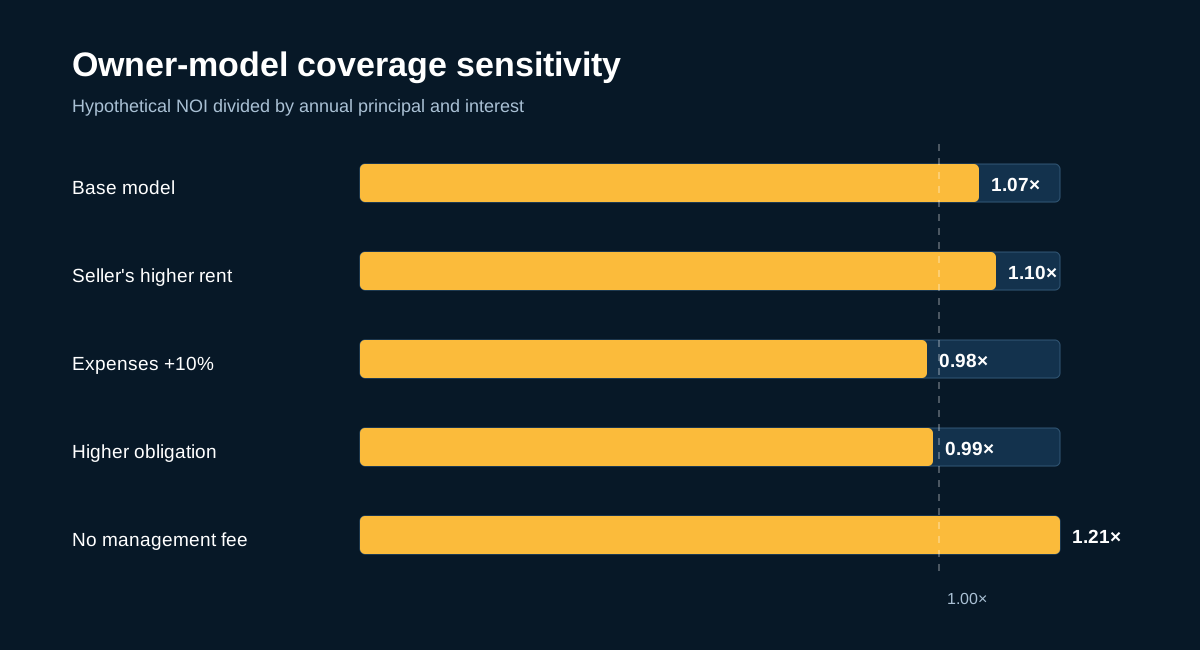
The base case is already thin, so modest changes matter. The following scenarios retain the same annual principal-and-interest debt service unless stated otherwise. “NOI ÷ P&I” is an investor-model coverage measure for this comparison; it is not the lender's 1.46 residential rent-to-PITIA ratio.
| Scenario | NOI before reserves | Annual P&I debt service | NOI ÷ P&I | Cash after $4,000 reserve |
|---|---|---|---|---|
| Base model | $43,864 | $40,944 | 1.07× | −$1,080 |
| Full occupancy, seller's $1,950 Unit 4 rent | $44,925 | $40,944 | 1.10× | −$19 |
| Expenses 10% above base | $39,985 | $40,944 | 0.98× | −$4,959 |
| P&I payment rises to $3,700 monthly | $43,864 | $44,400 | 0.99× | −$4,536 |
| No management fee charged | $49,650 | $40,944 | 1.21× | $4,706 |
The last row shows why removing management from a spreadsheet can be misleading. If the owner performs the work, the property may avoid a third-party invoice, but the investor has accepted a recurring job and concentration of operating risk. The decision should price that commitment rather than erase it.
Decide the purchase price from supported cash flow
The ratio should lead back to the price. At $620,000, the base NOI implies a capitalization rate of 7.1% before reserves. That percentage does not establish market value; it only relates the modeled income to the asking price. If verified taxes or insurance increase, NOI and the implied return fall immediately.
The proposed loan also leaves substantial acquisition cash outside the lender ratio:
| Illustrative acquisition cash | Amount |
|---|---|
| Down payment: $620,000 − $465,000 | $155,000 |
| Closing and diligence allowance: 3% of price | $18,600 |
| Vacant-unit turnover | $4,000 |
| Near-term exterior repair | $14,000 |
| Designated roof reserve | $18,000 |
| Initial and designated cash | $209,600 |
Annual cash of negative $1,080 on $209,600 of initial and designated cash is approximately −0.5% cash-on-cash return under these assumptions. That result is an analytical output, not a recommended return threshold. Each investor must define the minimum return, liquidity and downside protection required for the risk and work involved.
The break-even price is also only a boundary, not a recommendation. With base NOI of $43,864 and a $4,000 reserve, annual principal and interest cannot exceed $39,864 if the property is to avoid a modeled cash deficit. At 8.00% with 30-year amortization, that payment supports a loan of approximately $452,700. If the loan remains 75% of price and every other assumption stays fixed, the corresponding price is about $603,600. A positive target return would require a lower price or better supported economics; taxes, insurance, closing costs and repair needs may also change with the transaction.
A defensible offer analysis answers four separate questions:
- What rent is supported today, and what cost and time are required to reach any higher rent?
- What recurring operating costs will the buyer actually incur?
- What loan amount and monthly obligation are supportable under the lender's stated method?
- After acquisition cash, reserves and debt service, does the expected return compensate for the property's risks and the investor's work?
For this example, the current price and assumed obligation do not produce positive reserve-adjusted cash flow. A lower purchase price, more favorable financing, supportable additional income or a different operating plan could change the result. Raising projected rent without evidence does not.
Reject or pause the analysis when leases and collections do not reconcile, material repairs remain unpriced, taxes or insurance rely on the seller's historic bill without checking the buyer's likely cost, or the loan only works at the most favorable rent and interest assumptions. The purpose of DSCR analysis is to expose those dependencies before the investor becomes committed.
References
1. Madeline Liu. Apartment building with many balconies and windows. https://unsplash.com/photos/apartment-building-with-many-balconies-and-windows-YG1U8xo_UxQ. Unsplash. Used under the Unsplash License. Accessed October 3, 2026.
2. Consumer Financial Protection Bureau. 12 CFR § 1003.2(n), Definition of Multifamily Dwelling. Current electronic regulation. https://www.consumerfinance.gov/rules-policy/regulations/1003/2/. Accessed October 3, 2026.
3. Fannie Mae. Multifamily Selling and Servicing Guide, Section 203.01: Underwritten Net Cash Flow and Section 203.02: Underwritten DSCR. https://mfguide.fanniemae.com/node/7526. Accessed October 3, 2026.
Figure and table provenance. All property facts, loan assumptions, calculations, tables and the analytical graphic are hypothetical and were created by Faundare Capital for instruction. The opening photograph is cited in the references.