
A small apartment property may look easier to understand than a large complex: fewer units, a shorter rent roll and a purchase price that often attracts individual investors. The analytical burden is still commercial. Once a property generally reaches five units, lenders and buyers usually evaluate the income that remains after vacancy and operating expenses rather than using the residential rent-to-PITIA calculation common to one-to-four-unit DSCR programs.
The acquisition decision therefore depends on four connected records: the leases establish contractual rent, collections show what was actually received, the operating statement shows what it cost to produce that income, and the physical inspection identifies cash needs that the income statement may not reveal. If one record is weak, a calculated return can be precise without being reliable.
This article develops a hypothetical 12-unit acquisition from those records. The figures illustrate a method, not a market forecast, appraisal, lending standard or Faundare Capital program term.
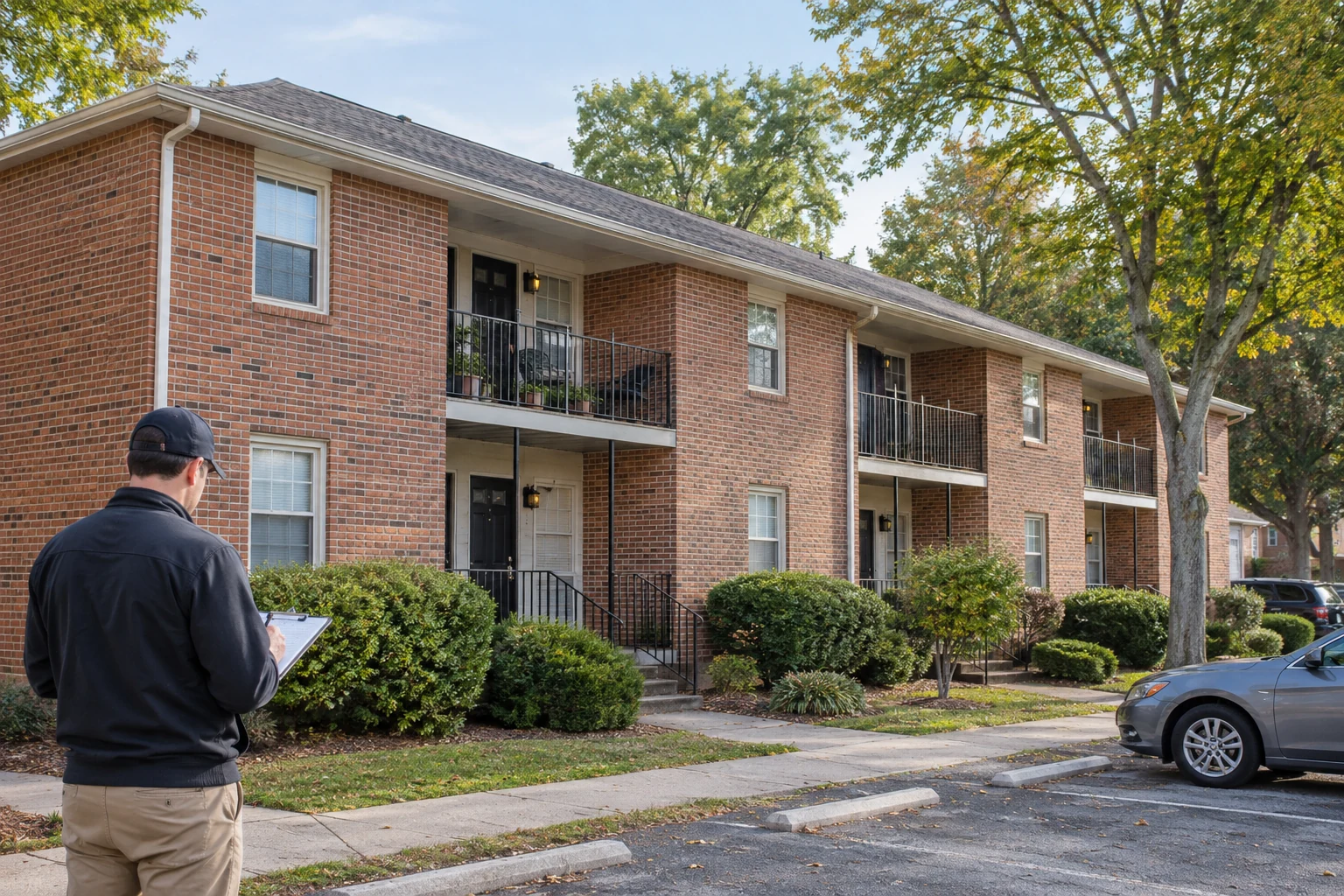
Understand what changes at five or more units
“Small multifamily” has no single boundary across every lender or market. Freddie Mac research has used five to 50 units to describe the segment, while individual financing programs may define eligibility by unit count, loan size, geography and property condition.2 The important analytical boundary is the move from a residential rental calculation to property-level commercial underwriting.
For a one-to-four-unit DSCR loan, a lender may divide qualifying monthly rent by PITIA. For a five-plus-unit apartment property, underwriting more commonly begins with annual income, deducts vacancy and recurring operating expenses, and evaluates the resulting cash flow against annual debt service. The companion article How to Analyze a DSCR Rental Property Before You Buy compares the two frameworks directly.
That distinction changes the investor's work. A quoted rent premium does not become value until the analyst verifies the units that can earn it, the time and capital required to reach it, and the expenses that accompany the higher income. A low expense ratio is not automatically efficient operation; it may reflect deferred repairs, owner-performed labor or omitted costs.
Rebuild the rent roll from unit-level evidence
Assume a 12-unit property is offered for $1,400,000. The seller's summary advertises $16,150 of potential monthly rent. The leases and current rent roll show a different starting point:
| Unit group | Units | Monthly rent per unit | Current monthly rent | Condition or lease issue |
|---|---|---|---|---|
| Renovated units | 6 | $1,350 | $8,100 | Leases expire across the next 10 months |
| Standard units | 3 | $1,250 | $3,750 | Comparable condition; no renovation premium |
| Recent renewals | 2 | $1,375 | $2,750 | One tenant has paid late twice |
| Vacant unit | 1 | — | — | Seller projects $1,550 after turnover |
| Occupied contract rent | 11 | $14,600 | Before collection adjustments |
Market evidence supports $1,400, rather than $1,550, for the vacant unit after $9,000 of turnover work. The supported fully occupied schedule is therefore $16,000 a month, or $192,000 a year. The seller's $16,150 projection assumes both a higher vacant-unit rent and successful execution; it should remain an upside case until evidence supports it.
The rent review should also reconcile:
- each tenant, unit, lease term, deposit and concession;
- billed rent to bank deposits or property-management collections;
- delinquency, write-offs and payment plans;
- month-to-month tenancies and near-term expirations;
- utility responsibilities and reimbursements; and
- vacant-unit condition, turnover scope and achievable lease date.
A current lease proves an obligation, not collection. A deposit proves cash received, not necessarily recurring rent. The two records should be tested together before either becomes an underwriting input.
Build effective income without treating occupancy as certainty
Use the supported $16,000 monthly schedule as gross potential rent, then make vacancy and collection loss explicit. Other income should be supported separately rather than hidden inside rent.
| Annual income model | Amount |
|---|---|
| Supported scheduled rent: $16,000 × 12 | $192,000 |
| Vacancy and collection allowance: 6% of scheduled rent | −$11,520 |
| Parking and laundry income | $9,600 |
| Effective gross income | $190,080 |
The 6% allowance is a hypothetical input, not a market benchmark. Its support should come from the property's history, current delinquency and turnover, competing supply, lease-expiration schedule and local demand. If a property is currently 100% occupied but routinely loses one month between tenants, a zero-vacancy model would still overstate durable income.
The same discipline applies to parking, laundry, pet fees and reimbursements. Verify the number of rentable spaces or machines, the actual charge, collections and operating cost. A seller's “other income” line can combine recurring revenue with application fees, forfeited deposits or one-time receipts that should not be capitalized as though they repeat every year.
Normalize the operating statement before accepting NOI
The seller's trailing statement is evidence, not the finished forecast. Recast every line to the buyer's expected ownership period and compare it with invoices, contracts, tax records, insurance indications and utility history.
| Annual operating model | Amount |
|---|---|
| Effective gross income | $190,080 |
| Property taxes | −$28,000 |
| Insurance | −$18,000 |
| Owner-paid water and common electricity | −$13,200 |
| Repairs and routine maintenance | −$12,000 |
| Management: 7% of effective gross income | −$13,306 |
| Payroll, landscaping and grounds | −$8,400 |
| Administration, legal and accounting | −$4,800 |
| Net operating income before replacement reserve | $92,374 |
| Replacement reserve | −$6,000 |
| Underwritten cash flow before debt service | $86,374 |
Net operating income excludes financing costs, depreciation, income taxes and major capital expenditures. A replacement reserve is shown below NOI here so the reader can see both the conventional property measure and the cash retained for recurring capital replacements. Lenders and investors may position or size reserves differently, so the label and calculation must remain visible.
Management deserves an expense even when the buyer plans to self-manage. Removing the fee does not make the work disappear; it converts a property cost into the investor's uncompensated labor and concentrates operating risk. Likewise, a historic insurance premium or tax bill may not represent the buyer's post-closing cost. Obtain current indications and examine reassessment rules rather than applying a flat growth rate to the seller's bill.
Separate recurring operations from capital work
The operating statement does not capture every use of cash. The property inspection, unit walk, service records and specialist reports identify work whose timing may determine whether the acquisition can perform.
Assume diligence identifies:
| Capital item | Timing | Amount | Treatment in the acquisition model |
|---|---|---|---|
| Vacant-unit turnover | Before lease-up | $9,000 | Immediate acquisition cash |
| Plumbing repair and isolation valves | First 90 days | $30,000 | Immediate capital work |
| Roof replacement | Within two years | $45,000 | Designated capital reserve |
| Parking-lot repair and drainage correction | Within two years | $18,000 | Designated capital reserve |
| Identified capital need | $102,000 | Separate from annual operating expenses |
Classifying the roof as capital rather than repair may be correct accounting, but it does not reduce the cash required. The investor must decide whether the price, financing or seller credit recognizes the obligation and whether the work can occur without disrupting occupancy.
The $6,000 annual replacement reserve in the operating model covers recurring wear and future replacements that are not assigned to a known project. The separate roof and parking reserves fund work already identified during diligence. Keeping those uses distinct prevents the analyst from omitting known capital needs or counting the same project twice.
Environmental and legal diligence also remain property-specific. EPA describes All Appropriate Inquiries as the pre-acquisition process for evaluating environmental conditions and potential liability; a compliant Phase I process includes historical sources, government records, visual inspection and other inquiries.3 Zoning, certificates of occupancy, building-code history, title, survey, access, utilities and local rental requirements should be reviewed by the appropriate professionals. Twelve physical units do not establish that all twelve are legally authorized or financeable.
Translate income into value and supportable debt
At the $1,400,000 asking price, $92,374 of NOI implies a 6.60% capitalization rate before reserves. That observation does not establish value. It shows the relationship between the modeled income and price so the analyst can compare the acquisition with market evidence and required returns.
Assume an appraiser or investor supports a 6.75% capitalization rate for the property's location, condition and income durability. The income indication is:
$92,374 NOI ÷ 6.75% = approximately $1,369,000
The $31,000 difference from the asking price is small relative to the transaction, but the direction matters: the buyer would be paying above the value produced by the base income assumptions before funding identified capital work.
Debt must be tested separately. Assume a proposed 7.25% fixed rate, 25-year amortization and a required debt-service coverage ratio of 1.25. Fannie Mae's multifamily guidance defines underwritten DSCR as underwritten net cash flow divided by annualized debt service and deducts required replacement reserves in its underwritten cash-flow framework.4 Individual lenders may calculate income, reserves and debt service differently; their current written terms control the actual loan.
Using $86,374 of cash flow before debt service:
| Loan-sizing test | Calculation | Result |
|---|---|---|
| Maximum annual debt service at 1.25 DSCR | $86,374 ÷ 1.25 | $69,099 |
| Approximate loan supported at 7.25%, 25 years | Payment-sized from $69,099 annual debt service | $797,000 |
| Annual debt service on $797,000 | 12 × approximately $5,761 | $69,129 |
| Resulting DSCR | $86,374 ÷ $69,129 | 1.25× |
| 70% loan-to-value limit on $1,369,000 value | $1,369,000 × 70% | $958,000 |
The lower constraint governs this illustration: income supports about $797,000 even though a 70% LTV test would permit more. An investor who models only leverage may therefore overestimate proceeds by roughly $161,000.
Measure the equity burden and stress the assumptions
The supported loan leaves a large cash requirement:
| Initial and designated cash | Amount |
|---|---|
| Purchase equity: $1,400,000 − $797,000 | $603,000 |
| Closing, financing and diligence allowance: 2.5% of price | $35,000 |
| Vacant-unit turnover | $9,000 |
| Immediate plumbing work | $30,000 |
| Roof reserve | $45,000 |
| Parking and drainage reserve | $18,000 |
| Operating liquidity | $50,000 |
| Initial and designated cash | $790,000 |
The base case produces approximately $17,245 after replacement reserve and annual debt service. Dividing that cash flow by the full $790,000 of initial and designated cash produces a 2.2% return on total committed cash before income taxes and unplanned capital work. Some investors calculate cash-on-cash return using only acquisition equity and immediate closing cash, excluding liquidity or reserves held for later work; that narrower denominator would produce a different percentage. This article uses the broader denominator because the buyer must still control those funds to execute the stated plan.
The acquisition should then be tested under changes that can occur together:
| Scenario | NOI before reserve | DSCR | Cash after reserve and debt service |
|---|---|---|---|
| Base case | $92,374 | 1.25× | $17,245 |
| Supported rents rise 5% | $100,766 | 1.37× | $25,637 |
| Vacancy and collection loss reaches 10% | $85,232 | 1.15× | $10,102 |
| Operating expenses run 10% above base | $82,603 | 1.11× | $7,474 |
| Rate is 8.25% on the same $797,000 loan | $92,374 | 1.15× | $10,967 |
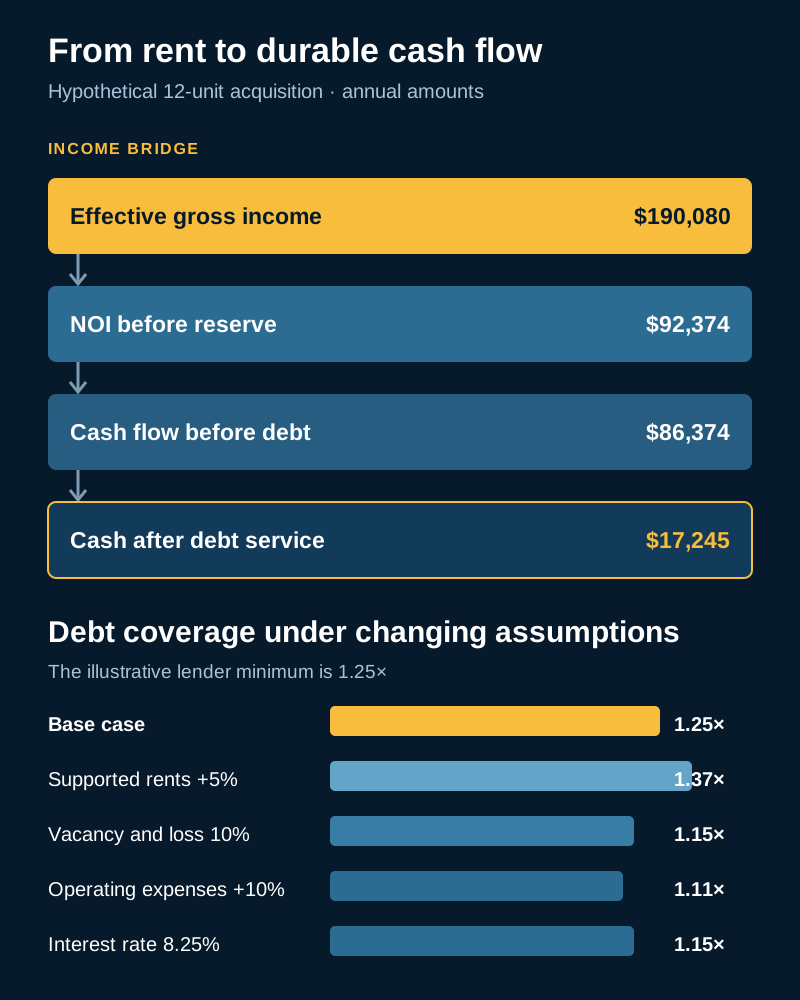
The base case barely clears the illustrative coverage requirement and produces a modest return on a large cash commitment. The downside cases do not immediately create negative cash, but they remove much of the protection available for unplanned repairs, collection delays or lease-up slippage. A simultaneous increase in vacancy and expenses would be more severe than either isolated row.
Decide which evidence could change the purchase
This example does not support the asking price on income alone. The buyer would contribute about $790,000, accept identified capital obligations and earn an estimated 2.2% cash-on-cash return in the base year while depending on a loan sized at the edge of the assumed coverage requirement.
The property could still become viable if new evidence changes the model: a lower price, seller-funded capital work, documented rents above the base schedule, an expense reduction that does not defer maintenance, or financing that improves cash flow without creating unacceptable maturity or rate risk. Each change should be supported independently. Raising rents, lowering vacancy and cutting repairs at the same time is not a strategy unless the operational work and capital required to achieve all three are also modeled.
Before making an offer, the investor should be able to identify which income is contractual, which expenses have been normalized, which capital items remain uncertain, which loan-sizing test constrains proceeds and how much cash remains after closing. If those answers rely on the seller's projection rather than reconciled records, the next step is more diligence or a different price—not a more optimistic spreadsheet.
References
1. Faundare Capital. Small multifamily property inspection. Commissioned editorial image generated for this article, October 7, 2026. The scene is illustrative and does not depict a funded property, borrower or client transaction.
2. Freddie Mac Multifamily. Multifamily Research Perspectives: Small Balance Loans. July 24, 2015. https://mf.freddiemac.com/research/business-analysis/20150724-multifamily-research-perspectives-small-balance-loans. Accessed October 7, 2026.
3. U.S. Environmental Protection Agency. Brownfields All Appropriate Inquiries. Updated May 7, 2026. https://www.epa.gov/brownfields/brownfields-all-appropriate-inquiries. Accessed October 7, 2026.
4. Fannie Mae. Multifamily Selling and Servicing Guide, Sections 203.01 and 203.02: Underwritten Net Cash Flow and Underwritten DSCR. https://mfguide.fanniemae.com/node/7526. Accessed October 7, 2026.
Figure and table provenance. All property facts, rents, expenses, capital needs, financing assumptions, calculations, tables and the analytical graphic are hypothetical and were created by Faundare Capital for instruction.