
A fix-and-flip exit is the transaction that repays the short-term loan and converts the completed project into either cash or a long-term rental investment. The three labels—sell, refinance and hold—sound simple, but each requires different evidence, timing and capital. A completed renovation does not itself repay the bridge loan.
The exit should be chosen before acquisition and retested while work is underway. A sale depends on marketable condition, buyer demand and net closing proceeds. A refinance depends on a new appraisal, qualifying rent, a supportable payment and separate loan approval. Holding without replacing the bridge debt leaves the investor exposed to short-term interest and maturity.
This article continues the hypothetical project used in How Fix-and-Flip Loans Work: a $200,000 purchase, $80,000 renovation, $400,000 after-repair value, $252,000 bridge commitment, 10% illustrative rate and six-month project period. The assumptions teach the method; they are not current quotes or promised terms.
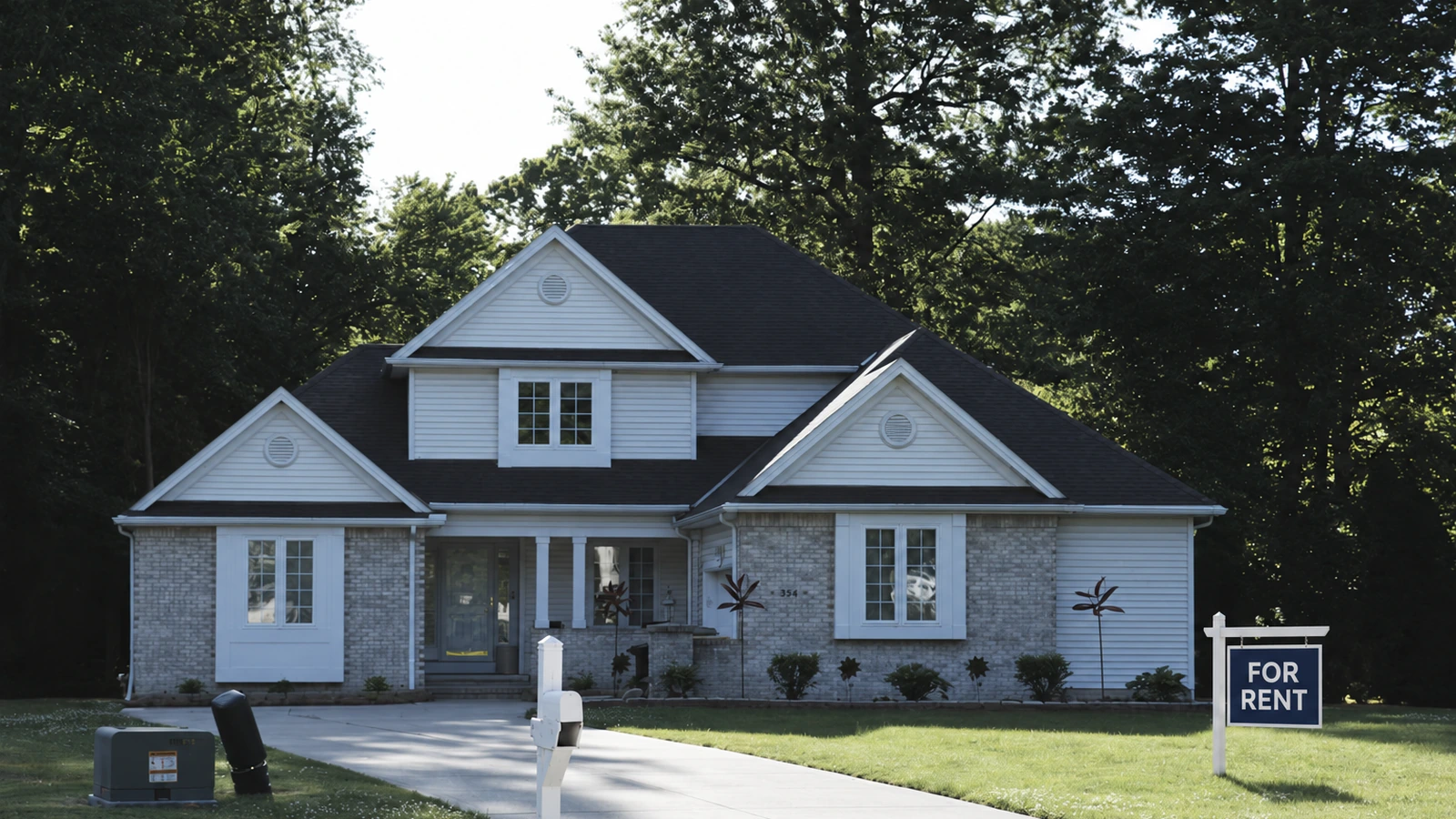
Define the exit as a repayment event
The first question is not whether selling or renting sounds more attractive. It is what event will produce enough money, soon enough, to satisfy the bridge payoff and every closing deduction.
- Sale: an arm's-length buyer funds the purchase, and the closing agent applies the proceeds to the bridge payoff and selling costs.
- Refinance: a permanent lender makes a new loan against the completed property, and that closing pays off the bridge loan.
- Hold: the investor retains ownership. This becomes a complete exit only when operating cash or replacement financing retires the bridge debt before maturity.
Bridge financing is short-term by design. Banking guidance describes it as interim financing used until a property reaches the condition or operating performance needed for sale or permanent financing.2 The project plan should therefore state the proposed repayment source, the evidence required for it and the latest date by which it must close.
Carry one completed-project model into every exit
The exit comparison should begin with one reconciled project ledger. Changing the exit does not erase acquisition, renovation, financing or carrying costs already incurred.
| Project component | Amount |
|---|---|
| Purchase | $200,000 |
| Renovation | $80,000 |
| Lender fee, assumed at 2% of commitment | $5,040 |
| Other acquisition and closing costs | $4,750 |
| Interest through the six-month modeled exit | $10,800 |
| Taxes, insurance, utilities and maintenance | $7,200 |
| Project cost before sale expenses | $307,790 |
The bridge loan contributes $252,000: $180,000 at acquisition and $72,000 through renovation draws. The investor contributes $55,790 of permanent project cash before any temporary draw-funding requirement or retained liquidity reserve:
$20,000 purchase equity + $8,000 unfunded renovation + $5,040 lender fee + $4,750 other acquisition and closing costs + $10,800 interest + $7,200 carrying costs = $55,790
Temporary cash used to pay eligible work before reimbursement is a timing exposure. It becomes permanent project cash only if the cost is not reimbursed. Keeping that distinction prevents the model from treating the same dollar as both an expense and a recoverable advance.
Calculate the sale exit from net proceeds
Assume the renovated property sells for the modeled $400,000 value and selling and sale-closing costs equal $32,000. The closing statement would produce:
| Sale-closing movement | Amount |
|---|---|
| Gross sale price | $400,000 |
| Selling and sale-closing costs | −$32,000 |
| Bridge principal payoff | −$252,000 |
| Cash delivered from sale closing | $116,000 |
This teaching model treats the $252,000 as principal and accounts for modeled interest separately. An actual payoff statement may also include accrued interest, extension charges, release fees or other amounts due under the loan documents.
The $116,000 is not profit. It returns the investor's earlier project cash and the remaining economic gain. Subtracting the $55,790 of permanent cash contributed before sale produces $60,210 of illustrative profit before income taxes.
| Sale result | Amount |
|---|---|
| Sale-closing cash | $116,000 |
| Earlier permanent project cash | −$55,790 |
| Illustrative profit before income taxes | $60,210 |
The same result appears by subtracting total project cost, including the $32,000 sale expense, from the $400,000 price: $400,000 − $339,790 = $60,210. The two reconciliations should agree. If they do not, the model probably omitted a use or counted a financed cost twice.
The sale still has execution risk. The contract price may differ from the supported value, buyer financing may require repairs, concessions may rise, or days on market may extend interest and carrying costs. A two-month delay after the full $252,000 commitment is funded adds about $4,200 of interest at the example's 10% rate before taxes, insurance, utilities and maintenance.
Size the DSCR refinance under both value and rent
A refinance is a new credit decision, not an automatic conversion of the Fix & Flip loan. For a completed one-to-four-unit rental, lenders commonly test both loan-to-value and residential debt service coverage ratio. The lower supported loan amount controls.
Faundare Capital's published program orientation currently shows DSCR refinance leverage up to 75% LTV, subject to underwriting and final approval.3 Applied to the example's $400,000 completed value, that creates a $300,000 gross LTV ceiling:
$400,000 × 75% = $300,000
The rent test is separate. Residential DSCR generally compares qualifying monthly rent with monthly PITIA: principal, interest, property taxes, insurance and association dues. It does not measure complete rental profit because vacancy, management, maintenance and capital replacements may remain outside PITIA.
Assume the completed property has $3,200 of accepted monthly rent. Use a 7.5% illustrative refinance rate, 30-year amortization, $450 monthly taxes, $180 monthly insurance and no association dues. These are teaching inputs, not current offered terms.
| Refinance component at $300,000 | Monthly amount |
|---|---|
| Principal and interest | $2,098 |
| Property taxes | $450 |
| Insurance | $180 |
| PITIA | $2,728 |
| Residential DSCR: $3,200 ÷ $2,728 | 1.17× |
Suppose the hypothetical program requires 1.15× DSCR. At $3,200 rent, that test supports about $307,861 under these rate, amortization, tax and insurance assumptions. The 75% LTV ceiling is lower, so the modeled loan remains $300,000.
If accepted rent falls to $2,900, the same 1.15× test supports only about $270,552. In that case DSCR, rather than LTV, limits the refinance. The actual lender determines eligible rent, expense treatment, appraisal value, rate, payment structure and required coverage.
Translate refinance proceeds into cash returned
Gross refinance proceeds are not cash to the investor. The closing agent first pays the bridge lender and the refinance transaction's deductions.
Assume the $300,000 LTV-capped loan closes with $8,000 of loan and transaction costs and $4,000 of initial escrows or reserves:
| Refinance-closing movement | Amount |
|---|---|
| Gross permanent loan | $300,000 |
| Bridge principal payoff | −$252,000 |
| Loan and transaction costs | −$8,000 |
| Initial escrows or reserves | −$4,000 |
| Cash returned at refinance closing | $36,000 |
The $36,000 does not recover all $55,790 of permanent project cash. Approximately $19,790 remains invested after closing. At the same time, the property has $100,000 of gross equity before any selling costs: $400,000 value less the $300,000 permanent loan. Remaining invested cash, gross equity and profit are different measures; none should substitute for a complete return analysis.
If the lower $2,900 rent constrains the loan to approximately $270,552, the same payoff and $12,000 of closing deductions leave only about $6,552 of cash returned. A supported appraisal alone cannot produce the expected cash-out when rent does not support the payment.
Test the hold economics after refinancing
Passing a residential DSCR test does not establish positive rental cash flow. Continue the example with $3,200 monthly rent and deduct four annual allowances: 5% vacancy, 8% management, 5% maintenance and 5% capital replacement reserves. These percentages are teaching inputs; actual costs depend on the property, lease and operating plan.
| Stabilized hold model | Annual amount |
|---|---|
| Scheduled rent | $38,400 |
| Vacancy allowance | −$1,920 |
| Management allowance | −$3,072 |
| Maintenance allowance | −$1,920 |
| Capital replacement reserve | −$1,920 |
| PITIA | −$32,732 |
| Cash after modeled items | −$3,164 |
The same $300,000 refinance that produces a 1.17× residential DSCR therefore produces a small modeled cash deficit after costs outside PITIA. Under these assumptions, annual rent after the four operating allowances is $29,568, leaving about $2,464 per month for PITIA. After the modeled $630 of monthly taxes and insurance, a 7.5%, 30-year loan payment of about $1,834 supports roughly $262,294 of debt, or 65.6% LTV on the $400,000 value. That is the approximate debt level at which this simplified hold model reaches zero cash flow.
The investor could improve the result through higher accepted rent, lower actual operating costs or less permanent debt. Holding without a completed refinance leaves the bridge maturity unresolved and is not an exit.
Test whether the property is ready for permanent financing
A refinance can fail even when the renovation looks complete. Before depending on it, verify:
- final permits, inspections and any certificate of occupancy are complete;
- title, liens and contractor releases permit the new loan to close;
- the appraisal can document the completed condition and supportable value;
- the lease and rent evidence meet the permanent lender's rules;
- insurance is available for the completed use and replacement cost;
- ownership seasoning and cash-out rules fit the transaction;
- the borrower's credit, liquidity and required entities remain eligible; and
- the permanent closing can occur before the bridge maturity with time for corrections.
Faundare Capital's Fix & Flip program states that an investor may refinance into a DSCR loan if the completed property supports that structure.4 That statement describes a possible sequence, not a commitment to approve the second loan. The permanent loan requires its own underwriting, documents and closing.
Compare the economic result, not only the closing check
The sale and refinance answer different investment questions.
| Decision measure | Sale | $300,000 DSCR refinance |
|---|---|---|
| Gross transaction amount | $400,000 price | $300,000 loan |
| Cash from closing after modeled payoff and deductions | $116,000 | $36,000 |
| Earlier permanent project cash | $55,790 | $55,790 |
| Immediate result | $60,210 profit before income taxes | $19,790 of project cash remains invested |
| Modeled annual rental cash after listed allowances | Not applicable | −$3,164 |
| Asset retained | No | Yes, with $300,000 permanent debt |
| Continuing exposure | Contract and closing through sale | Rent, operating costs, value and debt service after refinance |
The sale converts the project's value into cash and ends ongoing ownership and operating exposure when the transaction closes. The refinance returns less cash immediately but preserves ownership, future rental income and future appreciation or loss. A refinance should be selected because the stabilized rental return and remaining equity justify the ongoing risk—not merely because the closing produces cash.
Holding without a completed refinance is a separate, higher-risk case. If the bridge remains outstanding, the investor must fund interest and operations through maturity or obtain an approved extension. “Hold” is therefore not an exit unless the repayment source and timing are funded.
Set decision dates before the bridge matures
The exit process should have dated checkpoints:
- Before acquisition: model sale, refinance and downside cases using the same purchase, renovation and financing assumptions.
- During renovation: update cost to complete, funded balance, expected completion date and supportable value after each material change.
- Sixty to ninety days before completion: confirm the likely exit, begin permanent-loan or listing preparation and identify missing documents.
- At substantial completion: order or update the appraisal, close permits, document rent and resolve title or lien issues.
- Before maturity: preserve enough time to close the primary exit, correct deficiencies or execute an approved alternative without relying on an uncommitted extension.
The decision should be revised when value, rent, cost, timing or loan terms change. A useful trigger is the first point at which the preferred exit no longer repays the bridge on time or no longer meets the investor's required return.
Make the exit decision from one reconciled file
The final file should connect the current project ledger, bridge payoff, sale net sheet, refinance sizing, rental operating budget and closing timeline. That makes the tradeoff visible: selling realizes the modeled margin; refinancing preserves the asset but leaves cash and operating risk in the investment.
Use the Fix & Flip calculator to update acquisition, renovation, financing, carrying and sale assumptions. If the intended exit is a rental, use the DSCR calculator to test qualifying rent, PITIA, LTV and the loan amount supported by the lower constraint. Then replace every teaching input with the actual proposal, payoff, appraisal, lease and closing estimate before committing to the exit.
References
1. Ralph Florent. *Modern suburban house with a green lawn and trees*. Unsplash, published June 12, 2026. Unsplash License. Accessed October 18, 2026. Digitally edited by Faundare Capital to add an unbranded For Rent sign and cropped to 16:9 for editorial presentation.
2. Office of the Comptroller of the Currency. *Commercial Real Estate Lending*, Comptroller's Handbook, version 2.0. March 2022, p. 6. Bridge financing as interim financing until sale or permanent financing; the cited banking guidance is context rather than a statement of Faundare Capital terms.
3. Faundare Capital. DSCR Loans. Accessed October 18, 2026. Current published program orientation; actual leverage, rate, coverage, value and proceeds remain subject to underwriting and final approval.
4. Faundare Capital. Fix & Flip Loans. Accessed October 18, 2026. Current published program orientation and refinance-exit FAQ; financing remains subject to underwriting and final approval.