
A fix-and-flip loan can finance both a property purchase and an approved renovation, but the total commitment may differ from the amount delivered at closing. Part of the loan may fund the acquisition; another part may remain in a renovation holdback and become available only after work is completed and verified. The investor must bridge the time between paying project costs and receiving eligible draw reimbursements.
That timing distinction is as important as the advertised leverage. A proposal can show enough total proceeds to cover the budget and still leave the investor short of cash during construction. The useful question is therefore not only “How large is the loan?” It is “Which dollars arrive at closing, which require completed work, which costs remain outside the loan, and how much liquidity must remain available until the exit?”
This article follows one hypothetical project from loan sizing through closing, draws, interest and repayment. The assumptions teach the method; they are not market averages, guaranteed proceeds or Faundare Capital terms. The lender's final approval, loan agreement and draw instructions control an actual transaction.
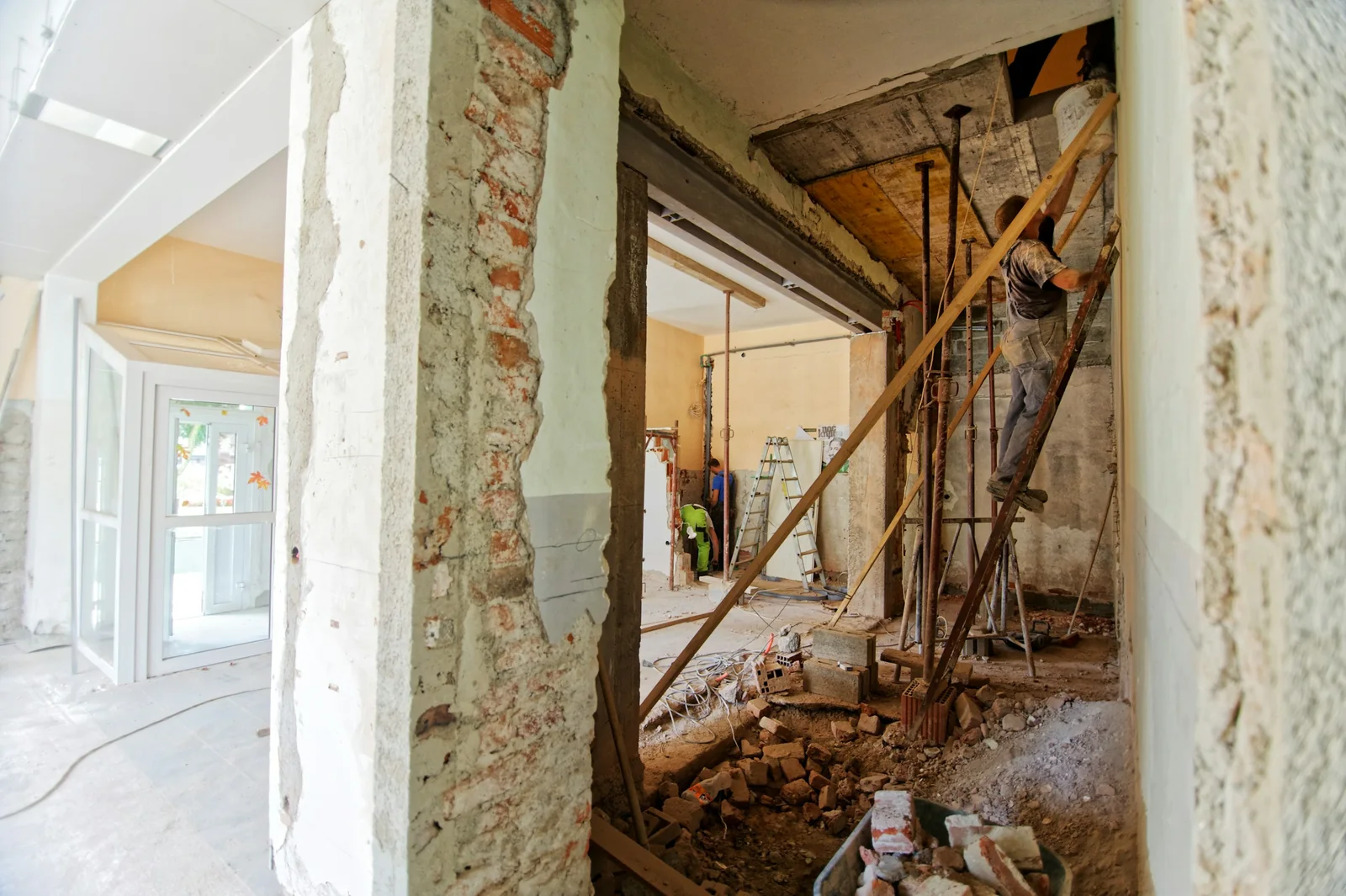
First, understand what the loan is designed to do
A fix-and-flip loan is short-term financing for an investment property that needs renovation or repositioning before sale or refinance. The loan is usually secured by the property and underwritten around the acquisition, scope of work, borrower, completed value and exit plan.
It differs from a conventional mortgage because the property may not yet be in the condition needed for ordinary long-term financing and because renovation funds can be part of the structure. It differs from a long-term DSCR loan because the repayment plan usually depends on a sale or a later refinance after completion, rather than years of scheduled payments supported by current rent. It is a specialized form of bridge financing tied to a defined property plan.
The financing does not create the project's profit. It changes the timing and amount of investor cash, adds interest and transaction costs, and places conditions on renovation disbursements. The underlying project must still support its purchase price, renovation, carrying period and exit.
Four values shape the loan request
Before applying a percentage, separate four inputs:
| Input | What it represents | Why it matters |
|---|---|---|
| Purchase price | Contract price for the property | Establishes the acquisition use and borrower equity at closing |
| As-is value | Supported value in current condition | May constrain the acquisition advance when price exceeds supportable value |
| Eligible project cost | Purchase and renovation costs accepted under the program | Provides the denominator for loan-to-cost when that test applies |
| After-repair value (ARV) | Prospective value after the specified work is complete | Can cap the total commitment through a completed-value test |
ARV is an opinion of prospective value, not promised sale proceeds. The Appraisal Foundation describes an appraisal as an independent, supported opinion of value developed under recognized standards.1 The investor's exit model must still deduct selling costs and test whether the finished property actually matches the condition, design and market evidence assumed in the valuation.
For the hypothetical project, assume:
| Project input | Amount |
|---|---|
| Purchase price | $200,000 |
| Supported as-is value | $210,000 |
| Approved renovation budget | $80,000 |
| Purchase plus approved renovation | $280,000 |
| Supported ARV | $400,000 |
The $120,000 spread between purchase price and ARV is not profit. It must absorb renovation, financing, carrying costs, selling costs and any amount by which the project underperforms.
Apply every loan-sizing constraint
Fix-and-flip programs do not necessarily use one leverage percentage. A proposal may limit the acquisition advance, total loan-to-cost, total loan-to-ARV, or all three. The lowest resulting amount binds.
Faundare Capital's current Fix & Flip program illustrates two distinct value tests: the acquisition advance is reviewed against the property's initial value, while total financing, including approved renovation funds, must also fit the supported completed value.2 The actual proposal may add a cost-based limit or other constraints. The point is structural: percentages with different denominators cannot be compared or added.
Assume the hypothetical proposal allows:
- acquisition funding equal to 90% of the $200,000 purchase price;
- up to 100% of the approved $80,000 renovation budget;
- total loan-to-cost no greater than 90% of the $280,000 eligible project cost; and
- total commitment no greater than 70% of the $400,000 ARV.
The calculations are:
| Constraint | Calculation | Maximum |
|---|---|---|
| Acquisition advance | 90% × $200,000 | $180,000 |
| Acquisition plus renovation request | $180,000 + $80,000 | $260,000 |
| 90% LTC cap | 90% × $280,000 | $252,000 |
| 70% ARV cap | 70% × $400,000 | $280,000 |
The modeled commitment is $252,000 because the 90% LTC cap is lower than the $260,000 acquisition-plus-renovation request and the $280,000 ARV cap. Quoting only “90% of purchase plus renovation” would overstate proceeds by $8,000. Quoting only “70% of ARV” would overstate them by $28,000.
Now lower the supported ARV to $350,000. The 70% ARV cap becomes $245,000, reducing the commitment by $7,000. The loan documents and approval determine whether that reduction comes from the closing advance, the renovation holdback or another component. The investor should not choose the allocation that produces the most convenient spreadsheet result.
Separate the closing advance from the renovation holdback
For the teaching model, assume the lender preserves the $180,000 acquisition advance and applies the binding LTC reduction to the renovation component. The $252,000 commitment then contains two different pools:
| Loan component | Amount | Availability |
|---|---|---|
| Acquisition advance | $180,000 | Applied at closing, subject to the final settlement statement |
| Renovation holdback | $72,000 | Reserved for eligible future construction draws |
| Total commitment | $252,000 | Not all cash available on closing day |
The purchase requires $20,000 of investor equity before transaction costs: the $200,000 price less the $180,000 acquisition advance. If $10,000 of earnest money has already been credited, the remaining purchase-equity contribution at settlement is $10,000. The investor also funds the $8,000 difference between the $80,000 renovation budget and the $72,000 holdback.
The $72,000 holdback does not pay the purchase equity or the $8,000 renovation contribution. It also does not necessarily pay contractors before work begins. The OCC's construction-disbursement framework connects advances to inspection reports, invoices, original cost estimates, prior disbursements and adequate remaining funds.3 That regulated-bank guidance is a neutral control framework rather than a statement of private-lender terms. The governing draw agreement must answer the question for the actual loan.
Understand what a draw reimburses
A draw is a controlled release from the approved holdback. It is not an increase in the commitment. The lender may compare completed work with the approved scope, inspect the property, review invoices or lien waivers, deduct fees and reject costs that are ineligible or unsupported.
Assume the $80,000 renovation budget, including its embedded contingency, is completed in three phases. The modeled lender draws reimburse $72,000 in total:
| Phase | Work completed and paid before request | Planned draw |
|---|---|---|
| 1 | Demolition, rough plumbing, rough electrical and framing corrections | $22,500 |
| 2 | Mechanical work, drywall, cabinets, tile and exterior repairs | $27,000 |
| 3 | Flooring, fixtures, paint, punch work and final completion | $22,500 |
| Total | $72,000 |
If the investor must pay each phase before reimbursement, the required working capital depends on invoice timing, contractor deposits, the size of each request and the time between payment and approved disbursement. A three-draw plan does not mean the investor needs only one-third of the budget. Overlapping trades or delayed reimbursement can raise the peak cash exposure.
Assume the modeled peak amount awaiting reimbursement is $35,000. That is a liquidity requirement, not an added project cost when the amount is later reimbursed. If a cost is rejected or the scope exceeds the approved holdback, however, the investor's temporary advance can become permanent equity.
Scope changes should be addressed before the money is spent. The OCC control framework calls for comparing disbursements with original cost estimates and confirming that undisbursed proceeds remain adequate to complete the project.3 The practical control is a written change process that shows the revised work, price, remaining contingency, effect on ARV and approval status.
Calculate interest from the balance that actually bears interest
Do not multiply the total commitment by an annual rate unless the proposal says the entire commitment bears interest from closing. Some structures charge interest only on funded principal. Others use an interest reserve, minimum-interest provision or different treatment of undrawn funds.
Interest treatment is not uniform. A proposal may accrue interest only on funded principal, use another defined balance, impose minimum interest or charge separate extension and draw fees. The actual proposal and note must identify the interest-bearing balance, when accrual begins and which additional charges apply.
Assume this hypothetical loan charges 10% annual interest on the funded balance and the project lasts six months:
| Period | Illustrative funded balance | Months | Interest calculation | Interest |
|---|---|---|---|---|
| Before first draw | $180,000 | 1.5 | $180,000 × 10% × 1.5/12 | $2,250 |
| After $22,500 draw | $202,500 | 1.5 | $202,500 × 10% × 1.5/12 | $2,531 |
| After another $27,000 | $229,500 | 1.5 | $229,500 × 10% × 1.5/12 | $2,869 |
| After final $22,500 | $252,000 | 1.5 | $252,000 × 10% × 1.5/12 | $3,150 |
| Illustrative project interest | 6 | $10,800 |
This simplified schedule assumes draws occur at six-week boundaries and excludes daily accrual differences, default interest, extension charges and lender-specific calculation conventions. The actual note and payment history control the payoff.
A two-month delay after the full $252,000 has been funded adds approximately $4,200 of interest before other carrying costs. The project model should therefore test time as a cost, not treat the maturity date as free optionality.
Reconcile project profit separately from loan cash flow
Assume the completed property sells for $400,000. The project result before income taxes is:
| Project use | Amount |
|---|---|
| Purchase | $200,000 |
| Renovation | $80,000 |
| Lender fee, assumed at 2% of commitment | $5,040 |
| Other acquisition and closing costs | $4,750 |
| Interest through modeled exit | $10,800 |
| Taxes, insurance, utilities and maintenance | $7,200 |
| Selling and sale-closing costs | $32,000 |
| Total project cost | $339,790 |
| Sale price | $400,000 |
| Illustrative profit before income taxes | $60,210 |
The fee and cost assumptions are teaching inputs. They are not recommendations or current program quotes. The table shows why loan proceeds and project profit answer different questions: the loan funds portions of the cost, while profit depends on the sale price minus every project cost regardless of who initially paid it. The resulting $60,210 profit equals about 15.1% of the sale price and 17.7% of total project cost; those figures describe the example, not an adequate-profit recommendation. How to Analyze a Fix-and-Flip Property Before Making an Offer explains how to set and stress a project-specific profit hurdle.
At sale, the outstanding principal and accrued amounts must be repaid from closing proceeds. The payoff is a financing cash flow, not a second project expense when the funded purchase and renovation costs are already included above. Counting both would understate profit.
Calculate the cash requirement in layers
The investor needs more than the $20,000 purchase equity. For this example, distinguish cumulative uses from peak timing exposure:
| Cash layer | Amount | Treatment |
|---|---|---|
| Purchase equity | $20,000 | Permanent project equity, including the $10,000 deposit already paid |
| Renovation cost outside the loan | $8,000 | Permanent project equity within the approved $80,000 renovation budget |
| Lender fee and other acquisition and closing costs | $9,790 | Project cost paid at or around closing unless financed |
| Peak eligible work awaiting reimbursement | $35,000 | Temporary timing exposure if fully reimbursed |
| Modeled interest | $10,800 | Project cost paid monthly, from reserve, or at payoff as documents specify |
| Taxes, insurance, utilities and maintenance | $7,200 | Project carrying costs |
| Retained liquidity after known uses | $25,200 | Hypothetical reserve equal to 10% of the $252,000 commitment; not a universal lender requirement |
On these assumptions, the capital plan calls for $115,990 across permanent equity, costs, temporary reimbursement exposure and retained liquidity. That does not mean $115,990 is wired at closing. It means the investor must map when each amount is needed and avoid spending the reserve twice in the model.
If the approved commitment falls from $252,000 to $245,000, required equity or unfunded renovation increases by $7,000 unless another verified source replaces it. If the peak reimbursement exposure rises from $35,000 to $50,000, liquidity increases by $15,000 even though total project cost is unchanged. Loan sizing and draw timing affect cash through different mechanisms.
Test the exit before accepting the structure
A sale exit must cover the loan payoff, selling costs and any work required to deliver the property in marketable condition. A refinance exit requires a separate approval based on the completed property's value, qualifying rent or net cash flow, borrower eligibility and the permanent program's limits.
Do not assume the full ARV can be borrowed at refinance. If the completed property is worth $400,000 and a hypothetical long-term program supports 75% LTV, the gross refinance amount is $300,000 before deducting the bridge payoff, closing costs, escrows and any required reserves. Cash returned to the investor is the remainder, not the gross loan.
The exit should also fit the short-term maturity. Appraisal, final permits, certificate of occupancy, lease-up, seasoning and permanent underwriting can extend beyond physical completion. An extension may require approval and can add fees and interest. How to Plan a Bridge Loan Exit Strategy develops that timeline and downside test in detail.
Reconcile the proposal before committing
The term sheet, settlement statement, budget and project model should answer the same questions:
- Which value and cost figures were approved?
- Which constraint determines the commitment?
- How much funds at closing, and how much remains in holdback?
- Which renovation costs are eligible, and what must be paid before a draw?
- What documents, inspections, fees and lien controls apply to each disbursement?
- Which balance bears interest, when does interest begin, and how is it paid?
- What cash remains available after closing for deposits, reimbursements, carrying costs and contingency?
- What evidence must exist before the sale or refinance exit can close?
The deal is financeable only when the property model and the loan cash-flow model work together. A large commitment cannot compensate for an unsupported ARV, incomplete budget or weak exit. A profitable project on paper can still fail if draw timing exhausts the investor's liquidity. The decision should rest on the binding loan constraint, the peak cash requirement and an exit that survives a realistic delay.
Use the Fix & Flip calculator to reconcile the acquisition, renovation, financing, carrying and sale assumptions. Then compare its timing assumptions with the actual proposal and draw documents rather than substituting the calculator for them.
References
1. The Appraisal Foundation. Consumers: What Every Home Buyer Should Know about an Appraisal. Accessed October 10, 2026.
2. Faundare Capital. Fix & Flip Loans. Accessed October 10, 2026. Current Faundare Capital program orientation; financing remains subject to underwriting and final approval.
3. Office of the Comptroller of the Currency. *Commercial Real Estate Lending*, Comptroller's Handbook, version 2.0. March 2022, pp. 102–103. Construction-disbursement controls addressing inspections, invoices, prior advances, lien protection and remaining funds; actual private-loan requirements may differ.