
A tenant-occupied commercial property is an operating business built from contracts. The walls and roof matter, but the leases determine when rent begins, what the tenant must pay, which costs remain with the owner and what can happen when a tenant renews, assigns its space, stops operating or leaves.
That makes lease review part of acquisition underwriting rather than a legal task saved for closing. The buyer needs counsel to interpret enforceability and state-specific rights. The investor still must understand how each economic provision reaches the property model. A lease can be valid and unfavorable, or financially attractive and difficult to finance because the rent is concentrated in a tenant whose term ends before the proposed loan matures.
This article follows a hypothetical 18,000-square-foot neighborhood retail acquisition. It shows how to move from executed documents to a lease abstract, reconcile billed rent and expense recoveries, price near-term rollover and decide whether the purchase price leaves enough capital for the obligations being acquired.

Begin with the rights being acquired
A purchase transfers the landlord's position under the leases, subject to the purchase agreement, assignment documents and applicable law. The buyer expects the right to collect rent, but also assumes landlord duties that may include maintaining common areas, replacing structural components, funding improvements, approving assignments, honoring exclusives and accounting for tenant deposits.
The property therefore cannot be understood from a rent roll alone. The rent roll is an operating summary. The executed lease, every amendment, guaranty, side letter, commencement notice and assignment establish the agreement. Billing records and bank deposits show how the agreement has performed. An estoppel certificate can then confirm material facts close to closing.
The Office of the Comptroller of the Currency identifies tenant strength, rollover risk, anticipated rent, renewal probability, outstanding lease terms and re-leasing costs as relevant parts of commercial real estate analysis.2 Those questions apply to buyers as directly as they apply to lenders: how long is the current income expected to remain, and how much cash may be required before replacement income begins?
Build an abstract from the complete lease file
Assume a four-space property is offered for $3,400,000. The seller supplies a rent roll showing three occupied suites and one vacancy:
| Space | Area | Current annual base rent | Stated recovery | Remaining term |
|---|---|---|---|---|
| Tenant A — neighborhood grocer | 8,000 sf | $160,000 | $80,000 | 5.5 years |
| Tenant B — dental practice | 4,000 sf | $104,000 | $8,000 | 3 years |
| Tenant C — fitness studio | 4,000 sf | $68,000 | $40,000 | 18 months |
| Vacant suite | 2,000 sf | — | — | Vacant now |
| Total | 18,000 sf | $332,000 | $128,000 |
These totals are only the beginning. Create a separate lease audit and abstract for each space. Record:
- the named tenant, permitted use and exact premises;
- commencement, rent commencement and expiration dates;
- base rent, scheduled increases and free-rent periods;
- additional rent, expense definitions, exclusions, caps and audit rights;
- deposits, letters of credit and lease guaranties;
- renewal, expansion, contraction, purchase and termination rights;
- assignment, sublease, change-of-control and recapture provisions;
- maintenance, repair, casualty and condemnation responsibilities;
- insurance, indemnity and compliance obligations;
- exclusives, prohibited uses, operating covenants and co-tenancy clauses; and
- tenant improvements, commissions or other landlord obligations that have not been fully performed.
Do not abstract only the original lease. An amendment may change the premises, rent, recovery method or option date without restating the rest of the agreement. A commencement notice may establish the operative dates. An assignment may replace the tenant but leave a prior guarantor liable. The abstract must describe the current contract after all documents are read together.
Reconcile base rent before judging the headline yield
Recalculate the rent schedule from the contract rather than copying the seller's annual total. Confirm the area to which the rate applies, the start date of each escalation and whether rent is stated per rentable or usable square foot. A lease signed at $20 per square foot does not necessarily produce $20 in the acquisition year if the rate changes midyear or a concession remains unamortized.
The same distinction applies to options. A renewal option may set a fixed rate, a scheduled increase, a percentage of fair market rent or an appraisal process. It may be personal to the original tenant, conditioned on the absence of default or exercisable only during a narrow notice window. Until the tenant validly exercises it, an option is not contractual income for the extension term.
For the example, assume the documents support the stated $332,000 annual base rent. The audit then finds:
- Tenant A has two five-year options at fair market rent, subject to timely notice and no uncured default.
- Tenant B has one five-year option at 95% of fair market rent and must give notice nine months before expiration.
- Tenant C has no renewal option. Its $17-per-square-foot base rent is 15% below the broker's supported $20-per-square-foot asking rent for comparable space.
- The vacant suite requires improvements before it can command the broker's proposed $24-per-square-foot rent.
The three occupied leases produce current rent. They do not establish that the property will remain occupied on the same economics through the buyer's intended holding period.
Determine which expenses the tenants actually reimburse
Labels such as “gross,” “modified gross” and “triple net” describe a general allocation, not the final economics. The executed definitions control. OCC guidance similarly warns that lease terms vary and should be reviewed to identify which expenses remain the landlord's responsibility.2
Tenant A and Tenant C are described as triple net leases. Their documents require proportionate reimbursement of taxes, insurance and common area maintenance, but the landlord remains responsible for the roof and structure. Tenant B has a modified gross lease: its base rent includes the first $8 per square foot of defined operating expenses, and it pays its proportionate share of increases above that expense stop.
Assume the property budget contains $180,000 of recoverable operating expenses and $50,000 of nonrecoverable ownership costs, for total operating expenses of $230,000. The lease calculations produce:
| Tenant | Contract method | Annual recovery |
|---|---|---|
| Tenant A | 44.44% of $180,000 recoverable pool | $80,000 |
| Tenant B | 4,000 sf × ($10 actual expense − $8 expense stop) | $8,000 |
| Tenant C | 22.22% of $180,000 recoverable pool | $40,000 |
| Vacant suite | No tenant reimbursement | $0 |
| Total recoveries | $128,000 |
A filed commercial lease illustrates why the details matter: its operating-expense clause defines a tenant's proportionate share, annual estimates, later reconciliation, audit rights, gross-up treatment and a cap that excludes specified uncontrollable expenses.3 These provisions can coexist in one contract. Applying only the cap or only the tenant percentage would not reproduce the amount owed.
The buyer should test the recovery ledger against invoices and collections. Confirm which costs enter the pool, whether management fees or capital expenditures are allowed, how vacancies affect the denominator, whether caps compound and whether exclusions apply. A reimbursement billed but consistently disputed is not equivalent to collected income.
Identify clauses that can change control or cash flow
The next review asks what either party can do during the remaining term. Focus on mechanisms whose exercise changes rent, occupancy, leasing flexibility or capital requirements.
An exclusive-use clause may prevent the landlord from leasing another suite to a competing business. A co-tenancy clause may reduce another tenant's rent or permit termination when a required anchor or occupancy threshold is absent. OCC notes that retail co-tenancy provisions can permit rent reduction or termination when an anchor stops operating.2 The risk is therefore not confined to the anchor's own space.
Assignment and sublease rights determine how easily the tenant can transfer operations. A landlord consent right may be limited by a reasonableness standard, a permitted-transfer exception or a change-of-control definition. A recapture right may let the landlord terminate instead of approving the transfer. The investor should determine whether the original tenant and guarantor remain liable afterward.
Also review:
- continuous-operation and “go-dark” rights;
- termination rights tied to sales, permits, exclusives or casualty;
- landlord relocation or demolition rights;
- expansion, contraction, purchase and right-of-first-offer provisions;
- rent abatement after casualty, access failure or service interruption;
- landlord work, delivery conditions and remaining improvement allowances; and
- default notice, cure periods and remedies.
These provisions should enter the downside analysis only when they can be triggered under the facts. Do not treat every theoretical right as certain loss. Do not omit a material right merely because the seller has never seen it exercised.
Confirm the lease facts with the tenant and lender documents
An abstract explains the documents in the file. It does not prove that the tenant agrees with the seller's account of current performance. Request the estoppel required by the lease and compare it with the abstract, ledger and seller representations.
The American Bar Association describes an estoppel certificate as a signed statement confirming lease facts and whether the tenant claims a landlord default. It also explains that lenders commonly take an assignment of leases and rents and may require a subordination, non-disturbance and attornment agreement to define the tenant-lender relationship after a default or foreclosure.4
For each material tenant, reconcile at least:
- the current lease and expiration dates;
- base rent and additional rent;
- deposits and prepaid amounts;
- open landlord obligations or tenant claims;
- defaults, offsets, abatements and disputes;
- remaining options and whether any have been exercised;
- unrecorded agreements or promises; and
- the entity currently occupying the space and paying rent.
Review the tenant's financial capacity separately. A recognizable trade name may be operated by a thin local entity. A guaranty may expire, burn off after a performance period or cap recovery. The investor should identify the obligated entity, guarantor, financial reporting rights and available evidence of payment capacity. Legal counsel should evaluate the documents; the acquisition model should reflect the resulting economic risk.
Rebuild NOI from enforceable and collectible income
The current lease file supports the following annual model:
| Annual property model | Amount |
|---|---|
| Base rent | $332,000 |
| Expense recoveries | $128,000 |
| Other recurring income | $12,000 |
| Scheduled property income | $472,000 |
| Credit and collection allowance: 2% of base rent and recoveries | −$9,200 |
| Effective gross income | $462,800 |
| Operating expenses | −$230,000 |
| Net operating income | $232,800 |
| Replacement reserve | −$9,000 |
| Cash flow before debt service | $223,800 |
The 2% collection allowance is a hypothetical input, not a market rule. The vacant suite already produces no base rent or recovery, so deducting a full-property vacancy allowance would count that absence twice. Future lease-up belongs in the forward scenario, with the related costs and timing made explicit.
At the $3,400,000 asking price, the current net operating income implies a 6.85% [capitalization rate](/yellow-book/cap-rate). That percentage describes the modeled first-year income relative to price. It does not price the near-term expiration, vacant-suite improvements or commissions required to preserve and grow the income.
Treat expiration dates as future capital calls
A lease expiration schedule converts the abstract into a timeline. Tenant C's 4,000-square-foot lease expires in 18 months, while 2,000 square feet is vacant at acquisition. Together, those spaces represent one-third of the building and require capital before the property reaches the proposed stabilized plan.
Assume the buyer underwrites nine months to lease the vacant suite and 12 months to replace Tenant C after expiration. During those periods, the owner carries each suite's share of recoverable expenses; Tenant C's downtime also removes its current base rent. New leases are modeled for seven years at $24 per square foot for the vacant suite and $20 per square foot for Tenant C, with tenant improvements of $35 per square foot, a 6% commission on aggregate base rent and $5,000 of legal and documentation cost per lease.
Those assumptions produce:
| Leasing exposure | Vacant suite | Tenant C rollover | Total |
|---|---|---|---|
| Lost rent or unrecovered expenses during downtime | $15,000 | $108,000 | $123,000 |
| Tenant improvement allowance at $35 per sf | $70,000 | $140,000 | $210,000 |
| Leasing commission | $20,160 | $33,600 | $53,760 |
| Legal and documentation | $5,000 | $5,000 | $10,000 |
| Estimated leasing exposure | $110,160 | $286,600 | $396,760 |
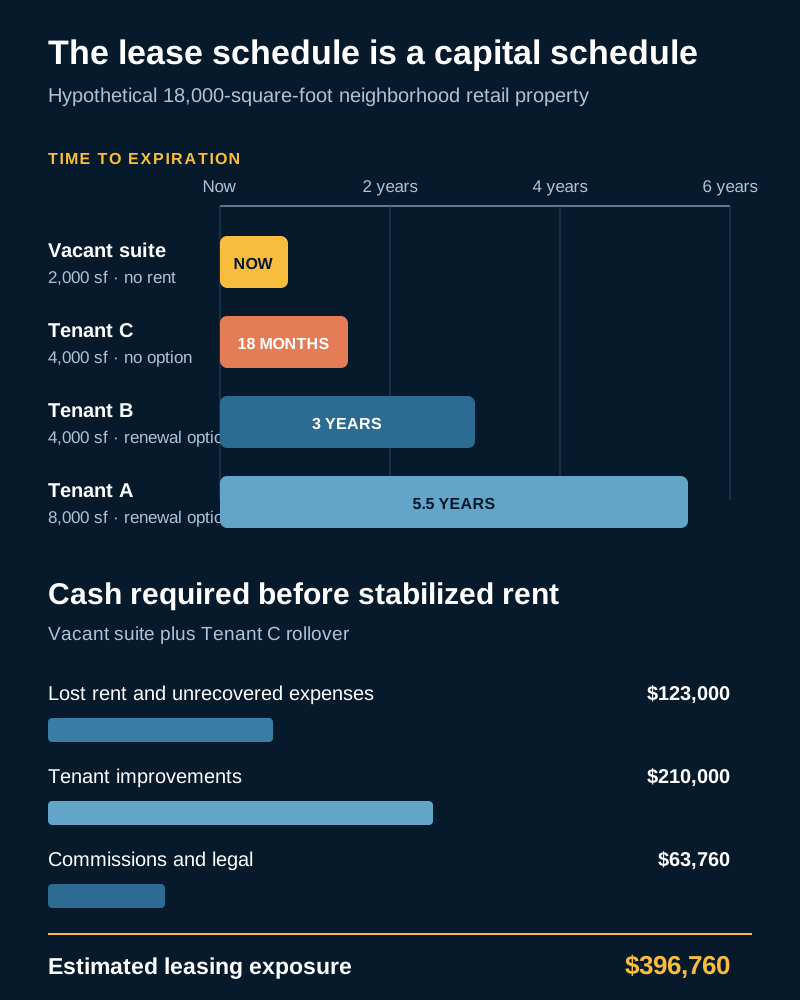
The vacant-suite downtime estimate is nine months of its $20,000 annual share of recoverable expenses. Tenant C's estimate is 12 months of its $68,000 current base rent and $40,000 recovery. Actual lease-up costs depend on market conditions, brokerage agreements, delivery obligations and the negotiated lease.
The $396,760 exposure is not an annual operating expense and should not be subtracted from one year's NOI. It is still acquisition capital. A model that capitalizes the current NOI while omitting the cash required to replace near-term income overstates the economics.
Test whether price and debt leave room for the lease obligations
Assume the proposed lender underwrites the $223,800 cash flow before debt service at a required debt-service coverage ratio of 1.30. Maximum annual debt service is:
$223,800 ÷ 1.30 = approximately $172,154
At an illustrative 7.00% rate and 25-year amortization, that payment supports a loan of approximately $2,030,000. A separate 70% loan-to-value limit on the $3,400,000 price would permit $2,380,000, so cash flow is the lower constraint in this example.
The buyer's initial and designated cash becomes:
| Cash requirement | Amount |
|---|---|
| Purchase equity: $3,400,000 − $2,030,000 | $1,370,000 |
| Closing, financing and diligence allowance: 2% | $68,000 |
| Vacant-suite and Tenant C leasing exposure | $396,760 |
| Operating liquidity | $75,000 |
| Initial and designated cash | $1,909,760 |
Annual cash flow after the illustrative debt service is approximately $51,646 before income taxes and unplanned capital work. That is about 2.7% on total committed cash. The percentage is not a recommended return threshold. It reveals that the asking price gives the buyer a modest current yield while requiring substantial additional capital to address vacancy and near-term rollover.
The acquisition could improve if the price recognizes the leasing exposure, the seller completes or escrows the work, Tenant C renews on supportable terms, or documented demand reduces downtime and concessions. Each improvement needs its own evidence. A broker's market-rent opinion does not eliminate the cash and time required to sign a tenant.
Before proceeding, the buyer should be able to trace every modeled dollar to an executed lease, amendment, collection record, supported market assumption or clearly labeled scenario. The remaining term, option language and recovery mechanics should agree across the abstract, estoppels, operating statement and proposed loan. If the current yield depends on recoveries the leases do not permit, or the purchase price consumes the capital needed for rollover, the lease review has changed the acquisition decision—as it should.
References
1. Faundare Capital. Commercial lease and tenant-space review. Commissioned editorial image generated for this article, October 7, 2026. The scene is illustrative and does not depict a funded property, borrower or client transaction.
2. Office of the Comptroller of the Currency. Comptroller's Handbook: Commercial Real Estate Lending, Version 2.0. March 2022, updated March 20, 2025, pp. 11, 42–44, 51–52 and 119–122. https://www.occ.treas.gov/publications-and-resources/publications/comptrollers-handbook/files/commercial-real-estate-lending/pub-ch-commercial-real-estate.pdf. Accessed October 7, 2026.
3. GeoVax Labs, Inc. Office Lease, Exhibit 10.6, §§ 5.1–5.3. Effective September 15, 2025. Filed with the U.S. Securities and Exchange Commission, EDGAR. https://www.sec.gov/Archives/edgar/data/832489/000143774925034811/ex_884833.htm. Accessed October 7, 2026. The exhibit is cited as an example of contractual mechanics, not as a model form or governing rule.
4. American Bar Association, Real Property, Trust and Estate Law Section. Commercial Real Estate FAQs. https://www.americanbar.org/groups/real_property_trust_estate/resources/real-estate/commercial-real-estate/. Accessed October 7, 2026.
Figure and table provenance. All property facts, rents, recoveries, expenses, lease provisions, financing assumptions, calculations, tables and the analytical graphic are hypothetical and were created by Faundare Capital for instruction.