
A trailing 12-month operating statement, usually called a T-12, shows the income and expenses recorded for a property during the 12 consecutive months ending on a stated date. It lets an investor see when revenue arrived, when costs occurred and whether a favorable annual total depends on one unusual month. Unlike a year-to-date statement, its first and last months move forward together; unlike a rent roll, it reports property-level financial activity rather than current lease terms.
The document is historical evidence, not a forecast and not proof that every entry is complete or classified correctly. The rent roll describes current units, tenants and contract rent; leases establish legal obligations; the general ledger and bank records support recorded transactions; invoices and tax bills explain specific costs. The T-12 organizes those records into a monthly operating history.
This article follows a hypothetical 12-unit apartment property. It shows how to test the statement's period and accounting basis, reconcile revenue, investigate monthly variations, recast unusual items and build a stabilized net operating income without treating every adjustment as an automatic improvement.

Confirm what the statement actually covers
Begin with the heading rather than the totals. A statement labeled “2026” may be year to date through August, a calendar year or the owner's fiscal year. A true T-12 ending August 31, 2026 covers September 1, 2025 through August 31, 2026. Replacing three missing months with an annualized average would create an estimate, not a T-12.
Freddie Mac's published multifamily guide materials describe current financial statements in T-12 format as the 12 months preceding the financing request and, when available, require monthly operations for each of those months.2 The monthly columns matter because a single annual total can conceal seasonality, turnover, delinquency or a cost recorded in the wrong period.
Record five facts before analysis:
- the first and last day of the reporting period;
- whether the statement uses cash, accrual or modified accounting;
- whether security deposits and owner contributions are kept outside revenue;
- whether capital expenditures and debt payments are separated from property operations; and
- whether the report covers only the subject property or includes another asset or management company.
A cash-basis statement records money when received or paid. An accrual statement generally records revenue when earned and expenses when incurred. Neither basis makes the report self-validating. Collections can lag billings, an unpaid invoice may be absent from a cash report, and an accrual report may show rent that was billed but never collected.
Read across each row before reading down the total column
The hypothetical seller reports $217,700 of revenue, $131,100 of expenses and $86,600 of NOI. Those annual totals do not reveal that August and September had lower rent collections, property taxes were paid in two large installments, a roof replacement sits inside repairs and the owner included personal travel in property expenses.
Read every material line from month to month. Look for:
- a level amount that should change with occupancy;
- a zero followed by a catch-up entry;
- a recurring charge recorded only once or twice;
- a sudden revenue increase without a matching rent-roll change;
- negative expenses, reversals or unexplained journal entries; and
- round-dollar amounts that may be estimates rather than posted transactions.
A variation is a question, not automatically an error. Insurance may be paid annually. Snow removal may be seasonal. A utility refund may reverse an earlier overcharge. The analyst's task is to connect the entry to its source and decide whether the annual total represents ongoing operations.
Reconcile rental income to occupancy and collections
Start with the current rent roll, then move backward through the monthly ledger. For each unit, compare contractual rent, concessions, move-in and move-out dates, delinquency and cash received. The T-12 should explain the revenue consequence of every material occupancy change.
The example contains these reported revenue lines:
| Reported T-12 revenue | Amount | Underwriting question |
|---|---|---|
| Residential rent collected | $206,600 | Do leases, ledgers and deposits support the monthly pattern? |
| Parking and laundry | $7,200 | Is the income recurring and traceable to collections? |
| Late and application fees | $2,400 | Should volatile, event-dependent fees continue at the historical amount? |
| Retained security deposit | $1,500 | Is this property income, or a deposit balance requiring separate treatment? |
| Reported revenue | $217,700 |
The retained deposit is removed from the operating model. A deposit is not ordinary rent merely because the owner posted it to revenue; the lease, ledger and applicable law determine whether it can be retained and recognized. The example also excludes late and application fees from stabilized income because their continuation is not supported. That is a conservative modeling choice for this illustration, not a universal lender rule.
Fannie Mae's current multifamily guidance illustrates the underlying principle: other income used in underwriting should be stable, common in the market, supported by prior periods and exclude extraordinary, nonrecurring items.3 A T-12 supplies evidence for that test; it does not answer the test by itself.
Separate operating expenses from capital, financing and ownership items
Operating expenses are the costs of operating and maintaining the property. Loan principal and interest, depreciation, income taxes and owner distributions do not belong in NOI. A major replacement may consume cash without being a current operating expense. Conversely, a self-managing owner may omit a management expense that a buyer will incur.
The seller's $131,100 of reported expenses consists of:
| Reported expense | Amount | Treatment in the adjusted history |
|---|---|---|
| Real estate taxes | $26,400 | Retain; then update for the forward tax estimate |
| Insurance | $12,600 | Retain; then replace with a current quote |
| Utilities | $14,400 | Retain and compare with bills and occupancy |
| Repairs and maintenance | $18,900 | Retain subject to invoice review |
| On-site payroll | $8,400 | Retain |
| Management fee | $0 | Add a market-supported cost because the buyer will not self-manage |
| Grounds and seasonal service | $5,800 | Retain; inspect the monthly pattern |
| Legal and accounting | $3,600 | Retain recurring property work |
| Roof replacement posted to repairs | $32,000 | Remove from historical operating expense; track as capital work |
| Owner automobile and travel | $9,000 | Remove because it is not supported as a property operating cost |
| Reported expenses | $131,100 |
The roof adjustment does not make the roof free. The $32,000 remains part of the property's capital history and may affect the condition assessment and future replacement plan. OCC guidance distinguishes capital items from operating expenses while recognizing a replacement reserve in underwriting NOI.4 That distinction prevents a major replacement from distorting one year's operations without pretending buildings require no future capital.
Build an adjusted historical bridge before projecting forward
Use three columns rather than editing the seller's total in place:
- Seller reported: preserves the source exactly as received.
- Adjusted historical: corrects classification and scope for the same 12-month period, then shows any buyer-specific normalization separately.
- Stabilized forward: applies supported rent, vacancy and expense assumptions for the intended ownership period.
For the example, removing the $1,500 deposit from revenue and reclassifying the $32,000 roof and $9,000 owner travel produces adjusted historical NOI before management of $126,100. The buyer then adds an illustrative 5% management cost of $10,810 because the acquisition plan assumes third-party management. That buyer-specific normalization produces $115,290; it is not a claim that the seller incurred or omitted that exact historical charge.
| Adjusted historical bridge | Amount |
|---|---|
| Reported revenue | $217,700 |
| Less retained deposit | −$1,500 |
| Adjusted historical revenue | $216,200 |
| Reported operating expenses | $131,100 |
| Less roof replacement | −$32,000 |
| Less unsupported owner automobile and travel | −$9,000 |
| Adjusted historical expenses before management | $90,100 |
| Adjusted historical NOI before management | $126,100 |
| Add buyer's management assumption at 5% of adjusted revenue | +$10,810 |
| Buyer-normalized historical operating expenses | $100,910 |
| Buyer-normalized historical NOI | $115,290 |
The bridge preserves two different judgments: classification corrections about the reported period and a buyer-specific estimate of future ownership cost. Neither establishes next year's NOI.
Normalize the next ownership period with independent evidence
The forward model begins with the current rent roll and known ownership costs rather than the highest number in the T-12. Assume the current 12-unit rent schedule supports annual gross potential rent of $216,000. Apply a 5% vacancy and collection allowance for this hypothetical scenario, then add $7,200 of supported parking and laundry income:
$216,000 − $10,800 + $7,200 = $212,400 of effective gross income
The 5% allowance is an example input. Actual underwriting should consider current occupancy, collection history, lease expirations, competing supply and the applicable lender's method. OCC describes stabilized NOI as fully leased gross income adjusted by a vacancy factor supported by comparable market conditions, with variable expenses considered consistently.4
Forward expenses use the most relevant evidence available:
| Stabilized operating expense | Amount | Basis in the example |
|---|---|---|
| Real estate taxes | $27,600 | Current bill and acquisition-year estimate |
| Insurance | $15,000 | Buyer's current quote |
| Utilities | $14,400 | T-12 bills; no supported rate change |
| Repairs and maintenance | $18,000 | Multi-year history and condition review |
| On-site payroll | $8,400 | Existing recurring cost |
| Management | $10,620 | 5% of stabilized effective gross income |
| Grounds and seasonal service | $5,800 | Current contracts and T-12 pattern |
| Legal and accounting | $3,600 | Recurring property administration |
| Replacement reserve | $3,600 | $300 per unit illustrative reserve |
| Stabilized operating expenses | $107,020 | |
| Stabilized NOI | $105,380 |
The reserve is an underwriting assumption, not a claim that $300 per unit is sufficient for every property. A physical assessment and replacement schedule should determine the buyer's actual capital plan.
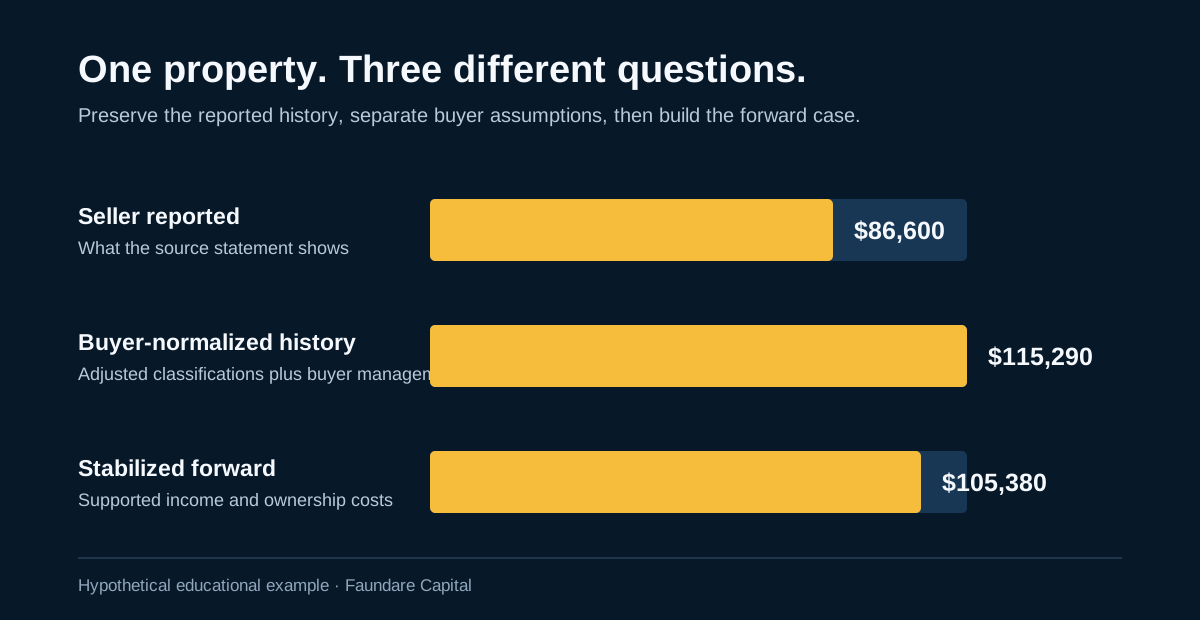
The stabilized NOI is below the buyer-normalized history because the forward model includes updated taxes and insurance, a vacancy allowance and a replacement reserve. A defensible normalization is not a search for the largest result. Favorable and unfavorable changes belong in the same bridge.
Test whether the monthly pattern supports the annual conclusion
Before using $105,380 for price or debt analysis, return to the monthly columns. The August and September rent decline should agree with unit turnover and bank deposits. The tax installments should reconcile to the bill. The insurance total should agree with the policy period rather than mix a canceled policy refund with a new premium. Repair spikes should connect to invoices and physical findings.
Compare the T-12 with at least the prior two annual statements when available. One year may contain unusually low repairs, a tax appeal refund or a temporary utility credit. Freddie Mac's guide materials request historical property statements in addition to current T-12 information for multifamily underwriting,2 while HUD guidance describes using multiple years of operating experience and comparing a trailing 12 months with those statements.5 The point is not to average every year mechanically. It is to determine which changes reflect the property and which reflect timing or classification.
Also compare the most recent three months with the full period. A T-12 can remain strong even as the property deteriorates because nine earlier months outweigh three weaker ones. Falling collections, rising concessions or deferred invoices near the end of the period deserve separate treatment.
Connect NOI to debt without confusing history with qualification
Assume proposed annual debt service of $82,000. The stabilized NOI implies a debt-service coverage ratio of:
$105,380 ÷ $82,000 = 1.29×
The seller-reported NOI would produce only 1.06×, while the buyer-normalized historical NOI would produce 1.41×. None is automatically the lender's qualifying figure. The lender may apply its own vacancy, management, reserve, income eligibility and expense standards. The comparison shows why the chosen NOI must be traceable rather than described simply as “the T-12 NOI.”
At an illustrative 6.50% capitalization rate, the stabilized NOI indicates approximately $1,621,000 of value before considering other appraisal evidence. Each $10,000 unsupported change to NOI would move that direct-capitalization indication by about $154,000. Classification questions therefore can become price and leverage questions.
Decide whether the statement is reliable enough to use
A usable T-12 should permit the analyst to trace material revenue and expenses to source records, explain significant monthly changes and separate historical facts from forward assumptions. Unresolved gaps should remain visible in the model.
Do not proceed from the annual total alone when:
- the report does not state its period or accounting basis;
- rent collections do not reconcile with leases, ledgers and deposits;
- expense lines combine several properties or owner businesses;
- capital work, loan payments or owner items are mixed with operations;
- taxes, insurance or utilities omit known post-closing costs;
- the most recent months show deterioration hidden by earlier results; or
- the seller cannot supply the ledger, bills or invoices behind material entries.
The completed analysis should preserve the seller's report, show every adjustment and state the evidence for the forward model. If the purchase price or requested loan works only after unsupported revenue is added or recurring expenses are removed, the T-12 has identified the decision problem. If the records reconcile and the forward assumptions remain supportable under a reasonable downside, the statement has done its job: it has connected the property's operating history to a cash flow that can be evaluated rather than merely accepted.
References
1. Filip Mishevski. Apartment buildings with ornate fire escapes and air conditioners. Unsplash, January 15, 2026. https://unsplash.com/photos/p2NQ_V2pwZs. Free to use under the Unsplash License. Accessed October 8, 2026. Editorially cropped.
2. Freddie Mac Multifamily. Multifamily Seller/Servicer Guide, Chapter 55, documentation and delivery requirements, p. 30 in the December 12, 2024 published redline. https://mf.freddiemac.com/docs/guide_chapter_redlines_12.12.24.pdf. Accessed October 8, 2026. The current electronic Guide controls; the cited publication documents the T-12 concepts discussed here.
3. Fannie Mae Multifamily. Underwritten Net Cash Flow. Effective June 2, 2026. https://mfguide.fanniemae.com/node/7531. Accessed October 7, 2026.
4. Office of the Comptroller of the Currency. Comptroller's Handbook: Commercial Real Estate Lending, Version 2.0. March 2022, updated March 20, 2025, pp. 11, 42–44 and 119–122. https://www.occ.treas.gov/publications-and-resources/publications/comptrollers-handbook/files/commercial-real-estate-lending/pub-ch-commercial-real-estate.pdf. Accessed October 7, 2026.
5. U.S. Department of Housing and Urban Development. Multifamily Accelerated Processing Guide, January 2016, Chapter 7, Valuation Analysis and Market Study, §7.8, Operating Expense Estimates and Underwritten Net Operating Income, pp. 193–197. https://archives.hud.gov/offices/hsg/mfh/map/4430GHSGG-bm.pdf. Accessed October 7, 2026. The 2016 Guide is archived; it is cited for the historical-statement comparison method described here.
Figure and table provenance. All property facts, rents, expenses, adjustments, financing assumptions, calculations, tables and the analytical graphic are hypothetical and were created by Faundare Capital for instruction.
This article is educational and does not provide legal, tax, accounting, appraisal or lending advice. Actual underwriting methods and loan requirements vary by lender, property and transaction.