
“Rural property” can describe a geographic classification, a federal program designation or a lender’s assessment of a specific parcel. Those are different questions. Financing also depends on the loan's purpose: a rural home occupied by its owner has different options from an investment rental or a commercial property.
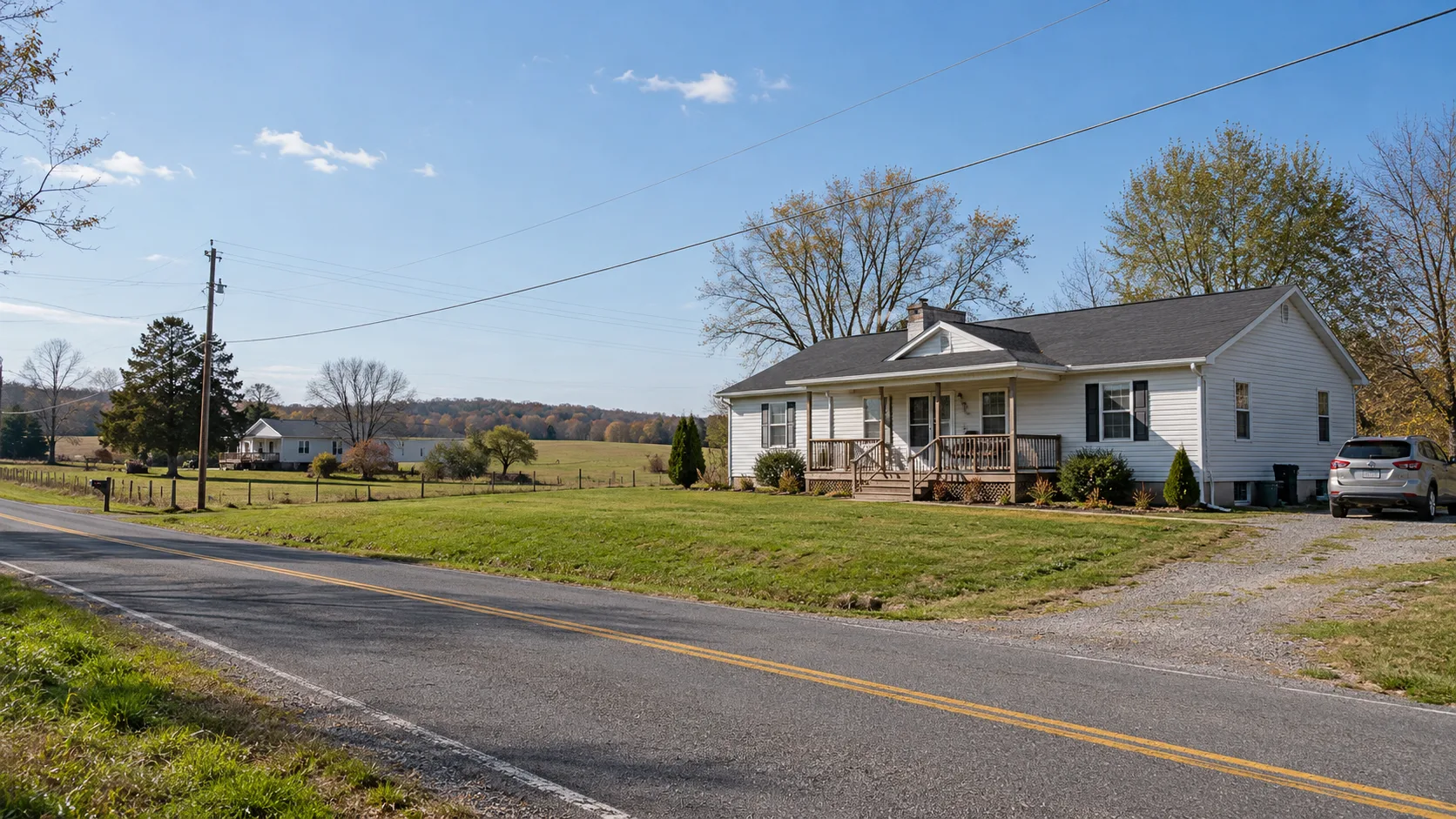
Which rural designation is being used?
The U.S. Census Bureau's urban-rural classification treats as rural the population, housing and territory outside its defined urban areas. It is a geographic classification used for statistics. It does not determine whether a particular investment qualifies for financing.
The Consumer Financial Protection Bureau's address tool provides a safe-harbor determination that a property is in a rural or underserved area for a specific mortgage regulation. A positive result does not necessarily mean the property is rural, and the tool does not test investment-loan eligibility. Regulation Z generally exempts business-purpose credit; its official interpretation deems credit to acquire, improve or maintain non-owner-occupied rental property to be business-purpose credit. Our rural property checker explains how to use the tool and interpret its address, year and result.
How the financing path changes by loan purpose
Investment rentals and private loans
Rural location can sharply narrow the lender pool for a DSCR or other private investment loan. Some programs reject rural collateral outright; others will consider it only within limits on acreage, property type, access or marketability. The lender's own rural definition controls its program decision, which may differ from a Census or CFPB classification. Confirm that the program accepts the location before modeling its maximum loan amount. Strong comparable sales cannot cure an express program exclusion.
Owner-occupied homes
A primary residence has a broader set of potential financing paths. Conventional residential appraisal guidance permits more distant comparable sales when they are the best evidence of value and the appraiser explains why. For eligible borrowers and properties, USDA's Section 502 Guaranteed Loan Program specifically finances primary residences in eligible rural areas; USDA has a separate property eligibility site. Rural location therefore need not create the same categorical barrier it can create for an investment loan. Borrower qualifications, property condition, appraisal and each program's rules still apply.
Commercial properties
For a business-purpose commercial deal, a CFPB rural-or-underserved result is not a lending verdict. A commercial lender may still finance the property when appropriate comparable sales, income, access and local market activity support the value and repayment plan. Another lender may decline the same location under its own policy. The question is whether a lender that accepts this property type and market can support the proposed proceeds and exit.
How rural characteristics can change a financing plan
Location becomes material when it changes the evidence supporting value, cash flow, property utility or repayment.
Value depends on a credible market, not a nearby sale at any price
Comparable sales may be sparse for an unusual rural property. A sale farther away can be more informative than the nearest sale if it competes for the same buyers and has similar access, acreage, improvements and use. For residential appraisals, Fannie Mae's guidance allows more distant sales when they are the best available indicators of value and the appraiser explains the selection. This illustrates the market-evidence problem; it is not a Faundare program rule for residential, commercial or land loans.
A house on two acres near a county seat may not be comparable to a remote cabin on forty acres. Land value can be driven by buildability, frontage, terrain and utility availability rather than acreage alone.
Property services affect both cost and marketability
Confirm the right to reach and use the property. A maintained public road, a recorded private easement and an informal driveway are different forms of access. Likewise, a nearby utility line does not prove a connection is available at a known cost. Wells, septic systems, drainage and insurance can create obligations that are absent from an urban comparison.
For a vacant lot, zoning and the legal parcel matter more than its rural label. The investment-lot guide sets out how to verify access, buildable area, utilities and the complete site budget before treating a parcel as construction-ready.
Income and exit should fit the local demand
A rental property needs support for achievable rent, vacancy and operating costs. Seasonal demand is not interchangeable with a year-round lease. A bridge loan needs a credible sale or refinance before maturity; limited buyer activity or a property type that few permanent lenders accept can lengthen that path.
What weaker value support can do to the cash requirement
Suppose an investor agrees to purchase a rural rental for $400,000 and has identified a lender whose program accepts the property. For this illustration only, assume the acquisition loan is capped at 70% of the lender's supported value, no other sizing constraint binds and closing costs are excluded:
- If the supported value is $400,000, the modeled advance is $280,000 and purchase cash before closing costs is $120,000.
- If market evidence supports only $340,000, the modeled advance is $238,000 and purchase cash before closing costs rises to $162,000.
The $60,000 value difference reduces modeled proceeds by $42,000. The purchase price has not changed, so the investor must provide that $42,000 in additional equity or renegotiate the transaction. The lower value is a hypothetical appraisal outcome, not a discount automatically applied to rural properties.
Now suppose a thin buyer market also adds three months to the planned exit. At a modeled $2,500 per month of interest and operating carry, that creates another $7,500 of cash exposure later in the project. The combined incremental need is $49,500, but the $42,000 equity gap and $7,500 of future carry arise at different times. Neither is captured by a map designation alone.
Put the status in the right place in the deal file
Start with the legal parcel, intended use and the rule or program for which a rural designation is being checked. For an investment loan, confirm that a lender accepts the location, then establish the financing case from comparable sales or rents, recorded access, utility and site evidence, property condition, and a repayment route supported by the likely buyer or refinance market.
If no suitable lender accepts the location, the financing plan needs a different source of capital or a different property. If a lender accepts it but the evidence does not support the price or repayment date, revise the offer, equity plan or exit before treating the deal as workable.