
Parcel development converts land into one or more legally approved, physically serviceable sites that can support buildings, be sold as finished lots or move into a later construction phase. The developer is not merely buying acreage. The developer is assembling a sequence of rights, engineering decisions, public approvals, infrastructure work and capital commitments whose value depends on one another.
That sequence creates opportunity because approved, serviced land can be worth more than land with uncertain use or infrastructure. It also concentrates risk before a building produces rent or sale proceeds. An attractive concept can fail because the parcel cannot obtain access, the utility system lacks capacity, the approval conditions change the budget, the market cannot absorb the finished lots or the next financing source does not close.
This article explains the process for residential, commercial and mixed-use parcel development in the United States. State and local requirements differ, so it provides a decision framework rather than a permit checklist for any one jurisdiction.
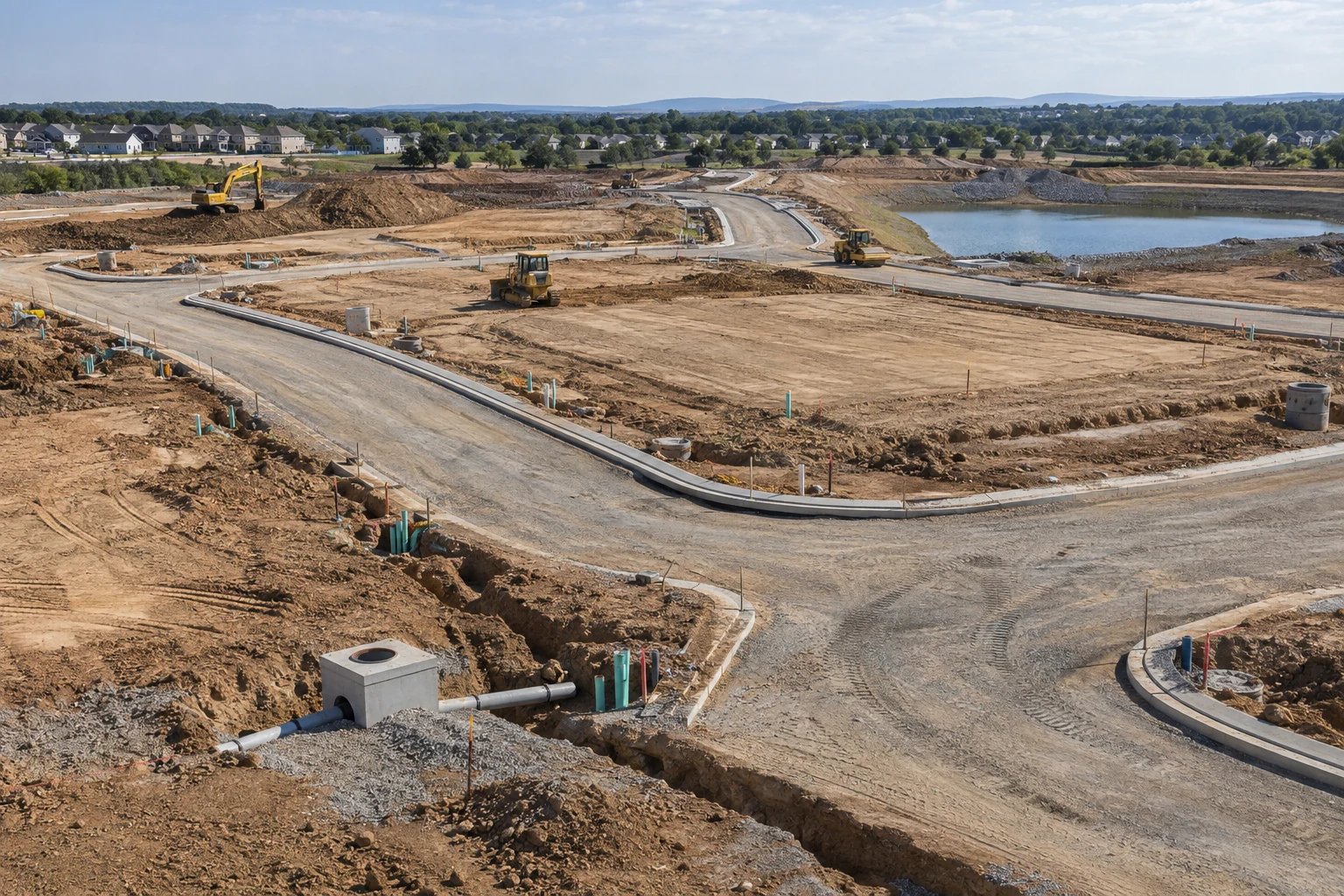
Begin with the distinction between land, lots and development
A parcel is a legally described tract of land. A lot is commonly a parcel or portion of a subdivision that can be separately conveyed and, subject to applicable rules, used for an intended improvement. Parcel development is the work required to move from the current tract to approved and usable sites.
The Office of the Comptroller of the Currency describes land-development loans as financing that prepares land for construction through work such as sewer and water pipes, utility cables, grading and streets.2 That description captures the physical portion of development, but the economic project begins earlier. Site control, diligence, concept planning, entitlement, subdivision and final engineering can consume substantial time and money before earthwork begins.
Scale changes the work. Dividing one urban parcel into two lots may require a modest plat and utility review. A tract with new public streets, drainage facilities and dozens of lots can require multiple hearings, agency permits, construction security, phased acceptance and a multiyear sales program. A commercial pad or mixed-use site may add access management, fire circulation, parking, loading and shared-maintenance documents.
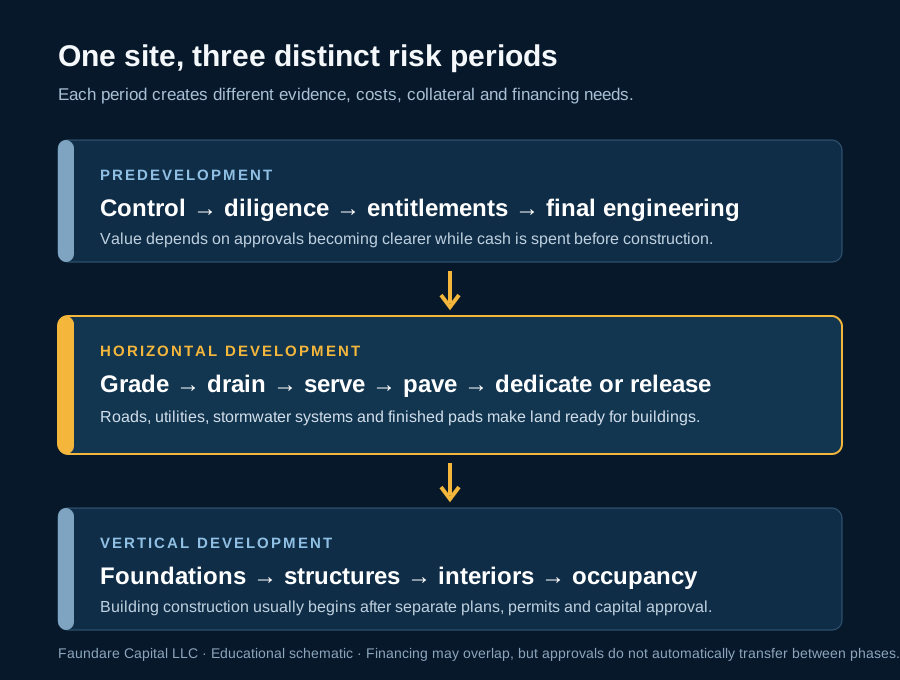
Horizontal development and vertical development solve different problems
Horizontal development prepares the ground and shared systems. It commonly includes clearing, mass grading, erosion controls, roads, curbs, sidewalks, water, sewer, storm drainage, dry utilities, detention facilities and finished pads or lots. It may also include off-site improvements required as a condition of approval.
Vertical development constructs the buildings and building-specific improvements: foundations, structural systems, walls, roofs, mechanical systems, interiors and the work needed for occupancy. A development can combine both phases under one sponsor, but the design documents, permits, contractors, budgets, draw controls, appraisals and lenders may differ.
| Dimension | Horizontal development | Vertical development |
|---|---|---|
| Primary output | Serviced lots, pads and shared infrastructure | Completed or occupiable buildings |
| Core plans | Civil, utility, grading, drainage and roadway plans | Architectural, structural and building-system plans |
| Main approvals | Subdivision, site plan, utility, access, stormwater and land-disturbance approvals | Building permits, trade permits, inspections and certificates of occupancy |
| Typical contractors | Site, utility, paving and civil contractors | General contractor and vertical trades |
| Common repayment | Lot or pad sales, land refinance, or a later construction facility | Unit sales, operating income, permanent financing or project sale |
| Central underwriting question | Will approvals and infrastructure create marketable sites at the expected cost and pace? | Can the buildings be completed and sold or operated at the expected cost and value? |
The distinction matters because horizontal completion does not authorize vertical work. A recorded plat may create lots without granting building permits. A construction loan may recognize developed land value while still requiring final plans, permits, contractor review, budget validation and equity for the building phase.
Control the site before spending heavily on it
Developers commonly acquire control through a purchase contract, option, phased closing, ground lease or joint venture. The document should give the developer enough time and authority to investigate the property and pursue approvals without assuming that every desired outcome will occur.
A useful due-diligence period aligns expiration dates with the actual approval path. The contract should address survey access, testing, application authority, extensions, assignment, title objections, casualty, condemnation and what happens to deposits if a stated condition cannot be satisfied. An approval contingency that expires before the hearing or utility-capacity decision does not protect the intended decision.
Site control also affects financing and value. A lender must understand whether the borrower owns the land, holds an assignable contract, controls it through an option or depends on another party's performance. A favorable purchase price does not compensate for a control agreement that cannot survive the development timeline.
Establish feasibility before drawing the final plan
Early feasibility combines legal, physical, market and financial evidence. The purpose is not to prove the preferred concept; it is to discover which concept the site can support.
Reconcile the legal land
Match the contract, legal description, assessor record, survey and title commitment. Identify access rights, easements, restrictions, mineral or water interests, encroachments and parcels needed for the complete project. Assemblage risk remains until every required tract and access right is controlled.
Test use and yield
Zoning compliance answers what current rules allow; entitlement analysis identifies discretionary approvals still required. A concept plan should test density or intensity, setbacks, open space, parking, loading, fire access, street geometry, stormwater area, utility routes and any land that cannot become saleable or buildable area.
Gross acreage is therefore not the same as net developable acreage. Wetlands, floodplain, steep slopes, rights-of-way, detention, buffers and public dedications can reduce the usable yield. A residual land value based on 80 lots is unsupported if the preliminary plan fits only 62.
Verify physical and environmental constraints
Use FEMA's Flood Map Service Center as the official public source for National Flood Insurance Program flood-hazard information, then reconcile the map with current survey and engineering evidence.4 Flood mapping is one layer; local drainage criteria, finished-floor elevations and off-site flow can impose additional constraints.
A Phase I Environmental Site Assessment evaluates recognized environmental conditions through records, site observation and interviews; it does not test soil or guarantee that contamination is absent. EPA explains that All Appropriate Inquiries can be relevant to specified federal liability protections, but the appropriate scope depends on the transaction and property history.5
Wetlands and waters require separate analysis. The U.S. Army Corps of Engineers administers permits for specified activities under Clean Water Act Section 404 and Rivers and Harbors Act Section 10; separate state or local requirements may also apply.6 A conceptual wetland line should not be treated as a final jurisdictional or permitting conclusion.
Obtain utility and access evidence
Confirm service location, capacity, connection rights, extension requirements, tap or impact charges, easements and timing for water, sewer, electric, gas and communications. “Utilities nearby” does not establish that the planned unit count can be served.
Road access may require a driveway permit, turn lane, signal, median work, frontage improvements or coordination with a state transportation agency. The cost can fall outside the parcel yet remain a condition of developing it.
Move from concept to legal lots and construction documents
The names and order of approvals vary, but the development path usually contains the following decisions.
- Pre-application review. Planning, engineering, utility, fire and transportation staff identify the applicable process, studies and likely external agencies.
- Concept or preliminary plan. The developer tests circulation, yield, open space, drainage, utilities and phasing before completing every design detail.
- Land-use approval. Rezoning, conditional use, planned development or a site-plan approval may be required when the current rules do not authorize the proposed form.
- Subdivision approval. A preliminary plat establishes the proposed lots, blocks, streets, easements and dedications; a final plat is prepared for recording after applicable conditions are satisfied.
- Final engineering. Civil plans translate approval conditions into buildable grading, drainage, utility and roadway documents.
- Permits and construction security. Agencies issue land-disturbance, utility, access and other permits. The developer may need performance bonds, letters of credit or other security for public improvements.
- Construction, testing and acceptance. Inspectors verify materials and completed work. Record drawings, test results, lien releases, warranties and maintenance security may precede public acceptance or final lot release.
Public approval does not remove private constraints. Recorded covenants, reciprocal easement agreements, utility agreements, development agreements and association documents can control construction, maintenance and cost allocation after the plat is recorded.
Treat the environmental permits as part of the schedule
Construction stormwater requirements can apply to activity disturbing one acre or more and to smaller sites that are part of a larger common plan of development or sale.7 The relevant NPDES permitting authority may be EPA or an authorized state. The project schedule should therefore include permit coverage, the stormwater pollution-prevention plan, inspections, stabilization and closeout rather than treating erosion control as a field detail.
Wetland, species, cultural-resource or state environmental review may change the design or sequence. These reviews should run early enough to inform the plan. Starting detailed engineering before resolving a constraint can create expensive redesign rather than useful progress.
The same principle applies to local conditions of approval. If the project must build an off-site sewer extension or traffic improvement before a specified phase, that obligation belongs in the critical path and sources-and-uses model.
Underwrite the development as a phased cash-flow business
Parcel development creates value through a sequence, not at one appraisal date. The model should connect each phase's cost and timing to the lots or pads it makes saleable.
For a hypothetical 60-lot project, assume the following development uses before any homes are built:
| Use | Amount |
|---|---|
| Land acquisition and closing | $3,000,000 |
| Design, studies, legal and approvals | $650,000 |
| Roads, utilities, grading and drainage | $4,500,000 |
| Off-site improvements and fees | $550,000 |
| Horizontal contingency | $450,000 |
| Financing, taxes, insurance and carrying | $850,000 |
| Total horizontal project cost | $10,000,000 |
If 60 finished lots are expected to sell for an average of $195,000, gross sellout is $11.7 million. The $1.7 million difference between gross sellout and modeled project cost is not automatically distributable profit. Sales commissions, closing costs and price concessions still reduce economic profit; any delay beyond the modeled period adds carrying cost. Required lot-release payments determine how the remaining sale proceeds are divided between loan reduction and cash returned to the sponsor.
The base case should be compared with at least three linked changes:
- yield: fewer approved lots spread shared infrastructure over fewer saleable units;
- cost: utility, soil or off-site work exceeds the preliminary allowance;
- absorption: lot sales occur later or at lower prices than projected.
Absorption affects both revenue timing and interest expense. A project that eventually sells every lot can still fail its equity return or loan maturity when sales arrive too slowly.
Understand where investment value can be created
Parcel-development strategies differ by how far the investor carries the process.
- Entitlement strategy: control land, resolve use and density, then sell or partner before infrastructure construction. The value increase depends on the approval's certainty, transferability, duration and economic feasibility.
- Finished-lot strategy: complete horizontal work and sell serviced lots or pads to vertical builders. The developer accepts construction and absorption risk but avoids the vertical build.
- Integrated development: complete horizontal and vertical phases under one sponsor. This preserves more potential margin but requires more capital, capability and market exposure.
- Phased development: build and release infrastructure in stages matched to contracted or supportable demand. Phasing can limit capital at risk, although duplicate mobilization and temporary facilities may increase cost.
- Repositioning or infill: assemble, replat or remediate underused parcels where existing infrastructure and market demand may support a higher-value use.
An approval alone is not the opportunity. The approval must produce a plan that can be financed, built and absorbed. Density that requires uneconomic structured parking or an expensive utility extension can destroy the benefit of the additional units.
Match financing to the risk period
The OCC and FDIC treat acquisition, development and construction lending as specialized real-estate credit because repayment depends on future improvements, sales or stabilized income rather than existing property cash flow.28 Capital typically enters the project in layers.
Predevelopment capital
Sponsor equity commonly funds deposits, options, surveys, consultants, application fees and carrying costs before approvals are certain. Seller financing, a land contribution or a joint-venture partner may reduce the immediate cash requirement, but each adds control, priority and return provisions that must be modeled.
Land-acquisition financing
A land or lot loan may finance an eligible parcel with a defined use and repayment plan. It generally does not fund a subdivision's full horizontal program. Faundare Capital's current Lot Loans page concerns select investment lots and expressly separates those transactions from subdivision-development financing.
Acquisition-and-development or horizontal-development financing
An acquisition-and-development facility can combine land purchase with approved horizontal costs. Advances are usually controlled through a budget, borrower equity, inspections and a draw schedule. The lender may underwrite both current value and completed-lot value, then require specified lot-release prices as collateral is sold.
The release schedule matters. A lot sale may produce cash but little distributable profit if most proceeds must reduce the loan. The project model should show gross sale price, transaction costs, required principal release, remaining collateral, remaining cost to complete and cash retained after every sale.
Vertical-construction financing
A separate facility may finance homes, apartments, retail, industrial or other structures after lots or pads are ready. Approval of the horizontal loan does not commit the same or another lender to fund the buildings. The vertical lender evaluates plans, permits, contracts, remaining equity, completed value and the expected sale or operating exit.
Bridge and permanent capital
A bridge facility may cover a defined gap between completion and sale or stabilization. A takeout loan can replace construction debt when the completed property satisfies its conditions. Both require a repayment source supported by dates and evidence; a future refinancing assumption is not a commitment.
Decide whether the parcel is ready for development capital
A development opportunity is ready to finance when the legal parcel, approvals, engineering, budget, schedule, market demand and repayment mechanics describe the same project. The strongest package is not the one with the most reports. It is the one in which each report resolves a decision and the remaining uncertainty is explicitly funded or conditioned.
Proceed only when the expected yield survives site constraints, approval conditions are reflected in the plans and budget, utilities and access are evidenced, the horizontal schedule is tied to permits and inspections, and the sales or vertical-construction path can repay the proposed debt under a credible downside case. If one phase works only because the next lender is assumed to appear, the capital plan is incomplete.
For a single eligible investment lot rather than a subdivision or tract-development request, review the separate investment-lot diligence framework. It focuses on whether one parcel is buildable and financeable before development-scale obligations are introduced.
References
1. Faundare Capital LLC. Horizontal parcel-development site, editorial image. Generated with OpenAI image generation, October 4, 2026. Created for this article; the scene is not a funded property, borrower or site record.
2. Office of the Comptroller of the Currency. Comptroller's Handbook: Commercial Real Estate Lending, version 2.0. https://www.occ.treas.gov/publications-and-resources/publications/comptrollers-handbook/files/commercial-real-estate-lending/pub-ch-commercial-real-estate.pdf. Accessed October 5, 2026.
3. Faundare Capital LLC. Parcel-development phase schematic and hypothetical 60-lot horizontal-development model. October 4, 2026. Created for instruction; costs, lot count, prices and financing observations do not describe an actual transaction or Faundare Capital loan terms.
4. Federal Emergency Management Agency. Flood Maps: Products and Tools. https://www.fema.gov/flood-maps/products-tools. Accessed October 5, 2026.
5. U.S. Environmental Protection Agency. Brownfields All Appropriate Inquiries. https://www.epa.gov/brownfields/brownfields-all-appropriate-inquiries. Accessed October 5, 2026.
6. U.S. Army Corps of Engineers. Regulatory Request System: Permitting. https://rrs.usace.army.mil/rrs/home/permitting. Accessed October 5, 2026.
7. U.S. Environmental Protection Agency. Construction General Permit Frequent Questions. https://www.epa.gov/npdes/construction-general-permit-cgp-frequent-questions. Accessed October 5, 2026.
8. Federal Deposit Insurance Corporation. Construction and Land Development Lending: Core Analysis. https://www.fdic.gov/risk-management-manual-examination-policies/construction-and-land-development-lending. Accessed October 5, 2026.